 MineArchive
Winding Engine
| Also known as | Winder (Usual short form), Steam winder (Where steam-powered), Koepe winder (The friction-drive type), Friction winder (Modern name for the Koepe type), Winding house (The building housing it) |
|---|---|
| Category | Structures & Machinery |
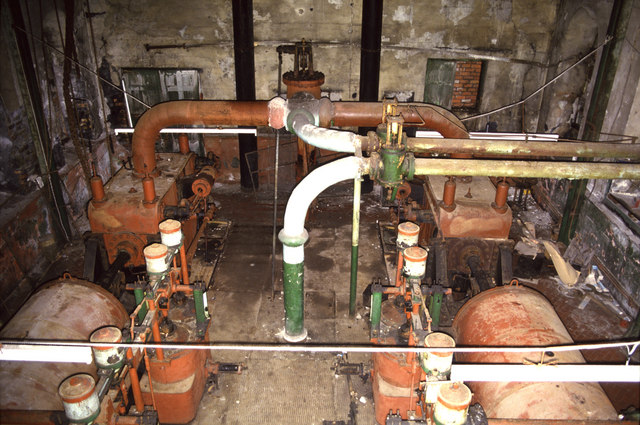
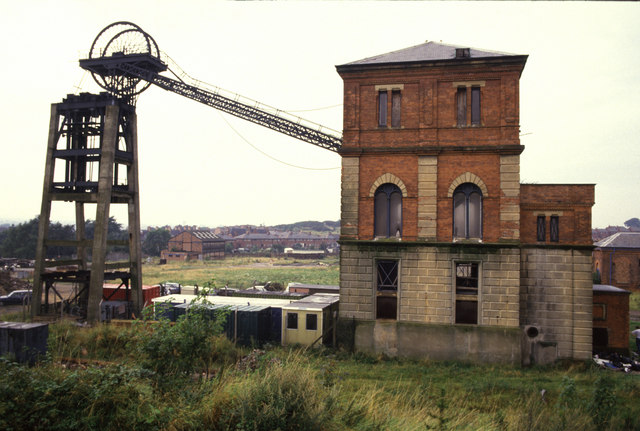
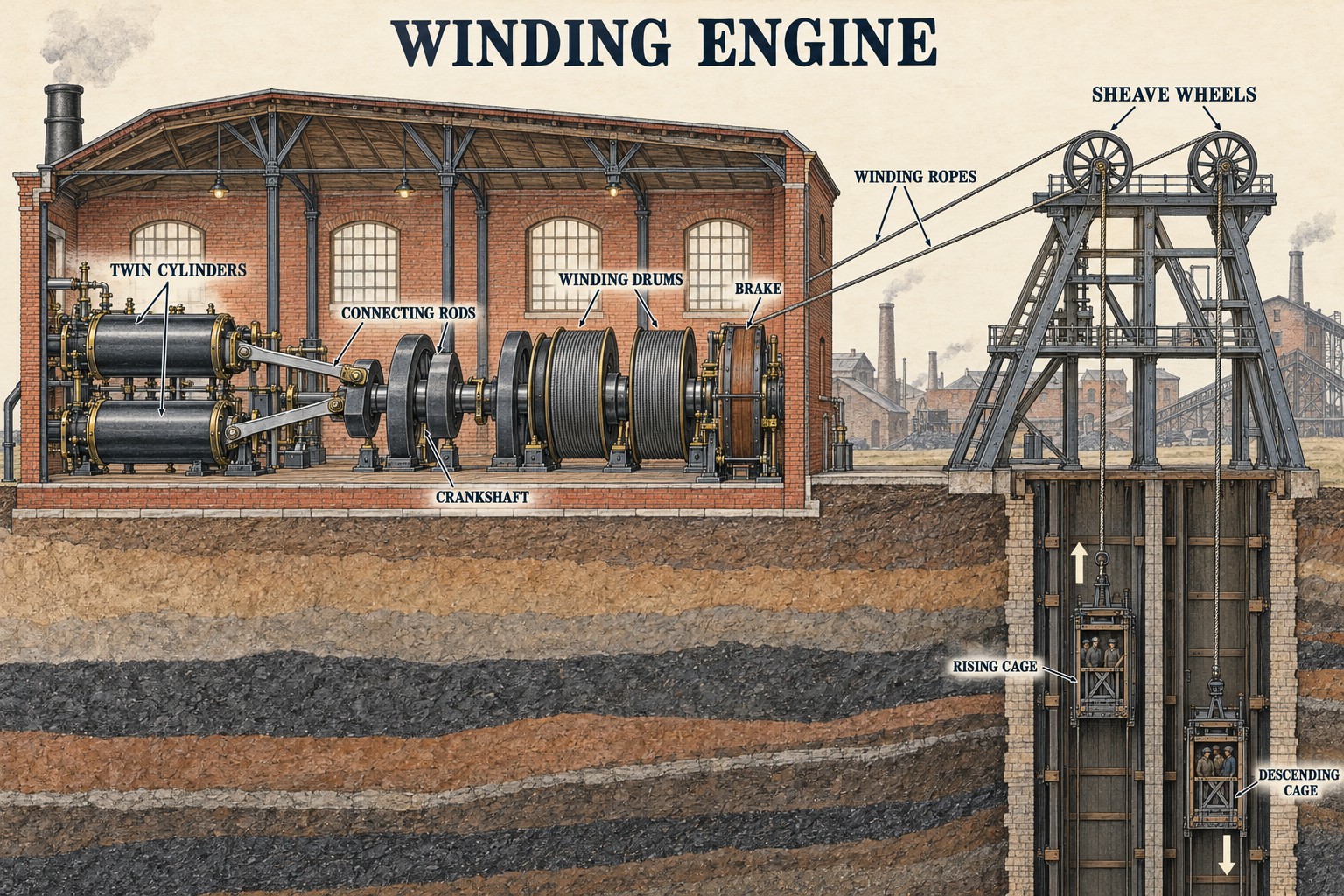
The engine at the top of a shaft that raised and lowered everything in it — coal, ore, waste, materials and men. The headgear carried the sheave wheels, but the winding engine did the work, and its house is usually the largest building left on a colliery site.
Historical usage
Before steam, winding was done by hand windlass, by horse whim, or by waterwheel. A geared variant of the horse whim gin was tried at Walker Colliery around 1750, needing eight horses at a rapid trot to raise five and a half hundredweight at 300 feet a minute; it was not a success and was given up after a few years. Coal was first wound by steam at Hartley Colliery in 1763, using what was probably a Newcomen atmospheric engine, but these attempts failed because a beam engine could not readily be made to turn a drum. Watt's crank of 1780 solved it, and in 1784 he installed the first rotative winding engine at Walker. From then on steam winding spread fast, though water-wheel winding remained common in northern England from about 1760 to 1800 wherever pumped water could be had, and an endless-chain system was used in shallow shafts between 1790 and 1840. Up to about 1850 the standard engine was a single-cylinder vertical with grab-hand reversing gear; horizontal twin-cylinder engines took over afterwards and grew very large — a twin tandem compound of 1912 developed 3,300 horsepower.
How it worked
A drum winder carries the rope on a drum: as one cage rises the other falls, so the engine only has to lift the difference between the two loads plus the coal. The alternative, patented by Friedrich Koepe in 1873, dispenses with the drum altogether and drives the rope by friction over a large wheel, the rope passing over the wheel and down both sides of the shaft with a balance rope beneath. Friction winding is lighter and better suited to great depth, because the machine does not have to carry the weight of a drum big enough to store thousands of feet of rope. The National Coal Board's electrification programme of the 1950s brought Koepe winders into British collieries in numbers; the first, at Bradford Colliery in Manchester, was a 3,720 horsepower machine designed to wind two twelve-ton skips from an ultimate 3,822 feet, its wheel faced with elmwood running on locked-coil rope.
Why it was used
Nothing else could move the quantities involved. A deep colliery had to raise its entire output, all its waste, all its timber and supplies and its whole workforce twice a day through one or two shafts, and the winding engine was the only thing standing between the coal at the bottom and the market at the top. It set the pit's capacity: a colliery could not produce faster than its winder could raise.
Risks & limitations
Winding accidents killed steadily throughout the industry's history — overwinds carrying a cage into the headgear, ropes failing, cages being lowered onto men working in the shaft, detaching gear jamming. Much of British mining safety legislation is about winding: prescribed rope inspections, overwind prevention, limits on winding men and coal together. The engine also fixed a colliery's capacity for as long as it stood, which is why so many pits were re-equipped rather than deepened.
Regional variation
Winder is the usual short form throughout British coalfields, and the building is the winding house or engine house. In Cornwall and Devon the equivalent duty was often done by a whim engine, and a smaller horse-powered winding drum anywhere is a whim or whim gin.
Related terminology
Beam Engine, Boiler House, Cage, Downcast Shaft and Upcast Shaft, Engine House, Headgear, Koepe Winding, Overwind, Shaft Sinking, Skip, Water Balance, Whim
Mines associated with this term
5 examples chosen from 164 linked records — the term page is not an index.
- Bowhill Colliery — Fife (well documented example)
Named twice in this record, first in the history: “…raised at least 1,400 gallons of water a minute, and coupled 30-inch winding engines on the two main pits were capable of raising at least 300,000 tons…” - Cardowan Colliery — North Lanarkshire (well documented example)
Named twice in this record, first in the history: “…tower, built by Redpath & Brown, housing an overhead electric winder. By the 1947 nationalisation of the coal industry, Cardowan was one…” - Cefn Coed Colliery — Neath Port Talbot (well documented example)
The colliery museum keeps its steam winding engines in place, including the 1927 Worsley Mesnes horizontal duplex engine that wound No. 2 shaft. - Frances Colliery — Fife (well documented example)
Named 4 times in this record, first in the workings: “…hours' production; the 111ft steel structure and its 1943 electric winding engine — supplied by Metropolitan-Vickers, Robeys and Barclays of…” - Gedling Colliery — Nottinghamshire (well documented example)
Named in this record’s history: “…was modernised through the postwar decades, replacing its steam winding engines with electric ones in 1970 using equipment from the closed Wellesley…”
Disasters associated with this term
5 examples chosen from 27 linked records, most direct relationship first.
- Naval Colliery Ely Pit cage accident, 1909 (direct cause)
The engine's reversing gear broke. - Botallack Mine shaft accident (relevant method/equipment)
The break cut the signal wire between the man-engine carriage and the winding engine, leaving the brake unworkable. - Gwaun Cae Gurwen Colliery shaft accident, 1847 (relevant method/equipment)
The men were wound by an engine on a chain. - Alvecote Colliery Cage Accident (contextual relationship)
Named in this record’s aftermath: “…installing new screens and a new cage system; a further new winding engine followed in 1928.” - Bickershaw Colliery shaft accident, 1932 (contextual relationship)
Named in this record’s cause: “The coroner's jury found the winding engine itself was not faulty, attributing the accident to an error of…”
Sources
- (primary) Koepe-winder Installation, Colliery Engineering, September 1954 — Colliery Engineering, via Durham Mining Museum
- (primary) The History of Winding - 2 — Durham Mining Museum
Record created: 24 August 2026 · Last researched: 24 August 2026