 MineArchive
Endless Rope Haulage
| Also known as | Endless Haulage, Endless-rope Haulage, Endless Rope (The plain form in the Durham and Scottish glossaries), Endless Chain (The chain-driven predecessor described by Barrowman and Gresley), Clipper (The man who put the clips on the rope) |
|---|---|
| Category | Structures & Machinery |
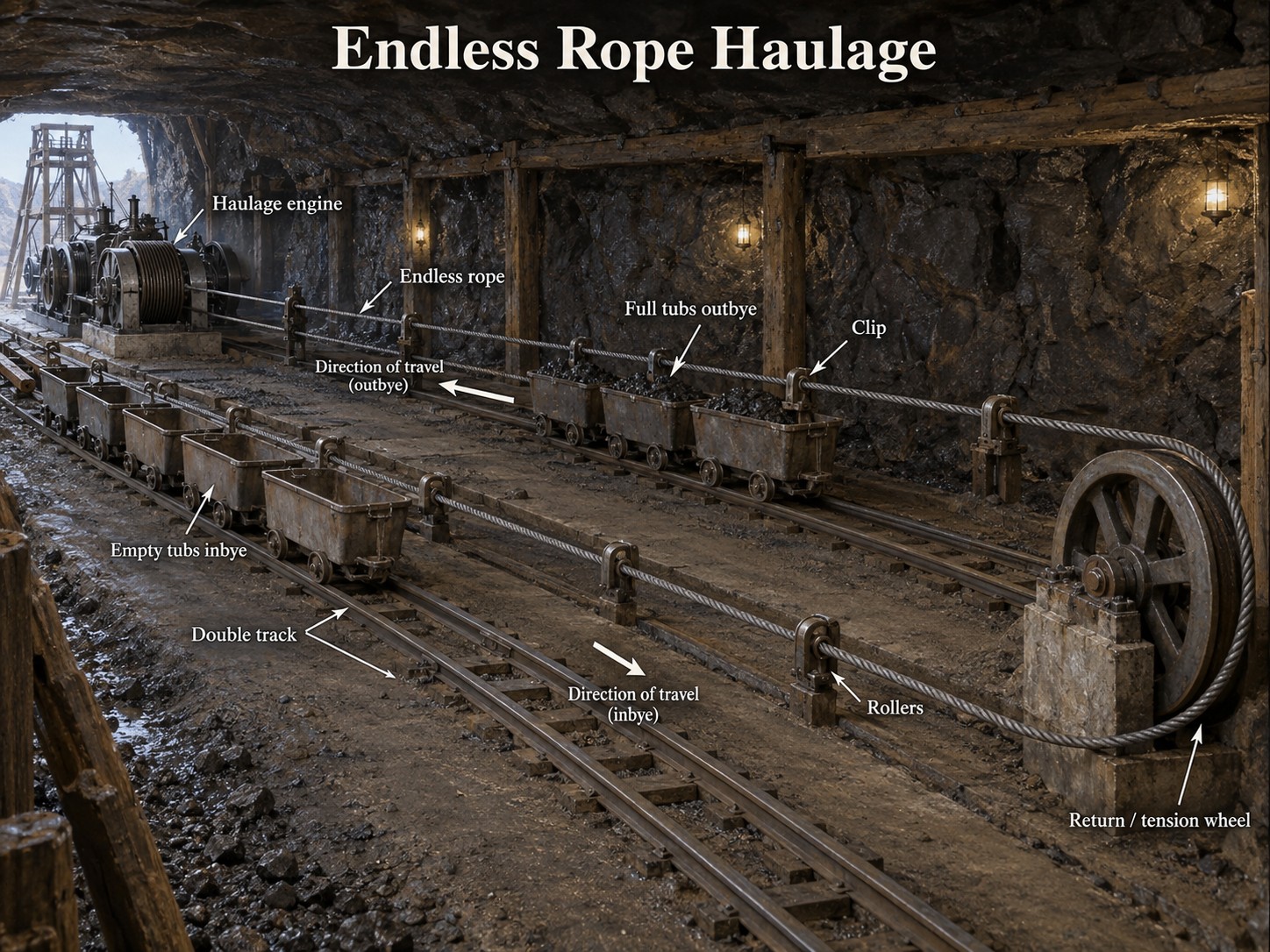
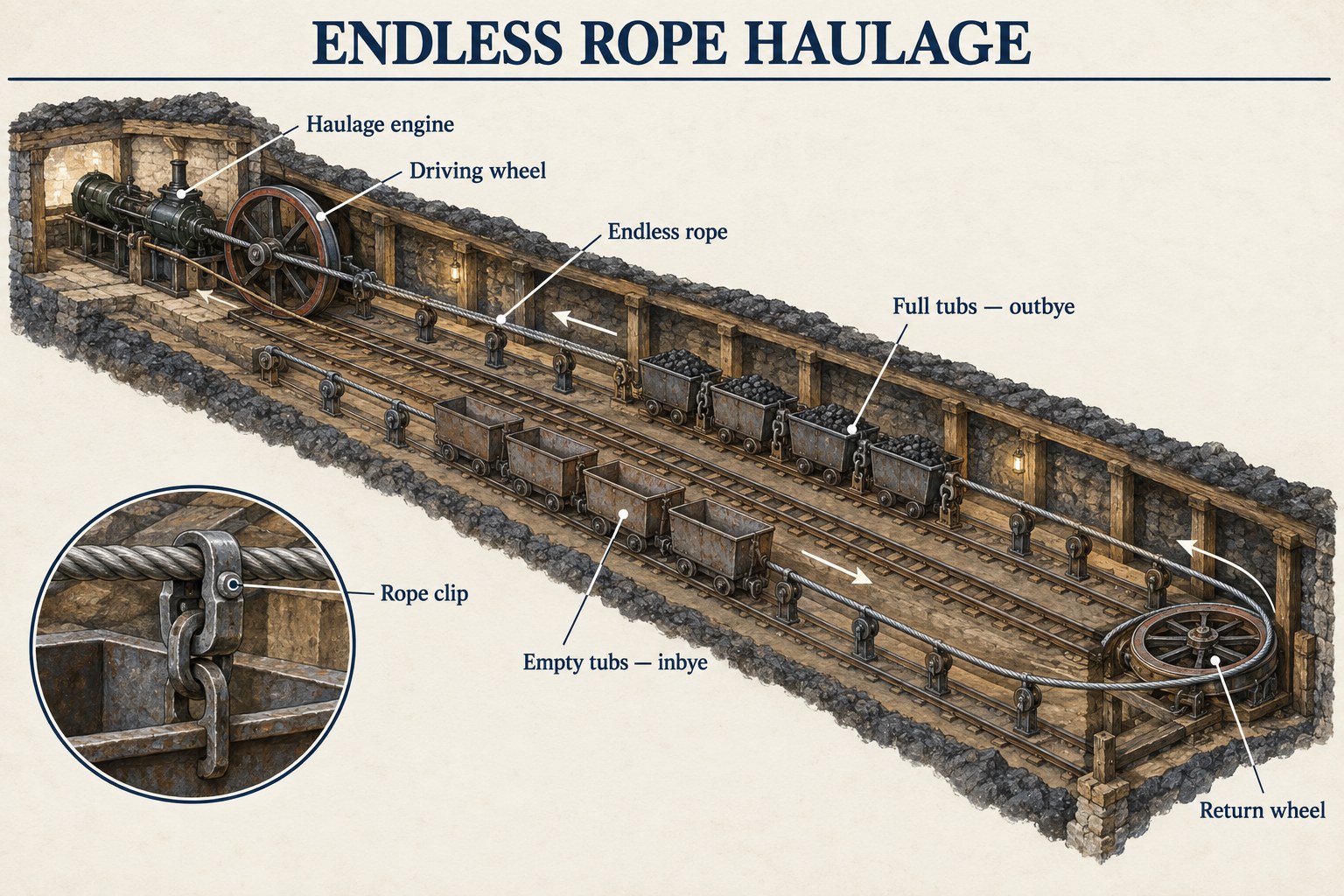
A system of underground haulage in which tubs are clipped to a single wire rope that runs continuously in a loop, driven by an engine at one end and tensioned round a return wheel at the other, so that full tubs travel out on one track while empties come in on the other. The North Staffordshire glossary defines it as 'a system of haulage, normally double track, employing a moving endless rope to which the tubs are clipped either individually or in sets'.

Historical usage
Barrowman's 1886 Scottish glossary already has the endless rope as a system 'similar to' the older endless chain, 'there being a rope of iron or steel instead of a chain', and Gresley's 1883 glossary describes both, noting the rope system as especially suited to seams of moderate inclination. It became the standard main-road haulage of British collieries from the late nineteenth century until conveyors and locomotives displaced it, and it was still being taught to trainees with a compressed-air engine at Wigan in the 1940s. A South Wales haulier's account of fifteen-dram journeys on an electric endless at Rose Heyworth in 1978–79 shows the system, and its clips, in use to the end of deep mining.
How it worked
An engine, steam, compressed-air or later electric, drove a rope in a loop along the main road, over rollers on the floor or hung from the roof, and back again; the return wheel at the inbye end could be moved to take up slack, so rope could be spliced in as the workings advanced without filling a drum, which is what made it 'endless'. Tubs were attached to the moving rope with a clip, of which there were many patterns: the Healey Hero glossary lists the Star, the short- and long-handled Smallman, the Screw and the Swan, and the Gresley and North Staffordshire glossaries the Bradley and Craven, Elswick and Bulldog. Where no clip was used a lashing chain was thrown over the rope and twisted tight. The man who put the clips on was the clipper, hanger-on or hooker-on; the lad who took them off at the landing was the knocker. James W. Smallman of Nuneaton, the best-known clip maker, was still patenting improvements to endless-rope haulage in 1913.
Why it was used
A single engine could keep a whole road moving in both directions at once, with no winding drum to fill and no need to stop and reverse as a main-and-tail system did. It suited long, fairly level or gently rising roads carrying a steady stream of tubs, and it could take men in clip-cars as well as coal.
Risks & limitations
The rope never stopped, so everything about it was a moving-machinery hazard. Clipping on had to be done by hand beside the rope; a clip that was not properly closed let a set of full tubs run back down the grade on to whoever was behind, which is how Richard Jackson, nineteen, died at Greenrigg Colliery in 1912 on his first day as a clipper, the inspector recording that he had not been properly instructed in the Smallman clip. A journey that left the rails could pull the rope through the front clip and concertina the drams together. On steep roads the rope could not hold a heavy journey, and the system gave way there to main-and-tail or to self-acting inclines.
Regional variation
General British usage. In Scotland the rope ran between hutches rather than tubs and the man on the rope was the hooker-on; in the North East the clip was a pig tail, in the Midlands a fork or hambone. Trimdon's Durham glossary gives the plain 'endless rope' as the name of the system.
Related terminology
Incline, Onsetter, Tub, Winding Rope
Mines associated with this term
5 examples chosen from 51 linked records — the term page is not an index.
- Greenrigg Colliery — West Lothian (notable incident)
Richard Jackson, 19, killed in 1912 on his first day as a clipper when a rake of four hutches he had attached with a Smallman clip ran back (Durham Mining Museum, inspector's report). - Alexandra Colliery — Merseyside (well documented example)
Named in this record’s workings: “…the night to balance a pumping bucket. Underground there were endless-rope and balance-brow haulage roads and a jigbrow. The pit brow was lit…” - Eastern United Colliery — Forest of Dean (well documented example)
Named twice in this record, first in the history: “…and a south dipple ten feet by seven for the main haulage, worked by endless rope, about twenty-five yards apart. They struck the old roadway of…” - Hoyland Silkstone Colliery — South Yorkshire (well documented example)
Named in this record’s workings: “…a boiler house underground. Coal travelled on engine planes and an endless-rope haulage road, and a coal-cutting machine was at work on one face by 1903. At…” - Hyde Colliery — Greater Manchester (well documented example)
Named twice in this record, first in the history: “…Black Mine, worked longwall, its coal brought to the engine brow by endless rope haulage and drawn up a brow 970 yards long to the pit bottom. Lighting was…”
Disasters associated with this term
Included only where MineArchive's own research gives a reasonable evidential basis, with the nature of the relationship stated — not every disaster where this term might plausibly apply.
- Bamfurlong Colliery fire, 1892 (relevant method/equipment)
The burning engine worked an endless rope. - Barncluith Colliery haulage accident, 1893 (contextual relationship)
Named twice in this record, first in the summary: “…1893 an empty rake of twelve hutches being drawn inbye on the endless-rope haulage at Archibald Russell's Barncluith Colliery, Hamilton, derailed on a…” - Duddingston shale mines runaway tub, 1912 (contextual relationship)
Named 3 times in this record, first in the summary: “…1 mine to their work, when a loaded tub slipped from the stationary endless rope and ran down onto them.” - Penllwyngwent Colliery runaway journey, 1910 (contextual relationship)
Named 4 times in this record, first in the cause: “A journey of empty trams came loose from the endless haulage rope and ran away down the drift.” - William Pit No. 6 Drift explosion, 1907 (contextual relationship)
The drift served the endless rope road.
Sources
- (observational) Endless Haulage Rope Clip — Out of the Blue Artifacts — Out of the Blue Artifacts
- (observational) Park Collieries, 1948 to 1959, by Fred Foster — Wiganworld — Wiganworld
- (primary) A Glossary of Terms Used in Coal Mining, by William S. Gresley, 1883 — Internet Archive
- (primary) Glossary of Scotch Mining Terms — James Barrowman (1886), via Scottish Mining Website
- (primary) US1059777A Endless-rope haulage (J. W. Smallman, 1913) — Google Patents
- (secondary) Glossary of mining terms (B) — North Staffordshire Miners' Group — Apedale Heritage Centre
- (secondary) Glossary of mining terms (E) — North Staffordshire Miners' Group — Apedale Heritage Centre
- (secondary) Glossary of mining terms (H) — North Staffordshire Miners’ Group, Apedale
- (secondary) Local Mining Terms — Trimdon Snippets
- (secondary) Pit Terminology — Healey Hero
Record created: 12 September 2026 · Last researched: 12 September 2026