 MineArchive
Haulier
| Also known as | Haliwr (Welsh), Colliery Horse Driver (South Wales), Halier (South Wales) |
|---|---|
| Dialect | South Wales |
| Category | Labour & Roles |
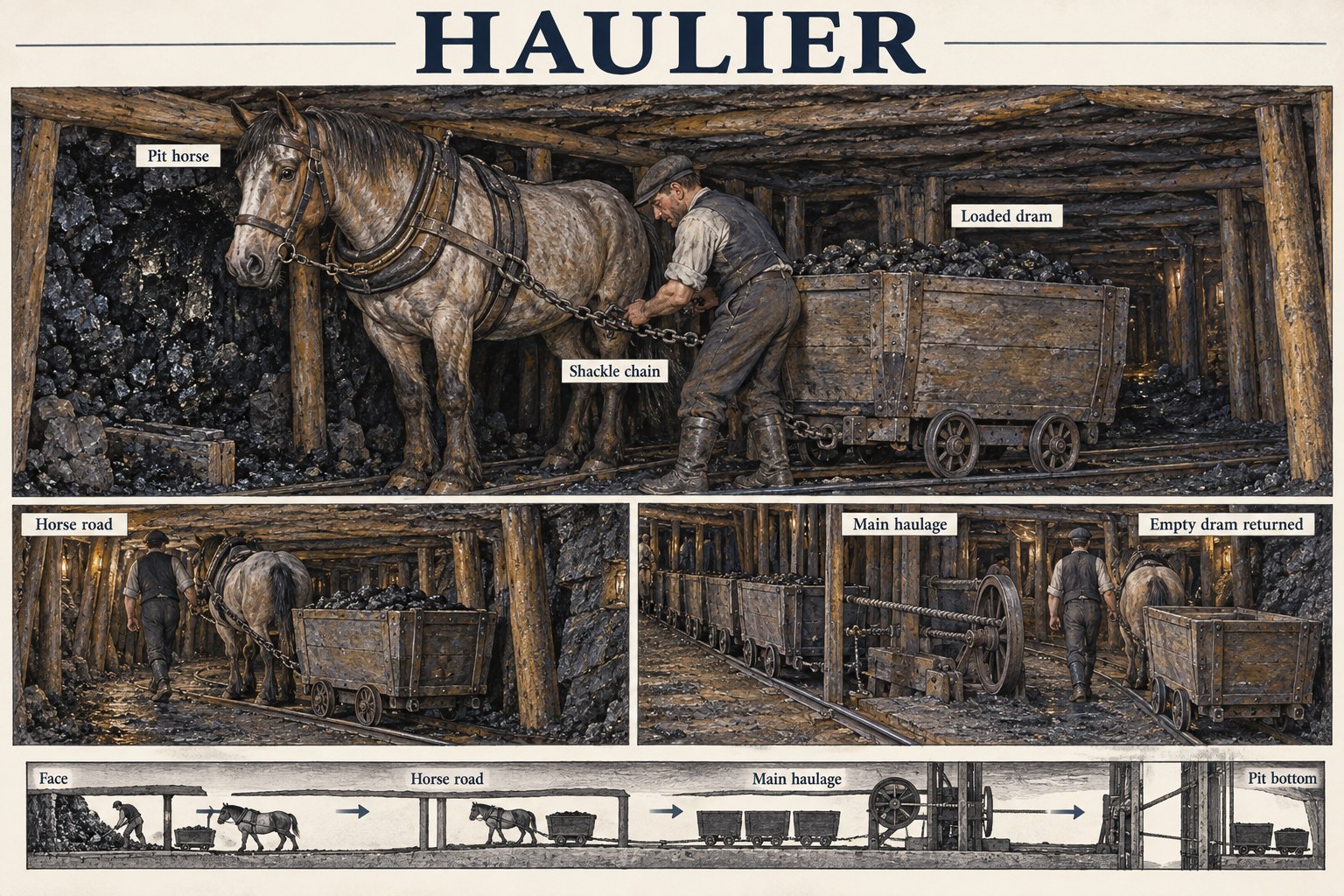
The man or boy who moved the coal along the underground roads: in South Wales, specifically the one in charge of a horse and its drams, shackling up at the face and taking the load out to the main haulage. The same word was also used of a man riding in charge of a journey of drams worked by a haulage engine.
Historical usage
Haulier is the word the South Wales censuses and inquest reports use, and it is the word this archive's own Welsh records use: the Windsor Colliery record has the haulier Thomas Isaac suffocated by a roof fall on the horse road in April 1910, and the Llanhilleth record a haulier run over by drams in 1904. It runs through the disaster narratives here from Abercwmboi in 1870 to Seven Sisters in 1907.
It was often a young man's job on the way up. The route through a South Wales pit ran from door boy to haulier to collier, and a haulier who knew his horse and his road was a skilled worker rather than a labourer. A master horse driver was set over the hauliers and pony drivers; a colliery horse driver was the same job under another name.
Gresley's glossary of 1883, written from the English coalfields, treats haulier as interchangeable with putter and hurrier, which is how it looked from Derbyshire. In Wales the distinction was real: the putter of the North East pushed tubs, and the haulier drove a horse.
How it worked
The collier filled his dram at the face and the haulier came in, shackled his horse to it, and took it out to the main roadway, where the main haulage — a rope engine — took ten drams at a time to the pit bottom. He then brought an empty back in. The horse was his for the shift: he looked after it during the day and stabled it at night, and the working relationship between a haulier and his horse is one of the things Welsh mining memory holds onto hardest.
Where a haulage engine did the work instead of a horse, the haulier rode with the journey and was responsible for it, which is the sense that survives in this archive's Dunnikier and Blaenclydach accident reports, and in the Journey and Man-riding terms held here.
Why it was used
Somebody had to close the gap between the face, where the coal was cut, and the haulage road, where the engine could reach. Machinery could not get to a working place that moved every few days; a horse and a man who knew the road could.
Risks & limitations
Hauliers died in numbers, and they died in ways that reflect the job: crushed between drams, run over by them, kicked, caught between a load and the roof, hurt jumping on or off moving vehicles. They worked in the low, poorly supported ground of the horse roads rather than at the well-timbered face, and they worked beside something heavy and moving all shift. Almost every list of colliery fatalities in this archive has hauliers on it.
Regional variation
South Wales, and strongly so. The North East said putter, Yorkshire hurrier, Lancashire drawer or waggoner, and this archive holds those under Putter. The word was pronounced differently even within Wales: contributors who know the coalfield give it as halier or halyer in one district and as haulier, rhyming with haulage, in the Rhondda. In nineteenth-century Merthyr Welsh it was haliwr.
Related terminology
Journey, Man-riding, Putter, Tub
Mines associated with this term
5 examples chosen from 23 linked records — the term page is not an index.
- Llanhilleth Colliery — Blaenau Gwent (notable incident)
A haulier was run over by drams here in 1904, one of a decade's roll of deaths on this record that also includes a boy of thirteen killed by a roof fall in 1899. - Windsor Colliery — Caerphilly (notable incident)
The haulier Thomas Isaac was suffocated by a roof fall on the horse road here on 8 April 1910 — the hazard the job carried, in the ground it was worked in. - Abernant No. 9 Pit — Rhondda Cynon Taf (well documented example)
Named in this record’s history: “…inches across and 390 feet deep. An explosion killed a ripper and a haulier on 16 May 1890, and falls of roof most of the other men who died…” - British Rhondda Colliery — Neath Port Talbot (well documented example)
Named in this record’s history: “…sixteen-year-old helper six weeks into the job the same year, and a haulier crushed by his horse in 1927. The archive's Rhigos Colliery record…” - Broadmoor Colliery — Pembrokeshire (well documented example)
Named in this record’s summary: “…Royal Commission found women at the windlass and an eight-year-old haulier with no shoes. A broken chain killed seven, including that boy, in…”
Disasters associated with this term
5 examples chosen from 43 linked records, most direct relationship first.
- Cwmbran Colliery scalding, 1866 (contributing factor)
The haulier's horse ran away or was driven too fast. - Aberaman Colliery shaft accident, 1883 (contextual relationship)
Named twice in this record, first in the summary: “…shaft tipped the ascending cage on 15 June 1883 and threw two hauliers to their deaths; the jury censured the colliery's officials.” - Abercrave Colliery roof fall, 1917 (contextual relationship)
Named in this record’s narrative: “…Colliery, three men whose stalls had just been cleared by a haulier were waiting on a parting in the nine-foot seam for an empty tram.…” - Abercwmboi Colliery Explosion, 1870 (contextual relationship)
Named in this record’s narrative: “…of an hour after that the explosion came. A fourteen-year-old haulier and his eleven-year-old brother, a door boy, both asleep after their…” - Albion Colliery explosion, 1906 (contextual relationship)
Named in this record’s narrative: “About fifty men were repairing in the No. 1 seam. A haulier felt a rush of air and telephoned that there had been a heavy fall.…”
Sources
- (primary) A Glossary of Terms Used in Coal Mining, by William S. Gresley, 1883 — Internet Archive
- (secondary) Mining occupations in Welsh mines, late 1800s and early 1900s — Welsh Coal Mines forum
- (secondary) Welsh colliery horses — Amgueddfa Cymru — Museum Wales
Record created: 10 September 2026 · Last researched: 10 September 2026