 MineArchive
Tub
| Also known as | Tram (South Wales), Dram (Welsh), Hutch (Scottish), Hurley (Scottish), Whirley (Scottish) |
|---|---|
| Category | Structures & Machinery |
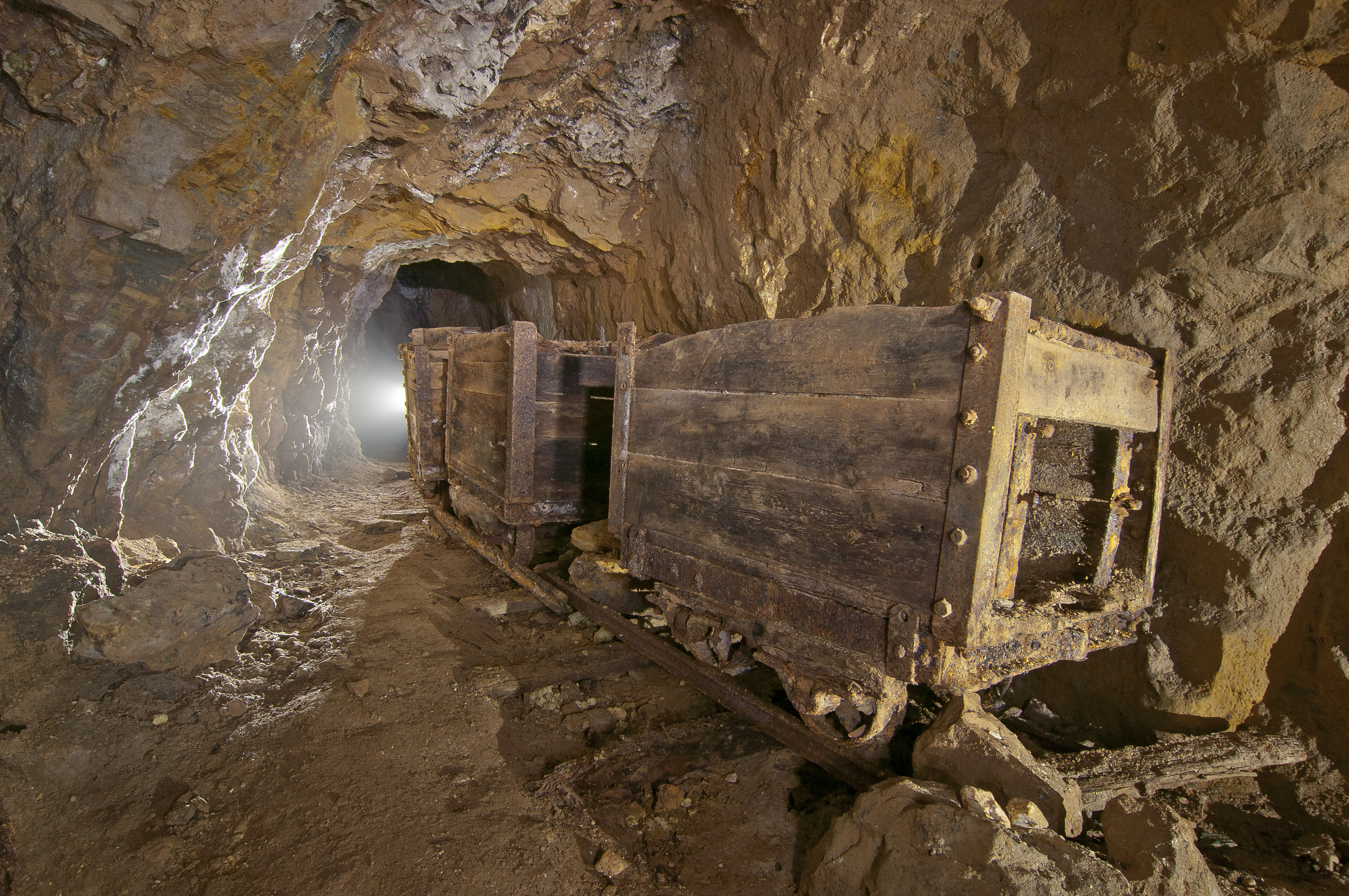
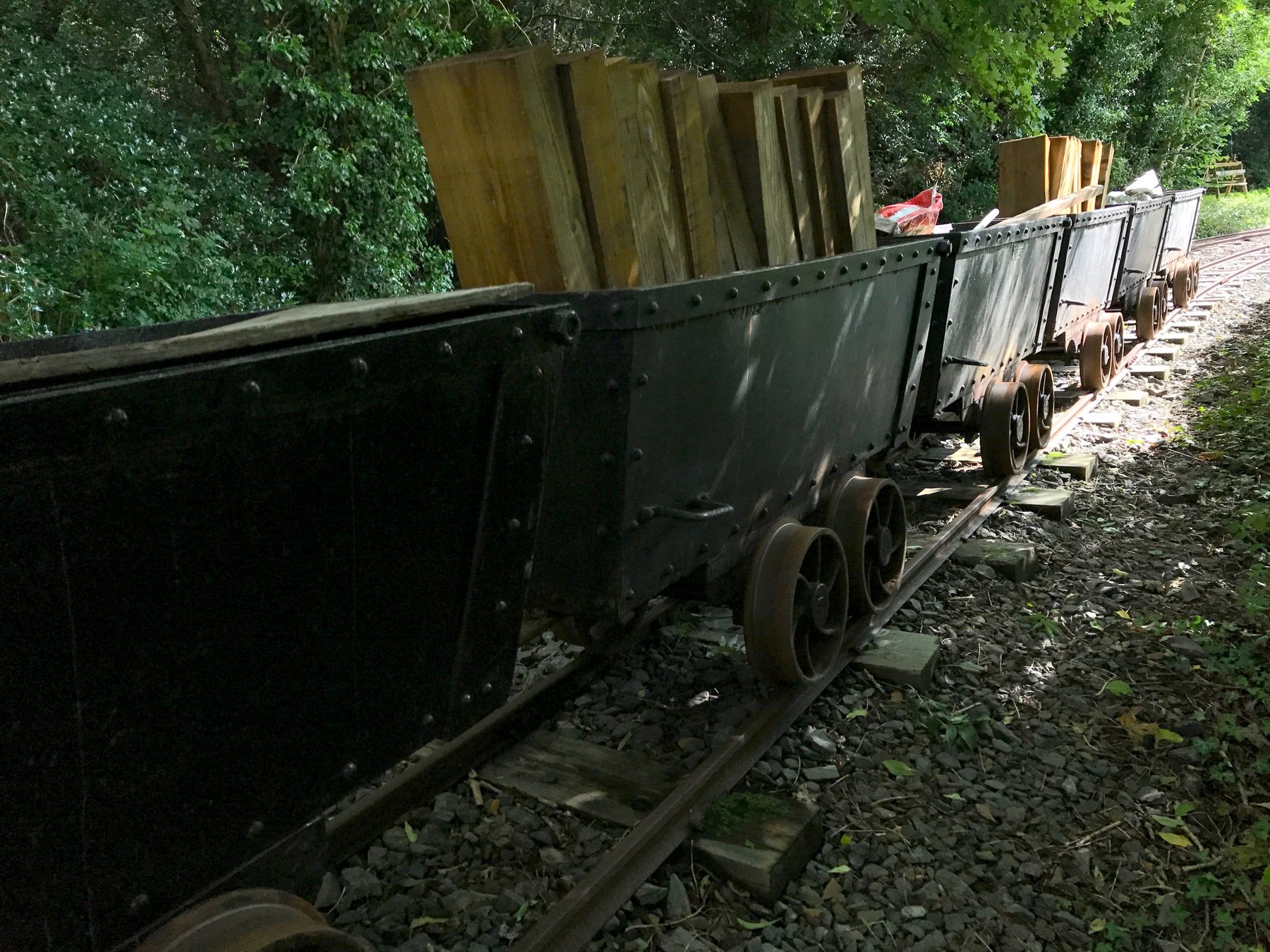
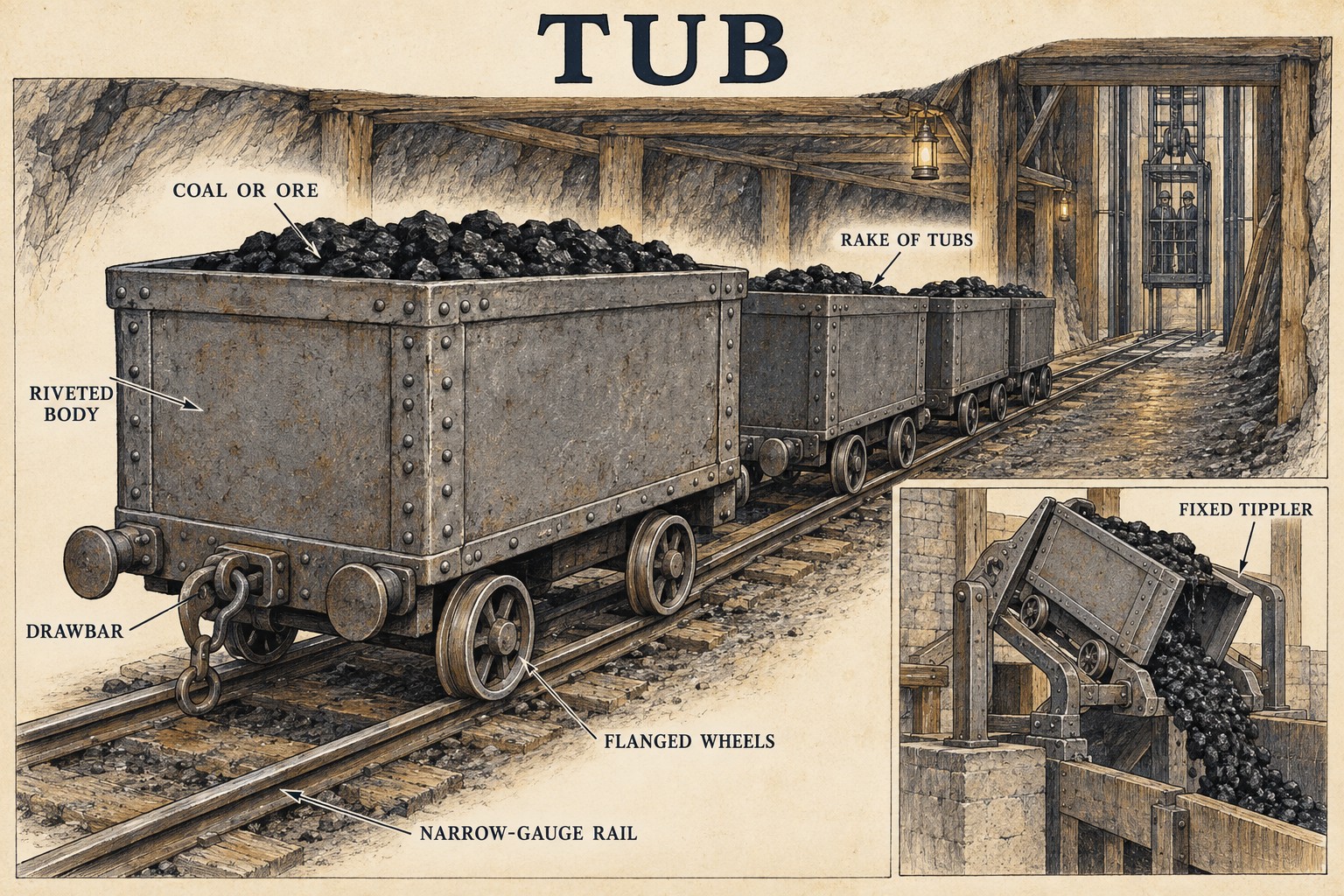
A small wheeled wagon, running on narrow-gauge underground rails, used to haul coal or ore from the working face to the shaft bottom or drift mouth — also called a tram or dram in some coalfields.
Historical usage
Tubs (and the underground waggonways they ran on) are among the oldest recorded pieces of British mining infrastructure, with the Wollaton Waggonway near Nottingham hauling coal on rails as early as 1605. As waggonways spread underground through the following two centuries, tubs running on narrow-gauge iron rails became the standard way to move coal or ore from the working face to the pit bottom, pulled by hand, by pit ponies, and eventually by mechanical or electric haulage on the main underground roads, with ponies typically kept to the shorter runs between the coal face and the main haulage road. Before wheeled tubs became standard, coal was often carried in a wicker or wooden basket called a corf, hauled or dragged rather than run on rails. Supplying tubs and tipping wagons also became an industry in its own right: Robert Hudson Ltd, founded in 1865 at Gildersome near Leeds by a family who themselves owned the Victoria Colliery at Bruntcliffe, grew into a major international manufacturer whose narrow-gauge tubs and wagons were used in almost every UK colliery. The Gildersome works -- 'Hudson's Foundry' to generations of local workers -- covered 38 acres and employed several hundred people before the company was liquidated in 1984.
How it worked
A tub ran on flangeless or flanged wheels along narrow-gauge rails laid through a mine's roadways and drifts; a full tub was hauled or pushed out to the shaft bottom or drift mouth, where it was either raised to the surface in a cage or run straight out along a drift, then emptied and sent back underground empty for refilling. Tipping mechanisms varied: some tubs simply overturned at a fixed tippler, while Robert Hudson's 1875-patented 'triple centre' design let one man tip a loaded tub to the side unaided. A related but distinct vehicle, the 'dandy', was a surface-only wagon used to cart pit dirt and rubble to the tip, rather than to move coal underground.
Why it was used
Moving coal or ore in a wheeled tub on rails was far more efficient than carrying it, allowing one haulier — animal, human or mechanical — to move loads many times greater than could be carried by hand.
Risks & limitations
A derailed or runaway tub was a genuine hazard to anyone working nearby underground, and tubs feature in the causes of several recorded accidents where a tub struck a person, a prop, or, in at least one case, a stored explosive cartridge.
Regional variation
Regional coalfields used different names for essentially the same vehicle: 'tub' was the general English usage, 'tram' (and, further back, 'dram') was standard in South Wales, and 'hutch' was the standard term throughout Scotland's coalfields, appearing throughout historic Scottish mining glossaries in terms like 'hutch road' and 'hutch axle'.
Related terminology
Cuddie Brae, Endless Rope Haulage, Haulier, Journey, Man-riding, Putter
Mines associated with this term
5 examples chosen from 115 linked records — the term page is not an index.
- Cambrian Colliery — Rhondda Cynon Taf (well documented example)
Named in this record’s workings: “…through the main roads and a spraying system used to wet coal on the trams as a dust-suppression measure — advanced practice for its time,…” - Flockton Collieries — West Yorkshire (well documented example)
Named in this record’s history: “…of children visited in 1841 and found boys and girls hauling tubs underground, they singled out the company for its civilising…” - Glencraig Colliery — Fife (well documented example)
Named in this record’s history: “…road, where a repairer named English was crushed by a rake of hutches when the haulage was started as he made for the pit bottom in 1933.…” - Grassmoor Colliery — Derbyshire (well documented example)
Named twice in this record, first in the history: “…cylinders and a six-foot stroke, the double-deck chairs taking two tubs on each deck. These were the Barnes collieries locally, and they…” - Stargate Colliery — Tyne and Wear (well documented example)
Named in this record’s current condition: “A replica colliery tub carrying the names of the 1826 dead stands near the site of the pit,…”
Disasters associated with this term
5 examples chosen from 92 linked records, most direct relationship first.
- Broadmoor Colliery chain break, 1844 (direct cause)
The men rode the shaft in the tub, which caught on timber. - Aberbaiden Colliery Pentre Slant explosion, 1944 (contextual relationship)
Named in this record’s narrative: “…colliers were killed: Edward Jenkins, 55, and his son John, 18, John Hurley, 17, and John Davies, 39. Three more were taken to hospital, the…” - Abercynon Colliery Haulage Accident, 1906 (contextual relationship)
Named 4 times in this record, first in the summary: “…minutes before the end of the shift, a journey of twenty-four full trams of coal ran away underground at Abercynon Colliery and into the men…” - Abercynon Colliery roof fall, 1913 (contextual relationship)
Named 3 times in this record, first in the summary: “A fall of about twenty-five drams of roof killed two repairers clearing an earlier fall at Abercynon…” - Annesley Colliery runaway tubs, 1907 (contextual relationship)
Named 3 times in this record, first in the summary: “On 15 August 1907 two datallers were run down by a runaway train of tubs at Annesley Colliery, in Nottinghamshire, as they walked to their…”
Sources
- (primary) Glossary of Scotch Mining Terms — James Barrowman (1886), via Scottish Mining Website
- (secondary) From mules to motors—the story of coal mine haulage — Black Diamond History
- (secondary) Quarry tub — Wikipedia
- (secondary) Railways and Coal Mines — The Sole Society
- (secondary) Robert Hudson (company) — Wikipedia
Record created: 24 August 2026 · Last researched: 10 September 2026