 MineArchive
Acomb Colliery
| Location | Acomb, near Hexham, Northumberland — 54.9883, -2.1111 (approximate) |
|---|---|
| Commodity | Coal |
| Type | Coal |
| Worked | By the 1840s; new colliery opened 1909–29 August 1952 |
| Maximum depth | No depth figure has been located in the sources read. |
| Operators | Stobart & Co., J. Morrison & Co., Messrs. Morrison, Tynedale Coal Co. Ltd (1909–1919), Acomb Coal Co. Ltd (1919–1946), National Coal Board (1947–1952) |
Overview
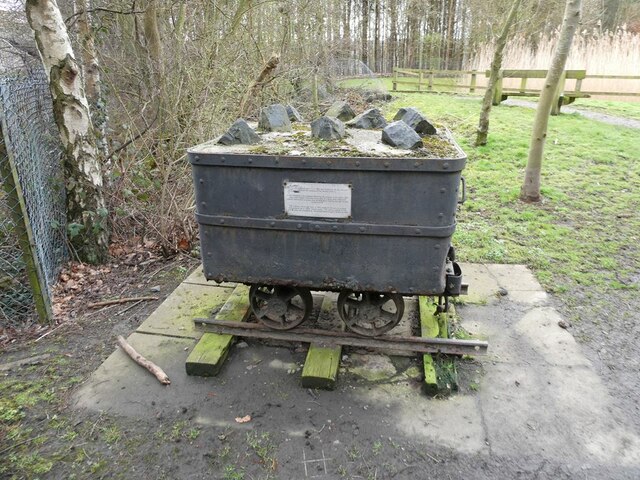
Acomb Colliery, on the north bank of the Tyne just above Hexham, was worked for more than a century. A 19th-century pit producing good coking coal for 41 coke ovens gave way to a new colliery opened in 1909, which under the Acomb Coal Co. and then the National Coal Board employed around 300 men until it closed in August 1952. The site is now a small industrial estate and a mine-water treatment wetland, marked by a memorial pit tub.
History
The Durham Mining Museum names Messrs. Stobart & Co. as owners in the 1840s, and the Inspectors of Mines recorded two unnamed deaths at Acomb in 1854, one from an explosion on 8 April and one from a fall of stone on 19 December as the overman drew props. J. Morrison & Co. followed in the 1860s. In 1875, as the Hexham Courant later recalled, a fire broke out on a coal seam and the colliery closed for an indefinite period, laying off most of its men and boys. By 1886 it was back at work, employing 200 and raising 51,000 tons a year of good coking coal, with 41 coke ovens in use. The Little Limestone seam was abandoned as unprofitable in 1887. A new sinking was under way in 1900, and the colliery that the site plaque dates from 1909 opened under the Tynedale Coal Co. Ltd, employing 9 in 1910 and 34 in 1915. The Acomb Coal Co. Ltd was registered in March 1919 to take over the Tynedale company's collieries at Acomb, and the pit grew quickly: 116 in 1921, working the Limestone Coal (Oakwood seam); 228 in 1930 after the Oakwood seam was abandoned in 1925 and the Acomb seam taken up; and 316 in 1940. The colliery passed to the National Coal Board in 1947, when it still employed close to 300. In January 1951 it faced closure unless a new workable seam could be struck, the second time in the pit's history that the village had faced losing it, and it closed on 29 August 1952. Sixteen men and boys are named as killed there between 1867 and 1947, most by falls of stone or crushed by tubs, including a deputy overcome by gas in 1940 and a shifter killed in a gas explosion in 1946.
Geology
Acomb lies on the Carboniferous limestone-series coals north of the Tyne. The 19th-century pit worked the Little Limestone seam, abandoned in 1887 and again, with the Oakwood seam, on the plans lodged in 1952. The Lists of Mines record the Limestone Coal (Oakwood seam) in 1921 and the Acomb seam from 1925, with both Acomb and Oakwood in 1950. The coal was noted in 1886 as a good coking coal.
Geological setting: Sedimentary Beds and Seams (well documented example)
Workings
A shaft colliery; the museum holds an 1878 section of the strata sunk through. In the 1880s the coal was coked on site in 41 ovens. The later colliery produced household coal and, by 1950, steam coal.
Closure
Threatened with closure in January 1951 unless a new workable seam was found, the colliery closed on 29 August 1952; the Oakwood and Little Limestone plans record abandonment on 17 September 1952. It had already been stopped once, by a seam fire in 1875.
What remains
Geograph photographs from 2020 and 2023 show the site restored: a small industrial estate, and a public space with lagoons and reed beds forming a mine-water treatment scheme for the Red Burn, where a memorial pit tub with a plaque now stands.
No colliery buildings are recorded; a memorial pit tub stands in the landscaped site.
Redevelopment
Northumberland County Council took over and restored the site in 1980. Part is now the Acomb Industrial Estate, and part a wetland of treatment lagoons and reed beds cleaning mine water before it reaches the Red Burn.
Related mines
- Tynedale Colliery — Owned in turn by the same companies, the Tynedale Coal Co. Ltd and the Acomb Coal Co. Ltd.
Nearby mines
- Tynedale Colliery — 1.3 km E
- Fallowfield Mine — 2.0 km N
- Brunton Bank Quarry — 3.9 km N
- Settlingstones Mine — 6.7 km W
- Stonecroft and Greyside Mine — 8.2 km W
Straight-line distance, within 15 km. Show on the map.
Recorded claims
Individual factual claims, each attached to the source(s) that support it below. Where sources disagree, both are kept.
- The Inspectors of Mines recorded an explosion death on 8 April 1854 and a fall of stone death on 19 December 1854. 1
- In 1875 a fire on a coal seam closed the colliery for an indefinite period, laying off most of its men and boys. 2
- In 1886 the colliery employed 200 and raised 51,000 tons a year of good coking coal, with 41 coke ovens in use. 3,4
- The Little Limestone seam was abandoned in 1887 as unprofitable. 1,5
- The later colliery started in 1909. 1,6
- The Acomb Coal Co. Ltd was registered in March 1919 to acquire the Tynedale Coal Co.'s collieries at Acomb. 7
- The museum's returns show a peak of 316 employed in 1940. (disputed) 1
- The memorial plaque says the colliery employed 290 men at its peak. (disputed) 6
- The plaque says the colliery produced over 70,000 tons of coal a year. (uncertain) 6
- In January 1951 the colliery faced closure unless a new workable seam was struck. 8
- The colliery closed on 29 August 1952; its Oakwood and Little Limestone plans record abandonment on 17 September 1952. 1,5
- Northumberland County Council restored the site from 1980; it holds an industrial estate and a mine-water treatment wetland for the Red Burn. 6,9,10
Photographs & further reading
Owners from the 1840s, employment 1900-1950, seams, abandoned plans and the names of those killed.
View sourceVillage page with the 1886 figures for the colliery and links to related records.
View sourceSources
- (secondary) Durham Mining Museum - Acomb Colliery — Durham Mining Museum
- (secondary) Hexham Courant headlines in Tyne Valley up to 150 years ago (4 May 2025) — Hexham Courant
- (secondary) Acomb, Northumberland — Wikipedia
- (secondary) Acomb, Northumberland — Co-Curate, Newcastle University
- (secondary) Catalogue of Plans of Abandoned Mines for Acomb Colliery — Durham Mining Museum (from the N.C.B. catalogue of abandoned plans)
- (observational) Pit tub at the (former) Acomb colliery (Geograph 6554230, Mike Quinn, 2020) — Geograph Britain and Ireland
- (secondary) Durham Mining Museum - Acomb Coal Co., Ltd. — Durham Mining Museum
- (secondary) What made the news in Hexham and Tyne Valley 150 years ago (18 January 2026) — Hexham Courant
- (observational) Pit tub, former Acomb Colliery (Geograph 7435432, Oliver Dixon, 2023) — Geograph Britain and Ireland
- (observational) Acomb Industrial Estate (Geograph 7435422, Oliver Dixon) — Geograph Britain and Ireland
Record created: 13 September 2026 · Last researched: 13 September 2026