 MineArchive
Sedimentary Beds and Seams
| Category | Deposit Types |
|---|
A layer of economically useful material formed as part of ordinary sedimentary rock deposition — laid down in more or less continuous sheets over a wide area, rather than concentrated along a narrow fracture the way a vein is. Coal seams are the classic British example, but the same basic layered structure applies to ironstone, rock salt, oil shale and other stratabound materials.
How it forms
Sedimentary beds form the same way any sedimentary rock does: material accumulates in layers, over a wide area, under conditions that stayed broadly consistent long enough to build up a workable thickness. A coal seam began as a thick accumulation of dead plant material — peat — in a waterlogged swamp where low oxygen levels stopped it fully decaying; as further sediment buried the peat over millions of years, the weight of that overburden and the accompanying rise in temperature squeezed out water and drove off other volatile material, compacting and chemically transforming the original plant matter into coal (roughly ten feet of peat compacts into about one foot of coal). Other sedimentary beds form differently again: ironstone beds like Rosedale's formed from iron-rich sediment deposited on an ancient sea floor, and rock salt beds like Winsford's formed when an enclosed sea or lake evaporated, leaving dissolved salts behind as a solid layer.
Why minerals concentrate here
Because a sedimentary bed forms as part of ordinary, wide-area deposition rather than being funnelled through a narrow structural conduit, the economically useful material is spread relatively evenly across the whole area the original depositional environment covered — a swamp, a sea floor, an evaporating basin — rather than being concentrated along one line the way vein material is. The bed's usefulness comes from the volume and consistency of that original environment, not from later fluid movement gathering scattered material into one place.
Typical shape of the deposit
A broadly flat, layered bed or seam, often extending continuously for miles in every direction, with a thickness that's usually far more consistent over short distances than a vein's — though seams still thin, thicken, and are cut out entirely by later erosion or faulting across a wider area, and are rarely perfectly flat once folding and faulting have affected them.
What this means for mining
Because the material forms a broad, laterally extensive layer rather than a narrow line, sedimentary deposits favour systematic, area-covering extraction methods that a vein's shape simply doesn't allow — room-and-pillar working, and in later coal mining, longwall working, both designed to clear a wide area of the seam methodically rather than chase an unpredictable narrow target. Depth still matters (a seam has to be reached by shaft or adit like anything else), but once reached, the mine's layout is dictated far more by the seam's lateral extent than by any need to follow a wandering, irregular line underground.
Associated commodities
Alum (Extracted from a specific sedimentary shale bed (Jurassic alum shale).), Chalk (A sedimentary bed in its own right, worked directly or dug through.), Coal (The archetypal British sedimentary seam commodity.), Iron (Stratabound ironstone beds, e.g. the Cleveland Ironstone Formation.), Jet (Occurs within a specific sedimentary bed (the Jet Rock).), Oil Shale (Stratabound oil-bearing shale beds.), Salt (Evaporite beds, e.g. the Cheshire Basin's rock salt.)
Related geology
Anticlines and Synclines, Coal Formation and Rank, Concealed Coalfields, Dykes and Sills, Evaporite Deposits, Sedimentary Ironstones
Related Mining Terms & Methods
Adit (Often used to reach a seam outcropping in a hillside.), Room and Pillar (The extraction method suited to a broad, laterally extensive bed.)
Diagrams
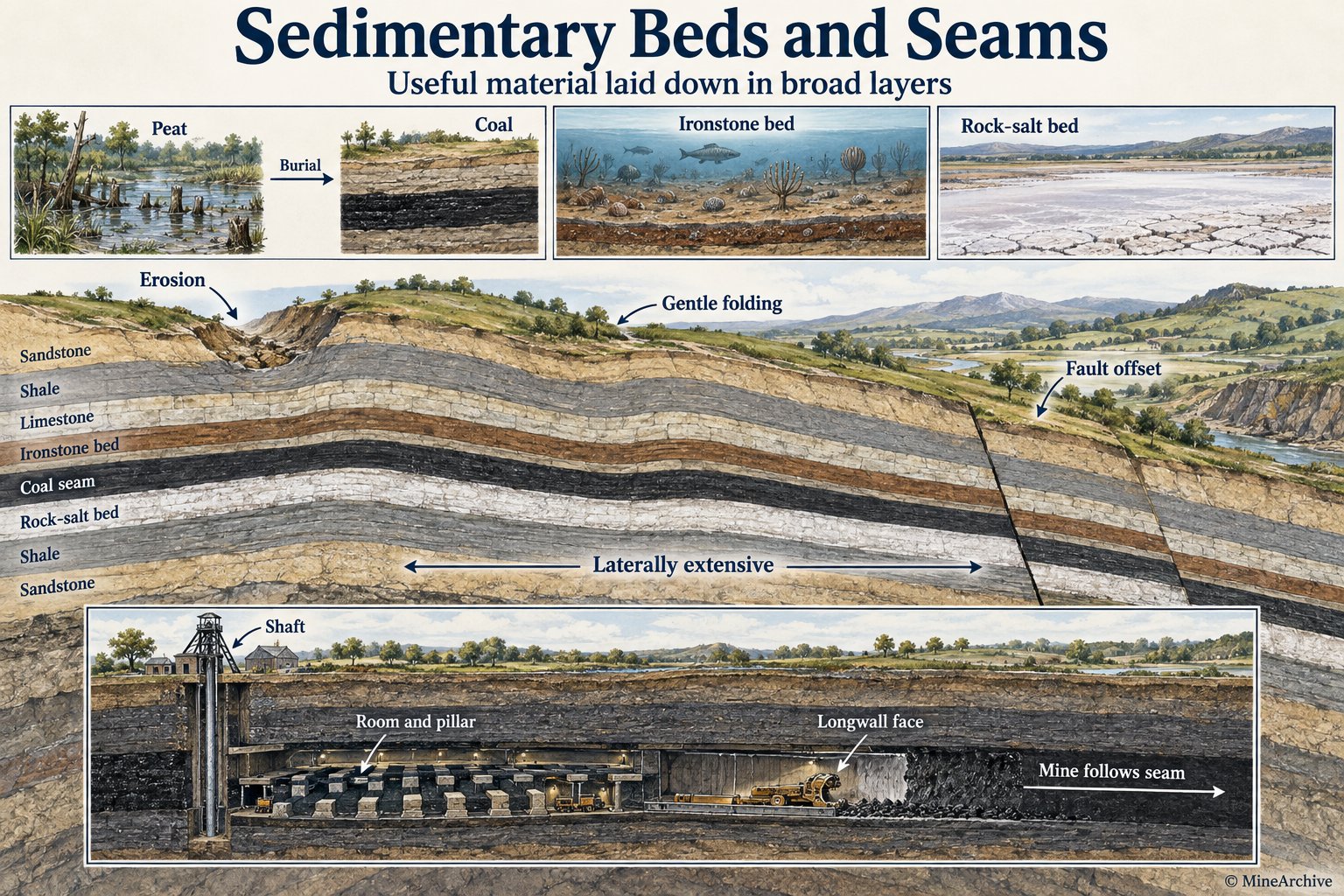
Images
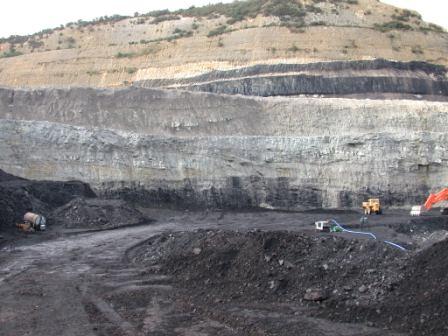
MineArchive examples
Included only where MineArchive's own research gives a reasonable evidential basis — not every mine where this geology might plausibly apply. Showing the 10 strongest examples of 631 linked mines.
- Birdshill Quarry — Carmarthenshire (surviving physical example)
A quarry whose worth now is the bedded Ordovician limestone section it left exposed, and the fauna preserved through it, as this record's geology describes. - Brunton Bank Quarry — Northumberland (surviving physical example)
A quarry whose whole scientific value is its bedding: the Main Posts of the Great Limestone, a 0.2 m shale parting at their base, and the metre-thick Chaetetes Band beneath, exposed in section as this record describes. - Crûg Farm Quarry — Carmarthenshire (surviving physical example)
A quarry valued for the bedded Upper Ordovician shelly limestone it exposes and the fauna preserved through it, as this record's geology describes. - Cynwyd Forest Quarry — Denbighshire (surviving physical example)
A quarry whose worth is the bedded Ordovician siltstone and mudstone section it left exposed, and the shelly fauna preserved through those beds, as this record's geology describes. - Heol Senni Quarry — Powys (surviving physical example)
A quarry whose section through pebbly, cross-bedded Old Red Sandstone preserves the stacked channels of a Devonian braided river — bedded sediment legible as the environment that laid it down, as this record's geology describes. - Rumney Quarry — Cardiff (surviving physical example)
A quarry whose value now is the bedded Silurian section it exposes — mudstones with thin sandstone bands beneath the Rhymney Grit, as this record's geology describes. - William Gill Colliery — North Yorkshire (surviving physical example)
Worked the Tan Hill Coal at its eastern outcrop; shaft and spoil survive. - Abercynon Colliery — Rhondda Cynon Taf (well documented example)
Sunk to the Nine Feet seam and working in turn the Six Feet, Nine Feet, Upper Four Feet, Seven Feet and Five Feet — the named seam succession of the South Wales coalfield. - Abernant Colliery — Neath Port Talbot (well documented example)
Worked the Red Vein and tried the Peacock seam; take bounded by the Gardner's and Duffryn faults (NMRS). - Alexandra Colliery — Merseyside (well documented example)
The Rushy Park and Little Delf mines of the St Helens Coal Measures, with slips in the roof named as the cause of fall after fall.
See all 631 linked mines.
Sources
- (primary) Magnitude and timing of peat-to-coal compaction — Geology / GeoScienceWorld
- (primary) Pennine Coal Measures Group, Carboniferous, Northern England — BGS Earthwise
- (secondary) Coal seam — Encyclopaedia Britannica
Record created: 22 August 2026 · Last researched: 22 August 2026