 MineArchive
Adit
| Also known as | Day level, Drainage adit, Day-hole (Coal-mining usage (Gresley, 1883)), Stulm (An older synonym) |
|---|---|
| Category | Mine Workings & Access |
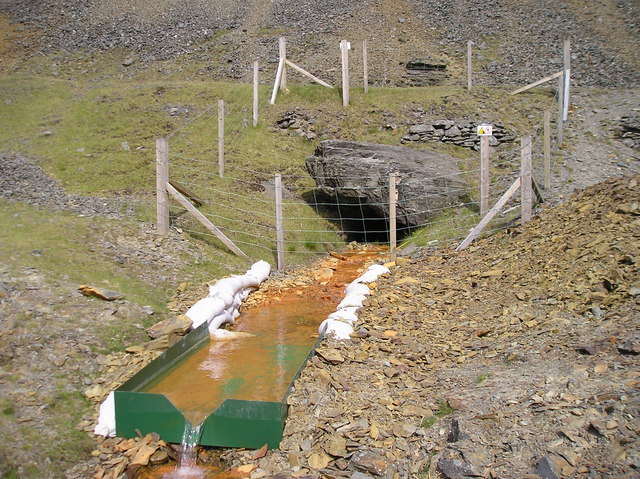
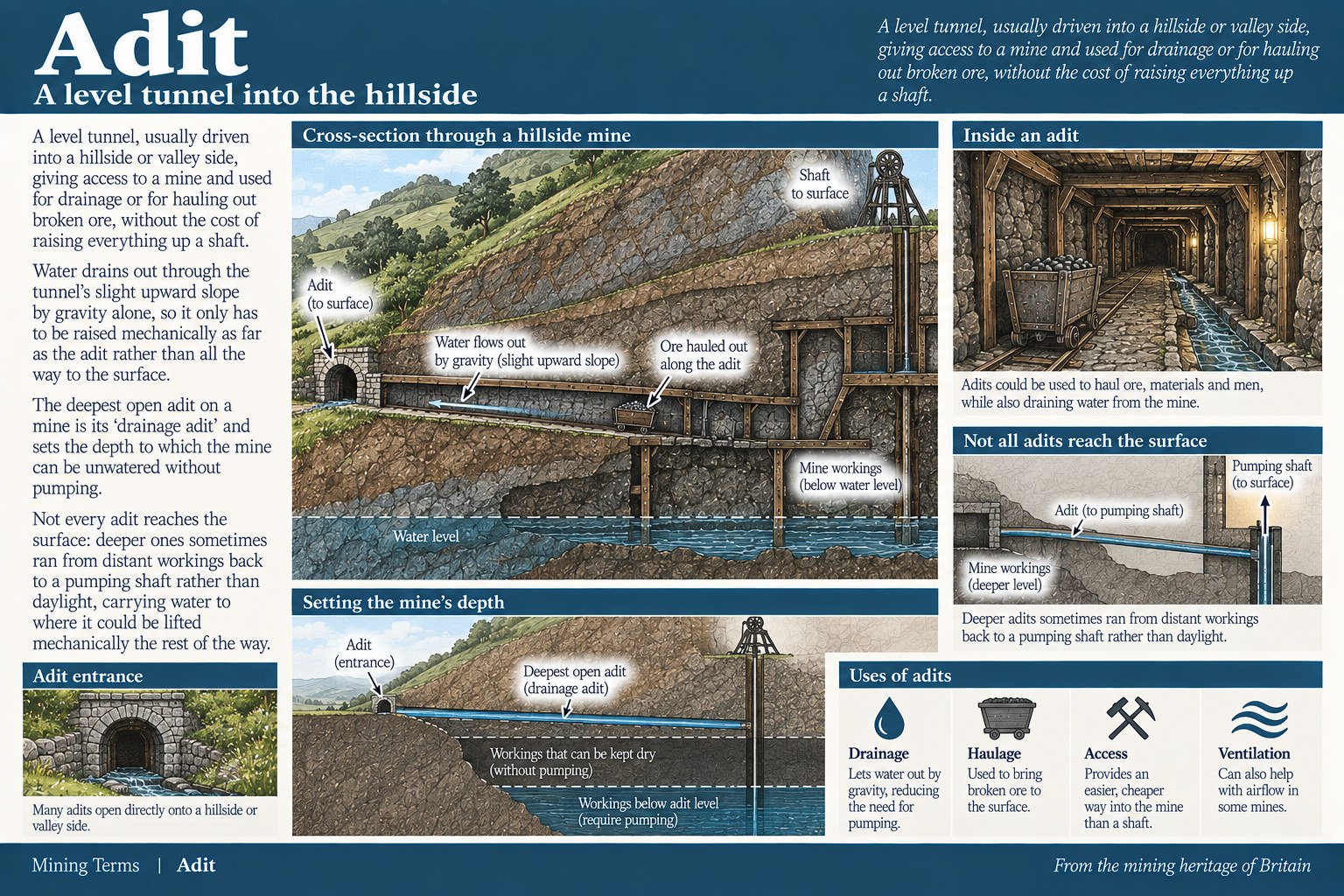
A level, or very gently rising, tunnel driven from the surface into a hillside or valley side to give access to a mine, drain it or haul out broken ore, sparing the cost of raising everything up a shaft.
Historical usage
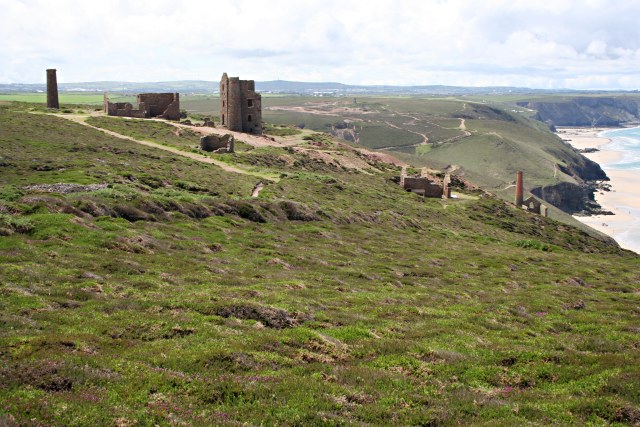
The word comes from the Latin aditus, an entrance, and the tunnel is as old as hillside mining itself. Adits were in use in Cornwall before 1500, and became essential to the tin and copper industry because the county's ore-bearing lodes run near-vertically, acting as channels for groundwater to flood into workings. As mines deepened through the 18th and 19th centuries, adits were extended for miles between setts to reach a valley low enough for water to drain away by gravity. The same expedient served every hill district in Britain: the lead mines of the north Pennines were entered by horse levels driven from the dale sides, the Milwr Tunnel in north Wales was carried some ten miles to drain the Halkyn mines, and in the coalfields the tunnel from daylight was so ordinary a thing that Gresley's 1883 glossary of coal-mining terms defines an adit simply as an underground level to the surface from the workings, or from part of the way down a shaft, generally used for drainage.
How it worked
Water drains out through the tunnel's slight upward slope by gravity alone, so it only has to be raised mechanically as far as the adit rather than all the way to the surface. The deepest open adit on a mine is its 'drainage adit' and sets the depth to which the mine can be unwatered without pumping: workings above adit stay dry as long as the tunnel stays clear, and everything below adit and below the water table floods unless pumped. Not every adit reaches the surface: deeper ones sometimes ran from distant workings back to a pumping shaft rather than daylight, carrying water to where it could be lifted mechanically the rest of the way. An adit also carries traffic and air. Men, tools and ore move along it on foot, by pony or by tramway with far less effort than up a shaft, and in combination with shafts it ventilates the mine, cool air entering along the adit, warming underground and rising out of the shafts.
Why it was used
An adit is far cheaper to run than pumping, since it moves water using gravity rather than engine power, and it gives a second means of access and ventilation besides the shaft. Where the topography allowed a tunnel to be driven into a hillside below the workings, it was usually the first drainage measure tried, with pumping engines only added once mining went deeper than the adit could reach; until the steam engine, the depth of the deepest adit was the main limit on deep mining. Where a lode outcrops on a hillside the adit may simply follow it, in which case it is rarely straight, and working ore this way is generally called drift mining.
Risks & limitations
An adit can only drain a mine down to its own level — anything worked below that still needed pumping, which is why deep Cornish mines combined adits with beam engines rather than relying on adits alone. Adits also need suitable terrain: on flat ground, or where the lode lies far from a hillside, driving one is impractical or prohibitively long, and in weak ground the cost of timbering a long adit could outweigh anything it saved.
Regional variation
'Adit' is the word of Cornwall and Devon, and of the general textbooks. In the Derbyshire lead orefield the equivalent drainage tunnel is a sough, the same principle under a different regional name. In Wales, the Pennines and the coalfields the same tunnel is more often a level, a day level or a day-hole: Gresley's 1883 glossary defines a day-hole as any heading or level from the surface communicating with the mine, and a water level as a heading driven very nearly dead level, on the strike of the seam, to carry the water off. 'Drift' in coal-mining usage generally means an inclined roadway driven in the seam or a gallery cut across the strata, rather than an opening to daylight in particular, and the older 'stulm' is occasionally met in the literature.
Related terminology
Abandonment Plan, Fire-setting, Horse Level, Shaft Capping, Shaft Sinking, Sough, Submarine Mining, Water Balance
Mines associated with this term
5 examples chosen from 134 linked records — the term page is not an index.
- Browns Folly Mine — Somerset (well documented example)
Named twice in this record, first in the history: “…with the Monkton Farleigh quarry next door, and the main adit was blasted, probably by the military, to shut off access to the…” - Ecton Copper Mines — Staffordshire (well documented example)
The Whey Adit is a well-documented, walkable example, later reused to store whey for a nearby creamery. - Faggergill Mine — North Yorkshire (well documented example)
Named twice in this record, first in the current condition: “The old workings survive as a network of adit levels, shafts and spoil across the hillside above Whaw; several…” - Greetwell Ironstone Mines — Lincolnshire (well documented example)
Named 6 times in this record, first in the summary: “An extensive system of ironstone quarries and shallow adit mines in Greetwell Hollow, on the north-eastern edge of Lincoln,…” - Honister Slate Mine — Cumbria (well documented example)
Named in this record’s current condition: “…third active and a third show mine: a mine plan shows some nineteen adits, most of them long since blocked by collapses.”
Disasters associated with this term
Included only where MineArchive's own research gives a reasonable evidential basis, with the nature of the relationship stated — not every disaster where this term might plausibly apply.
- Pochin Colliery Explosion, 1884 (contextual relationship)
Named in this record’s narrative: “…maintenance work was in progress at a pumping station set in an adit about halfway down the shaft. Fourteen men were at work there. All…” - Stargate Colliery explosion, 1826 (contextual relationship)
Named in this record’s narrative: “…at the shaft bottom, survived and crawled out over bodies by an old drainage adit about a mile away. Newspapers gave the explosion little space and…” - The Longannet Flooding (contextual relationship)
The Mines Inspectorate used the findings here to push other UK operators to reassess water-inrush risk, and to recommend supplementary guidance on treating disused shafts and adits. - Wheal Mary Ann Footway Shaft Rescue (contextual relationship)
Named in this record’s cause: “…trench, being dug alongside the Footway Shaft to help drain the adit below, collapsed and trapped a volunteer up to his chest while he…”
Sources
- (primary) A Glossary of Terms Used in Coal Mining, by William S. Gresley, 1883 — Internet Archive
- (secondary) A Cornish mining glossary — Cornish Mining World Heritage Site (UNESCO)
- (secondary) Adit — Wikipedia
Record created: 20 August 2026 · Last researched: 22 September 2026