 MineArchive
Heading
| Also known as | Headways (North East England), Drivage (The twentieth-century word for a roadway being driven in solid ground.) |
|---|---|
| Category | Mine Workings & Access |
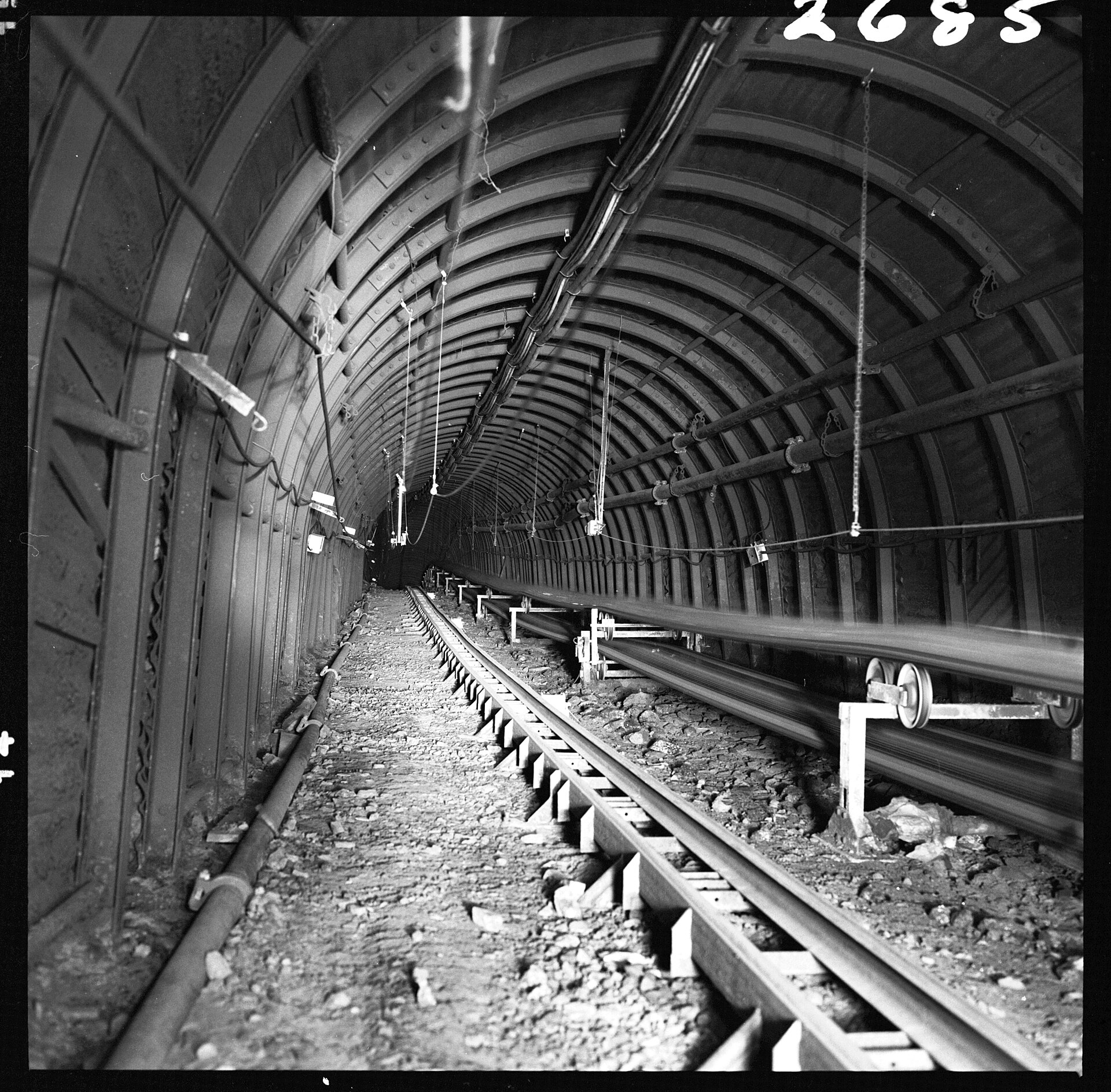
A roadway driven forward in the solid coal or stone to prove, reach and open out new ground; more loosely any underground roadway, and the work of driving one.
Historical usage
Gresley's 1883 glossary defines a head as any road, level or other passage driven in the solid coal for the purpose of proving and working the mine, and a heading as the same thing or the operation of driving one. A common size for an ordinary head was six feet by six feet, though sections ran from eight or ten square feet up to seventy or eighty. Coal was won, he wrote, by levels, by drifts, by headings to the rise or by headings to the deep: the heading was how a pit found and reached its coal before there was a face to work.
In the North East the word took a particular sense. Headways were places driven end-on, parallel with the cleat of the coal, and a set of headings extending from side to side of a set of boards was driven headways course; the pair of roadways driven to explore or win a seam were the winning headways, the fore-headways and the back-headways. Heading was bargain-work, done by contract, and in South Staffordshire a head was also the shift's stint of heading out, or deadwork. Twentieth-century usage is plainer: the Healey Hero glossary has headings as the roadways being developed to open up new faces, a header as the man driving one, and a drivage as a new gate road being driven in solid ground. A hard heading is one driven in stone.
How it worked
A heading was driven narrow, first by hand with pick and powder and later with drills and explosives, the men working at a dead end with the whole mine behind them. Its direction was set by the dial and kept by driving by lines: two weighted strings hung from stomps fixed in the roof three to six feet apart gave the bearing, and the line between them, prolonged, was the course the heading had to hold. Because a dead end has no through current of air, the heading needed its own ventilation: an air-box, a rectangular wooden pipe in lengths of nine to fifteen feet, or an air-sollar, a brattice carried beneath the tram rails. Headings were commonly driven in pairs, one serving as the return airway for the other and the two connected by thirls or holings at intervals, which is the North East's fore- and back-headways.
The inner end of a heading, where work was going forward or had stopped, was the back. A heading driven to the rise of the seam was Barrowman's Scottish sense of the word, against a level driven along the strike; one following the dip was a dip road or, in the North and in Scotland, a dook.
Why it was used
Nothing else in a pit could happen until the headings were driven. They proved the seam, connected the shaft to the coal, cut the main roads and airways, divided the ground into districts and panels, and carried the roadways forward as the faces advanced. In the older systems of working the headings and their cross-cuts were the narrow work that came first, with the pillars between them taken out afterwards; under longwall the gate roads driven ahead of or with the face did the same job of opening ground.
Risks & limitations
Driving a heading was dead work: it produced little saleable coal for the labour, and it was paid as such, by the yard under a bargain rather than by the ton. The dead end was the mine's worst-ventilated place until the second heading or the thirl reached it, which is why the glossaries describe so much apparatus for getting air to the face of a heading. A heading driven through a fault or in stone, a hard heading, was slow and costly work with rock drills and explosives.
Regional variation
Head and heading are general British usage; the North East's headways, headways course and winning headways are its own vocabulary for headings driven end-on with the cleat, and Barrowman's Scottish glossary makes a heading specifically a drift or roadway towards the rise. In North Staffordshire the head-side was the rise side of a heading driven on the strike. Elsewhere the word carried other meanings: in Somerset a head was any length of working face, and in Scotland the heads or heading were the large top coal loaded above the sides of a hutch. Gresley also records the Pennsylvania sense of a level driven parallel with a gangway as the mine's return airway.
Related terminology
Crosscut, Dook, Drift, Gate Road, Level, Ripping, Stone Drift
Mines associated with this term
5 examples chosen from 112 linked records — the term page is not an index.
- Auchenharvie Colliery — North Ayrshire (well documented example)
Named in this record’s summary: “…ended in 1895 by drowning nine people, four of them brothers, when a heading was driven through a dyke both landlords' leases forbade anyone to…” - Bedford Colliery — Greater Manchester (well documented example)
Named in this record’s workings: “…seat of the explosion was being worked on the retreating principle: headings driven into the coal, a face opened between them, and the props…” - Browns Folly Mine — Somerset (well documented example)
Named twice in this record, first in the history: “…into the hillside is a junction of several routes into the different headings, known as Clapham Junction from the rails laid in its floor; rails…” - Calverton Colliery — Nottinghamshire (well documented example)
Named twice in this record, first in the geology: “…and the High Hazles from 1981. A ten-foot fault was met in the south headings in 1952, and disturbed ground and a washout were encountered in the…” - Eastern United Colliery — Forest of Dean (well documented example)
Named twice in this record, first in the history: “…condition: monoclinal folding had lost the seams in the main headings, and they were only recovered by driving long cross dipples. By 1916…”
Disasters associated with this term
5 examples chosen from 119 linked records, most direct relationship first.
- Abercynon Colliery Shaft Accident, 1895 (contextual relationship)
Named twice in this record, first in the narrative: “…sinker, William Jones, and three sinkers reached them through the headings from the South Pit. Six men were killed at Tynybedw, a few miles…” - Abercynon Colliery roof fall, 1913 (contextual relationship)
Named in this record’s narrative: “…the coroner R. J. Rhys, heard that the first fall, in Prosser's heading in the North Pit, had come down overnight and had not been touched…” - Abernant No. 9 Pit explosion, 1890 (contextual relationship)
Named 3 times in this record, first in the contributing factors: “…was worked with naked lights, so gas gathering at the face of the heading had only to meet a light.” - Ammanford Colliery explosion, 1935 (contextual relationship)
Named 3 times in this record, first in the summary: “Two repairers boring in the stone of a cross-measure heading at Ammanford Colliery on 18 September 1935 were killed by an…” - Annesley Colliery fire and afterdamp (contextual relationship)
Named in this record’s narrative: “…Henry Lewis, went down and diverted the air passing down the heading, and the fire was cut off behind an airtight stopping without danger…”
Sources
- (primary) A Glossary of Terms Used in Coal Mining, by William S. Gresley, 1883 — Internet Archive
- (primary) Glossary of Scotch Mining Terms — James Barrowman (1886), via Scottish Mining Website
- (secondary) Glossary of coal mining terminology — Wikipedia
- (secondary) Glossary of mining terms (H) — North Staffordshire Miners’ Group, Apedale
- (secondary) Pit Terminology — Healey Hero
Record created: 6 October 2026 · Last researched: 6 November 2026