 MineArchive
Gate Road
| Also known as | Maingate, Main gate, Headgate, Tailgate, Through road (Somerset) |
|---|---|
| Category | Mine Workings & Access |
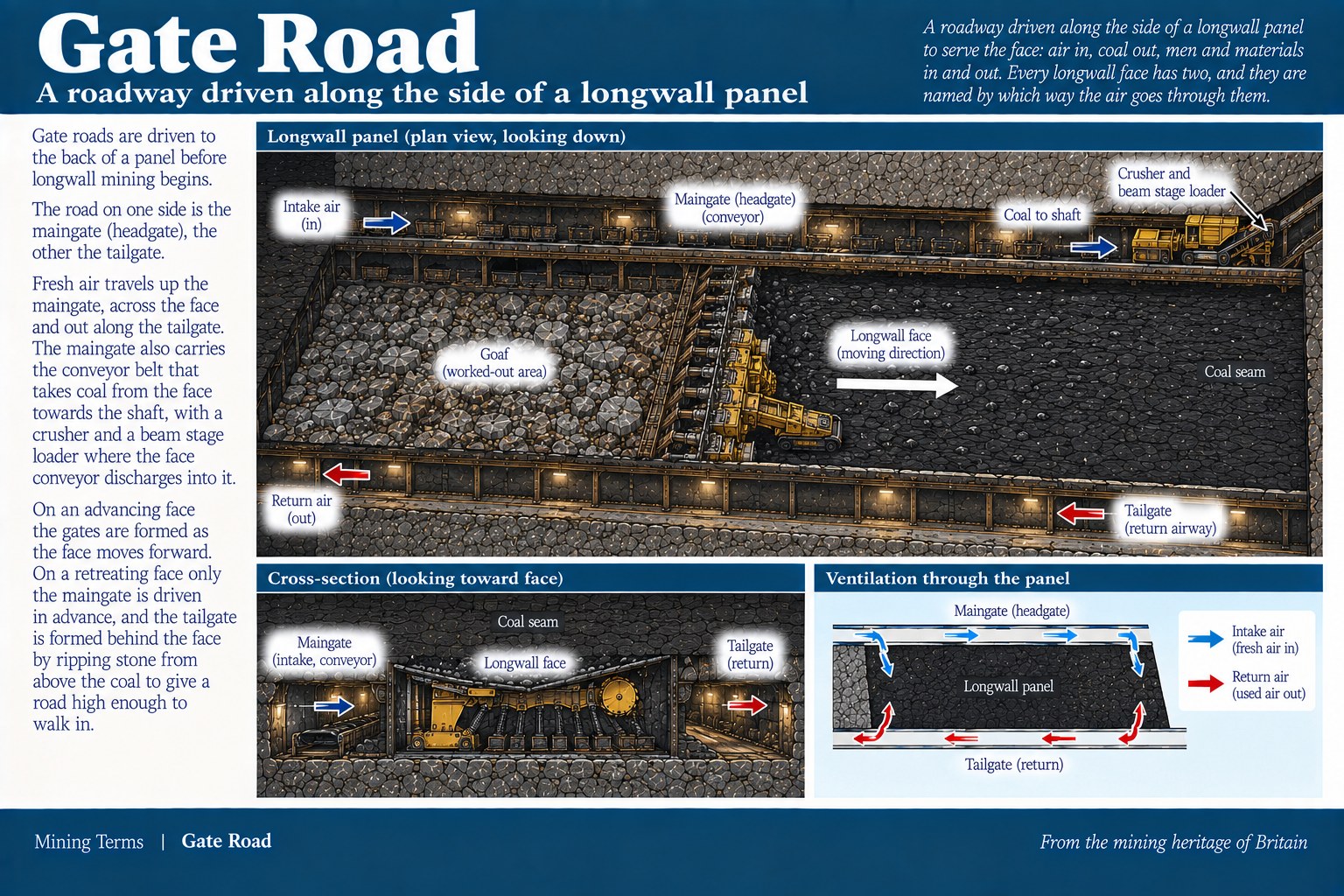
A roadway driven along the side of a longwall panel to serve the face: air in, coal out, men and materials in and out. Every longwall face has two, and they are named by which way the air goes through them.
Historical usage
The word gate for a way or road is old and general in the English coalfields, and it attached itself to the longwall roadways as longwall working spread. The Somerset coalfield's own usage survives in the verdict of the 1895 inquest at Conygre, which places the shot that caused the explosion in the through road. South Yorkshire miners also called the maingate the loadergate and the tailgate the returngate, after the warm return air it carried back towards the upcast shaft.
How it worked
Gate roads are driven to the back of a panel before longwall mining begins. The road on one side is the maingate or headgate, the other the tailgate. Intake air travels up the maingate, across the face and out along the tailgate, which is the U ventilation that most faces use; the maingate also carries the conveyor belt that takes coal from the face towards the shaft, with a crusher and a beam stage loader where the face conveyor discharges into it. On an advancing face the gates are formed as the face moves forward. On a retreating face only the maingate is driven in advance, and the tailgate is formed behind the face by ripping stone from above the coal to give a road high enough to walk in.
Why it was used
A longwall face is a machine a couple of hundred metres long that cannot make its own access. Everything it needs and everything it produces has to travel along its two ends, and its ventilation depends on there being exactly two, so that fresh air has one way in and one way out.
Risks & limitations
Gate roads sit in ground that the face has disturbed or is about to disturb, so they squeeze, and a tailgate formed behind a retreating face has the goaf on one side of it. The tailgate is also where the return air goes, carrying away the coal dust and the methane from the face and the goaf, so it is the part of the district most likely to be gassy.
Regional variation
Maingate and headgate are the same thing. Older and local words for a roadway serving a face include the through road in Somerset, and the archive's separate entries for the level, the crosscut and the return airway cover the same function in other systems of working.
Related terminology
Crosscut, Goaf, Longwall, Return Airway, Shearer
Mines associated with this term
5 examples chosen from 9 linked records — the term page is not an index.
- Bevercotes Colliery — Nottinghamshire (well documented example)
Named in this record’s workings: “…way, all controlled by one operator from a console in the gate road.” - Gospel Oak Colliery — West Midlands (well documented example)
Named twice in this record, first in the history: “…by firedamp that came away with water let out of a wrongly levelled gate road and fired a candle near the shaft bottom; the inspector, Lionel…” - Holditch Colliery — Staffordshire (well documented example)
Named in this record’s workings: “…blasted down and loaded onto a face belt conveyor that fed the main gate belt and so the haulage road. The Four Feet carried eight firemen…” - Homer Hill Colliery — West Midlands (well documented example)
Named twice in this record, first in the history: “…Yard Coal reached at 150 yards. From the shafts two broad parallel gate roads, about 50 yards apart, ran some 500 yards to the boundary, and the…” - Mansfield Colliery — Nottinghamshire (well documented example)
Named in this record’s workings: “…of the pit at work: horse and pony haulage with sets of tubs on gate roads, a partly covered sump at the shaft bottom, gateside packs built…”
Disasters associated with this term
5 examples chosen from 21 linked records, most direct relationship first.
- Backworth Colliery explosion, 1928 (contextual relationship)
Named 4 times in this record, first in the summary: “…he had found gas there, ignited firedamp that burned the men on the tailgate and the face; four died.” - Barnburgh Main Colliery explosion, 1957 (contextual relationship)
Named 3 times in this record, first in the cause: “A shot fired during back-ripping work in the main gate brought down a large stone, which fell on a power cable and damaged…” - Barnsley Main Colliery explosions, 1942 (contextual relationship)
Named twice in this record, first in the narrative: “…the roof on fire. Frederick Wood, his clothes alight, ran out of the tailgate; he died days later, and Ephraim Wilson was also burned. Efforts…” - Bentley Colliery explosion, 1931 (contextual relationship)
Named in this record’s cause: “…either in the waste ground between stalls 141 and 140 or in an old gate road, near stall 140.” - Brownhills Colliery fire, 1861 (contextual relationship)
Named twice in this record, first in the narrative: “…the smoke back to the Red Pit. The men had left their places in the gate-road, about 500 yards from the shaft, probably on discovering the smoke,…”
Sources
- (secondary) Glossary of coal mining terminology — Wikipedia
- (secondary) Longwall mining — Wikipedia
- (secondary) Mining Terminology — Orgreave Truth and Justice Campaign
Record created: 11 September 2026 · Last researched: 11 September 2026