 MineArchive
Shearer
| Also known as | Anderton shearer loader, Ranging drum shearer, Shearer loader, Th'cutter (Lancashire) |
|---|---|
| Category | Structures & Machinery |
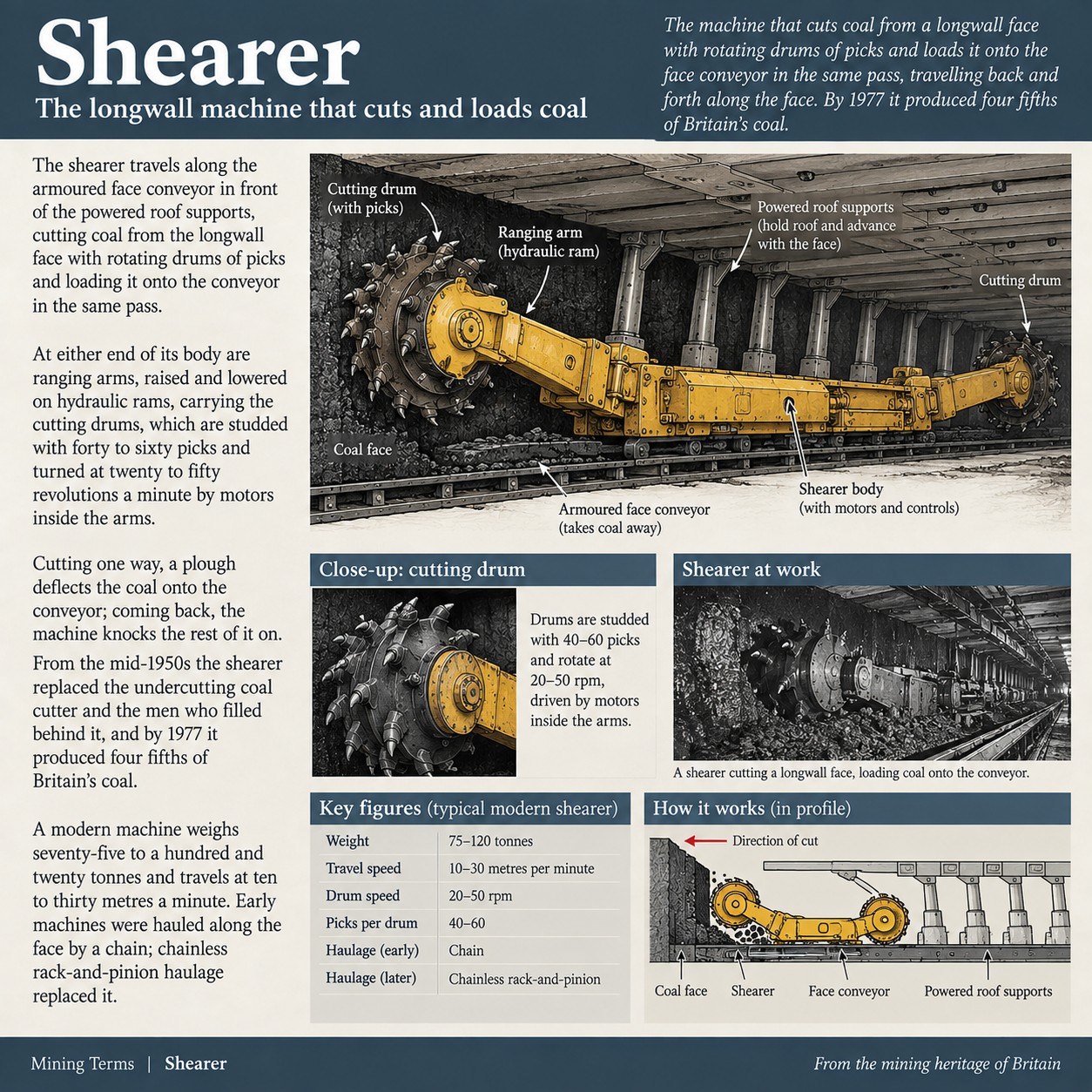
The machine that cuts coal from a longwall face with rotating drums of picks and loads it onto the face conveyor in the same pass, travelling back and forth along the face. From the mid-1950s it replaced the undercutting coal cutter and the men who filled behind it, and by 1977 it produced four fifths of Britain's coal.

Historical usage
The Anderton shearer loader was patented in 1953 and commissioned in 1954, developed mainly by James Anderton, production manager for the National Coal Board's St Helens Area and later chairman of its North-Western Division. It was first used in 1952 in the Rushy Park seam at Ravenhead Colliery, where Anderton worked, and went from there to Cronton and Golborne and out into the coalfields of the world. By 1966 it cut half the coal produced in Britain and by 1977 eighty per cent of it. A monument to Anderton stands in St Helens with the helical drum of a cutter beneath a collier's bust; the machine was known locally as th'cutter. The National Coal Board licensed the first designs to both Anderson Boyes and British Jeffrey Diamond; a fixed-drum BJD Anderton shearer, much like a chain undercutter with a drum in place of the chain race, is in the National Coal Mining Museum's collection.
How it worked
The shearer rides along the armoured face conveyor in front of the powered roof supports. At either end of its body are ranging arms, raised and lowered on hydraulic rams, carrying the cutting drums, which are studded with forty to sixty picks and turned at twenty to fifty revolutions a minute by motors inside the arms. Cutting one way, a plough deflects the coal onto the conveyor; coming back, the machine knocks the rest of it on. A modern machine weighs seventy-five to a hundred and twenty tonnes and travels at ten to thirty metres a minute. Early machines were hauled along the face by a chain; chainless rack-and-pinion haulage replaced it.
Why it was used
It collapsed three jobs into one. The older sequence was undercut the seam with a coal cutter, fire shots or wedge the coal down, then fill it onto the conveyor by hand. The shearer cut and loaded in a single pass and never stopped, and the men worked behind a line of hydraulic supports instead of in the open.
Risks & limitations
It wanted seams over about a metre thick and reasonably regular ground to be worth installing; a faulted or thin seam beat it. The coal it made was small, which suited power stations and suited nothing else — several of this archive's records note a poor saleable yield from shearer faces. And the dust: cutting at that rate in a confined face put respirable dust into the air on a scale hand-filling never had, which is why water is sprayed continuously over a modern face.
Related terminology
Coal Cutter, Coal Workers' Pneumoconiosis, Gate Road, Holing, Longwall, Power Loading, Powered Roof Supports
Mines associated with this term
5 examples chosen from 8 linked records — the term page is not an index.
- Williamthorpe Colliery — Derbyshire (well documented example)
Named in this record’s history: “…Under the National Coal Board it was steadily mechanised: an arc shearer for headings and a Joy loader in 1951, a training centre in 1952,…” - Blaenant Colliery — Neath Port Talbot (well documented example)
Named in this record’s workings: “…replaced the 1963 drift; the faces were worked by retreat, with ranging-drum shearers and self-advancing supports by 1981.” - Blenkinsopp Colliery — Northumberland (well documented example)
Named in this record’s workings: “…with the Wrytree drift, connected underground; latterly a longwall shearer face and roadheaders, with ventilation shafts.” - Britannia Colliery, Pengam — Caerphilly (well documented example)
Named in this record’s workings: “…roadway and 915-metre drift linking the two pits (mid-1970s), and ranging-drum shearers on the faces by 1980.” - Hill Top Colliery — Lancashire (well documented example)
Named in this record’s geology: “…ironstone nodules through the seam, which blunted the picks of the shearers introduced in 1964. Around Burnley and Todmorden Moor those nodules…”
Disasters associated with this term
Included only where MineArchive's own research gives a reasonable evidential basis, with the nature of the relationship stated — not every disaster where this term might plausibly apply.
- Sutton Colliery explosion, 1957 (contextual relationship)
Named in this record’s narrative: “…in the Low Main seam, 580 yards down. Less than a month earlier an Anderton shearer loader on an armoured conveyor had been put on the face, and from 11…”
Sources
- (secondary) Anderton Shearer Loader — Wikipedia
- (secondary) BJD Anderton Longwall shearer (YKSMM 1997.1051) — National Coal Mining Museum for England
- (secondary) Longwall mining — Wikipedia
Record created: 11 September 2026 · Last researched: 11 September 2026