 MineArchive
Sutton Colliery explosion, 1957
At about 11.30 on 21 February 1957 a stone fell from a gas-filled cavity over the loader gate of the new 28's face in the Low Main at Sutton Colliery, Sutton-in-Ashfield, and smashed a conveyor motor's terminal box. The flash fired the firedamp; twenty-five men were burned and five died.
| Date | 21 February 1957 |
|---|---|
| Mine | Sutton Colliery |
| Region | Nottinghamshire |
| Type | Explosion |
| Fatalities | 5 (Five died of burns: W. Savage, 29, J. W. Betts, 55, J. Lemm, 35, L. Reeves, 45, and J. Godber, 16.) |
| Injuries | Twenty-five burned in all; twenty-three were admitted to Mansfield General Hospital, and fifteen are named as seriously injured. |
| Context | During active mining |
Cause
Firedamp accumulated in an unsupported roof cavity over the loader gate was ignited by an incendive flash when a falling stone smashed the terminal box of the face conveyor motor.
Contributing factors
Roof falls left uncontrolled and unsupported after full caving began; inadequate ventilation, with the new fan not yet working; no firedamp tests in the cavity on the morning shift; statutory air measurements not taken.
What happened
The 28's district lay a mile and a quarter inbye in the Low Main seam, 580 yards down. Less than a month earlier an Anderton shearer loader on an armoured conveyor had been put on the face, and from 11 February full caving of the roof had begun. Falls in the loader gate followed, and by the morning of the explosion they had left a cavity about 36 feet long and up to 12 feet high above the steel arches, covered with boards and two wooden chocks but not supported. A fall between six and seven that morning partly buried the conveyor engine; the men cleared it under the acting undermanager and work restarted with nothing done to secure the roof.
Forty men were in the district. At about half past eleven, as P. Smith and D. Reeves cleaned up by the conveyor engine, a stone about three feet square fell from the cavity onto the motor. There was a flash and a bang, and a ball of red and blue flame passed over them and along most of the face. The men groped out through the dust; eight were carried out on stretchers, and all twenty-five in the flame's path were burned. Twenty-three were taken to Mansfield General Hospital. W. Savage, J. W. Betts, J. Lemm, L. Reeves and J. Godber, aged sixteen, died of their injuries.
The Mansfield and Chesterfield rescue teams found all the men accounted for, brought out two ponies, put out smouldering clothes and belting, and found up to 3.5 per cent firedamp in the return.
Rescue & recovery
Mansfield rescue station's team was below by noon, joined by Chesterfield's; a fresh-air base was set up at 12.55 p.m. and the district was found clear by mid-afternoon.
Investigation & inquiry
A. Winstanley, H.M. Deputy Chief Inspector of Mines, reported to the Minister of Power on 11 November 1957. The inquest, delayed until 7 October so that the injured could give evidence, returned an open verdict.
Changes to practice & legislation
The inspector recommended controlling strata to prevent large cavities, never hiding cavities behind supports and boards, protecting electrical apparatus from falls, faster earth-leakage trip devices, and applying the NCB's ventilation planning standards to all mines.
Memorials & commemoration
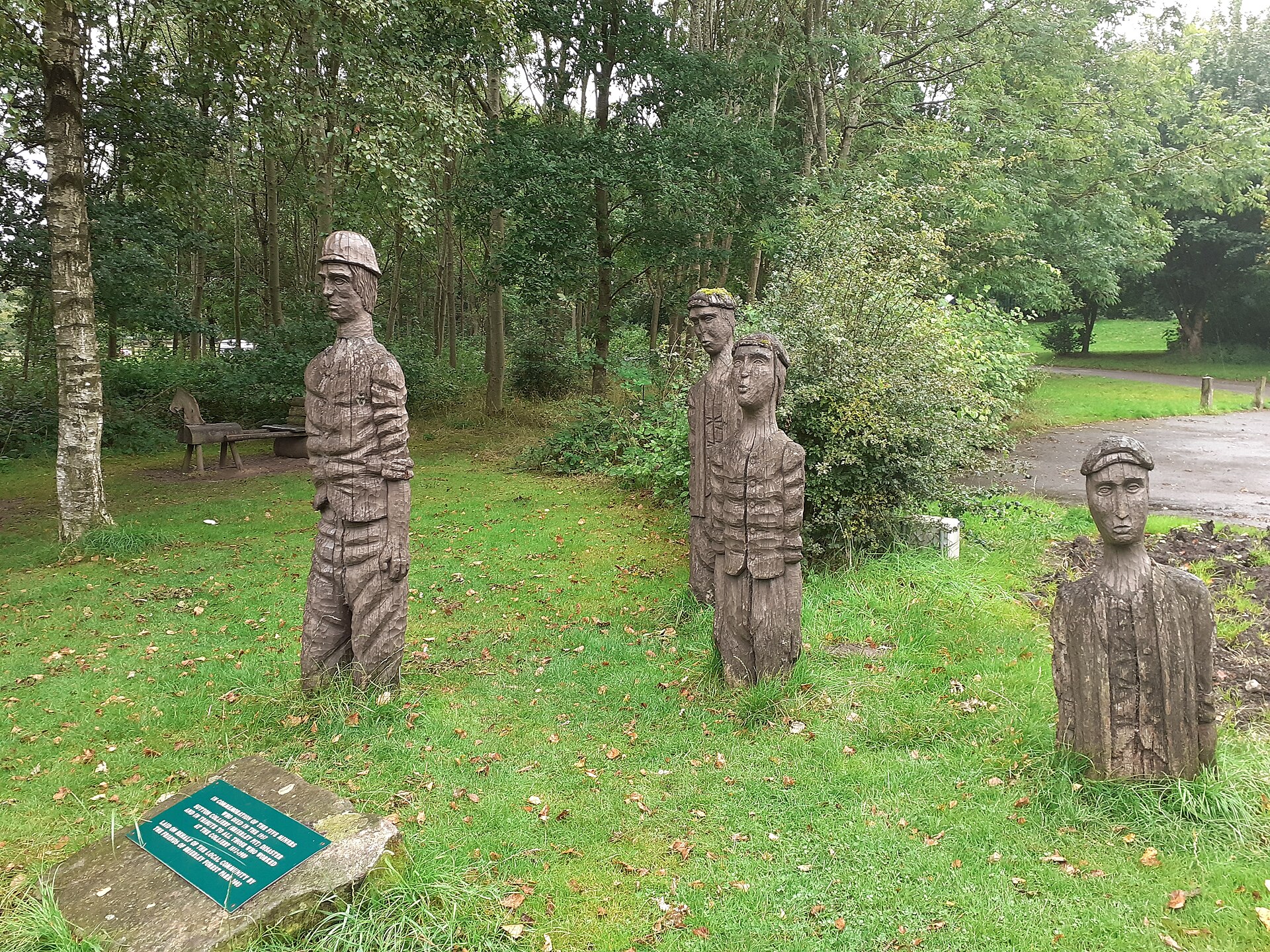
Carved wooden figures of miners and a memorial stone to the five who died stand in Brierley Forest Park, on the colliery site.
Recorded claims
Individual factual claims, each attached to the source(s) that support it below. Where sources disagree, both are kept.
- On 21 February 1957 an explosion in the 28's district of the Low Main seam at Sutton Colliery burned twenty-five men, five of whom died. 1,2,3
- A stone falling from a roof cavity above the loader gate struck the conveyor motor's terminal box and the incendive flash fired firedamp in the cavity. 2,3
- The inquiry found the ventilation insufficient to keep firedamp from accumulating, and the cavity had been left unsupported after repeated falls. 2
- The inquest at Mansfield on 7 October 1957 returned an open verdict. 2
- The district had been worked by an Anderton shearer loader for less than a month. 1,2
Related terminology
Mining terms this disaster is structurally linked to, with the nature of the relationship.
- Deputy (contextual relationship)
Named in this record’s investigation: “A. Winstanley, H.M. Deputy Chief Inspector of Mines, reported to the Minister of Power on 11…” - Filler (contextual relationship)
Named 3 times in this record, first in the summary: “…on 21 February 1957 a stone fell from a gas-filled cavity over the loader gate of the new 28's face in the Low Main at Sutton Colliery,…” - Firedamp (contextual relationship)
Named 3 times in this record, first in the summary: “…and smashed a conveyor motor's terminal box. The flash fired the firedamp; twenty-five men were burned and five died.” - Fresh Air Base (contextual relationship)
Named in this record’s rescue and recovery: “…rescue station's team was below by noon, joined by Chesterfield's; a fresh-air base was set up at 12.55 p.m. and the district was found clear by…” - Shearer (contextual relationship)
Named in this record’s narrative: “…in the Low Main seam, 580 yards down. Less than a month earlier an Anderton shearer loader on an armoured conveyor had been put on the face, and from 11…”
Photographs & further reading
This page doesn't try to reproduce everything — these are the best original sources found for this disaster.
A full account drawn from the official report, with the inspector's recommendations.
View sourceThe five dead and the injured, with a link to the inspector's report.
View sourceSources
- (secondary) Sutton Colliery — Wikipedia
- (secondary) Sutton Colliery Explosion - Mansfield - 1957 — Northern Mine Research Society
- (primary) Colliery Disaster: Sutton, 21 February 1957 — Durham Mining Museum
Record created: 4 October 2026 · Last researched: 4 October 2026