 MineArchive
Fresh Air Base
| Category | Ground Conditions & Hazards |
|---|
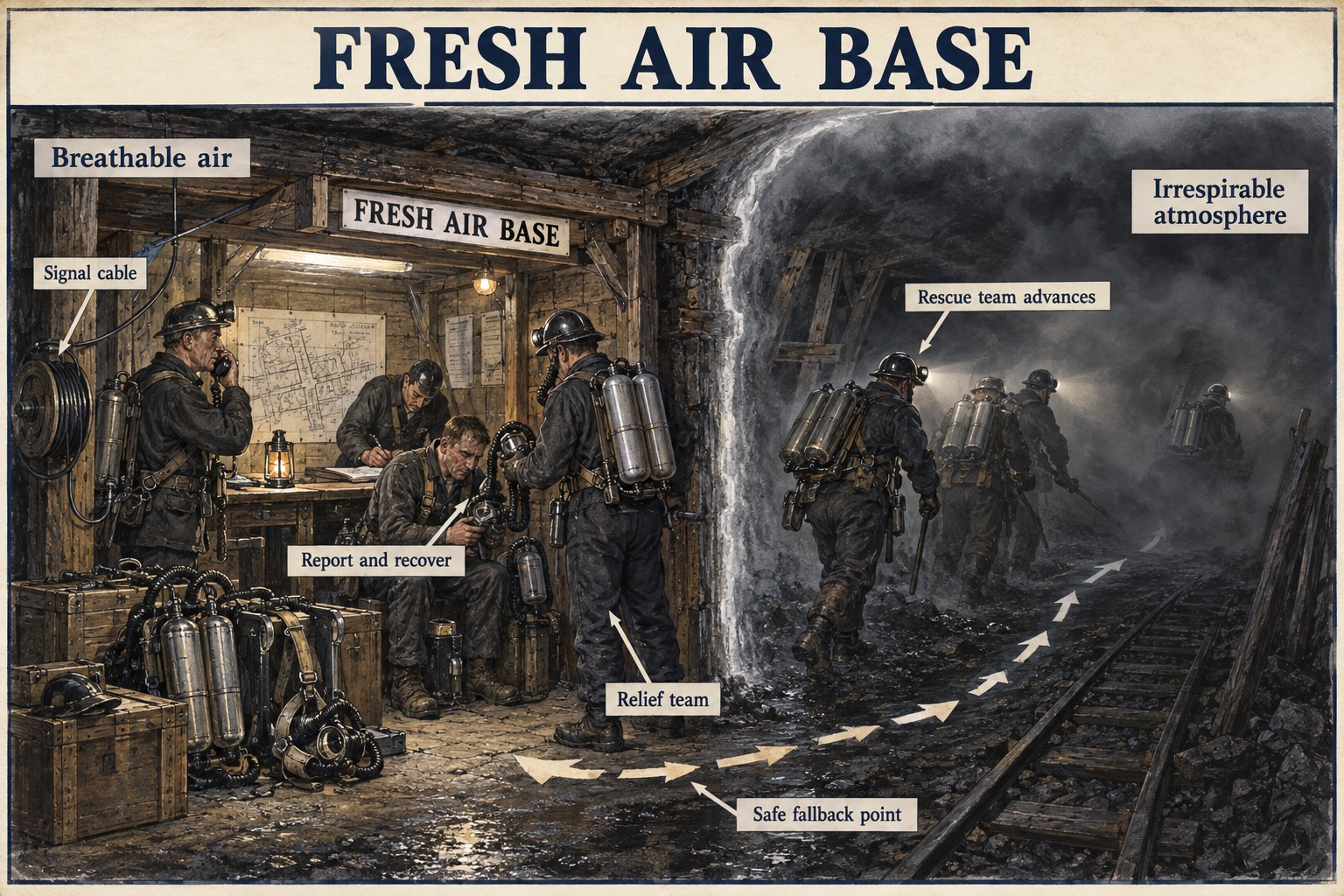
A forward post established underground, at the limit of breathable air, from which mines rescue teams wearing breathing apparatus advance into gas-filled or smoke-filled workings, and to which they retreat to change apparatus, recover, or hand over to a relief team.
Historical usage
Formalised mines rescue procedure developed in Britain following the establishment of organised colliery rescue stations after the Coal Mines Act 1911, and became standard practice at major underground incidents through the 20th century, including the prolonged rescue operation at Easington Colliery in 1951.
How it worked
A rescue team advances underground, usually paying out a telephone or signal cable as it goes, to the furthest point still within breathable air, and establishes a manned base there. From this fixed point, teams wearing self-contained breathing apparatus are sent forward in relays into the irrespirable atmosphere beyond, each excursion limited by the working duration of their apparatus, before returning to the base to report findings, recover, and be replaced by a fresh team for the next stage.
Why it was used
Breaking a rescue into apparatus-limited stages from a series of fresh air bases lets teams push progressively further into contaminated workings than a single team could manage in one excursion, while keeping a safe, breathable fallback point close to the actual working front rather than all the way back at the shaft bottom.
Risks & limitations
The base itself remains vulnerable to further explosions, roof falls, or a sudden change in ventilation making its own air irrespirable; because progress can only be made cautiously, stage by stage, a rescue conducted this way can take days to advance relatively short distances — the Easington rescue in 1951 continued for 257 hours before it was completed.
Related terminology
Breathing Apparatus, Mines Rescue Station
Disasters associated with this term
5 examples chosen from 8 linked records, most direct relationship first.
- Cardowan Colliery explosion, 1960 (rescue/recovery concept)
A fresh air base was set up at No. 1 East Junction. - Easington Colliery explosion, 1951 (rescue/recovery concept)
The disaster's own recorded rescue account explicitly describes fresh-air bases being established and progressively advanced during the 257-hour operation. - Bickershaw Colliery explosion, 1959 (contextual relationship)
Named twice in this record, first in the narrative: “…four together and one a few yards away, and carried them to a fresh-air base on the belt, where artificial respiration and oxygen failed. The…” - Dumbreck Colliery fire, 1938 (contextual relationship)
Named in this record’s rescue and recovery: “…was ruled out. Rescue teams in breathing apparatus set up a fresh-air base at 2.10 p.m. and made repeated attempts along the return and Kelly's…” - Eden Colliery explosion, 1927 (contextual relationship)
Named twice in this record, first in the narrative: “…the bodies were found, very badly burned, and carried down to the fresh-air base at the bottom. Analysis of the dust carried by the blast showed 7 to…”
Sources
- (secondary) Easington Colliery Explosion - West Hartlepool - 1951 — Northern Mine Research Society
- (secondary) Mines Rescue Practices — Selby Superpit
Record created: 23 August 2026 · Last researched: 23 August 2026