 MineArchive
Bickershaw Colliery explosion, 1959
Carbon monoxide from an explosion in an abandoned district of the Plodder Seam killed 5 men at Bickershaw Colliery on 10 October 1959.
| Date | 10 October 1959 |
|---|---|
| Mine | Bickershaw Colliery |
| Region | Greater Manchester |
| Type | Explosion |
| Fatalities | 5 (John McLeod, 28, overman; Frederick Brian Sargent, 27, deputy; Henry Thomason, 48, haulage hand; Jeremiah Dawber, 39, and Reginald Evans, 38, both members of the Boothstown Permanent Rescue Corps. All five died of carbon monoxide poisoning.) |
| Context | During active mining |
Cause
An explosion occurred in an abandoned district of the Plodder Seam, releasing carbon monoxide that reached working areas of the mine.
What happened
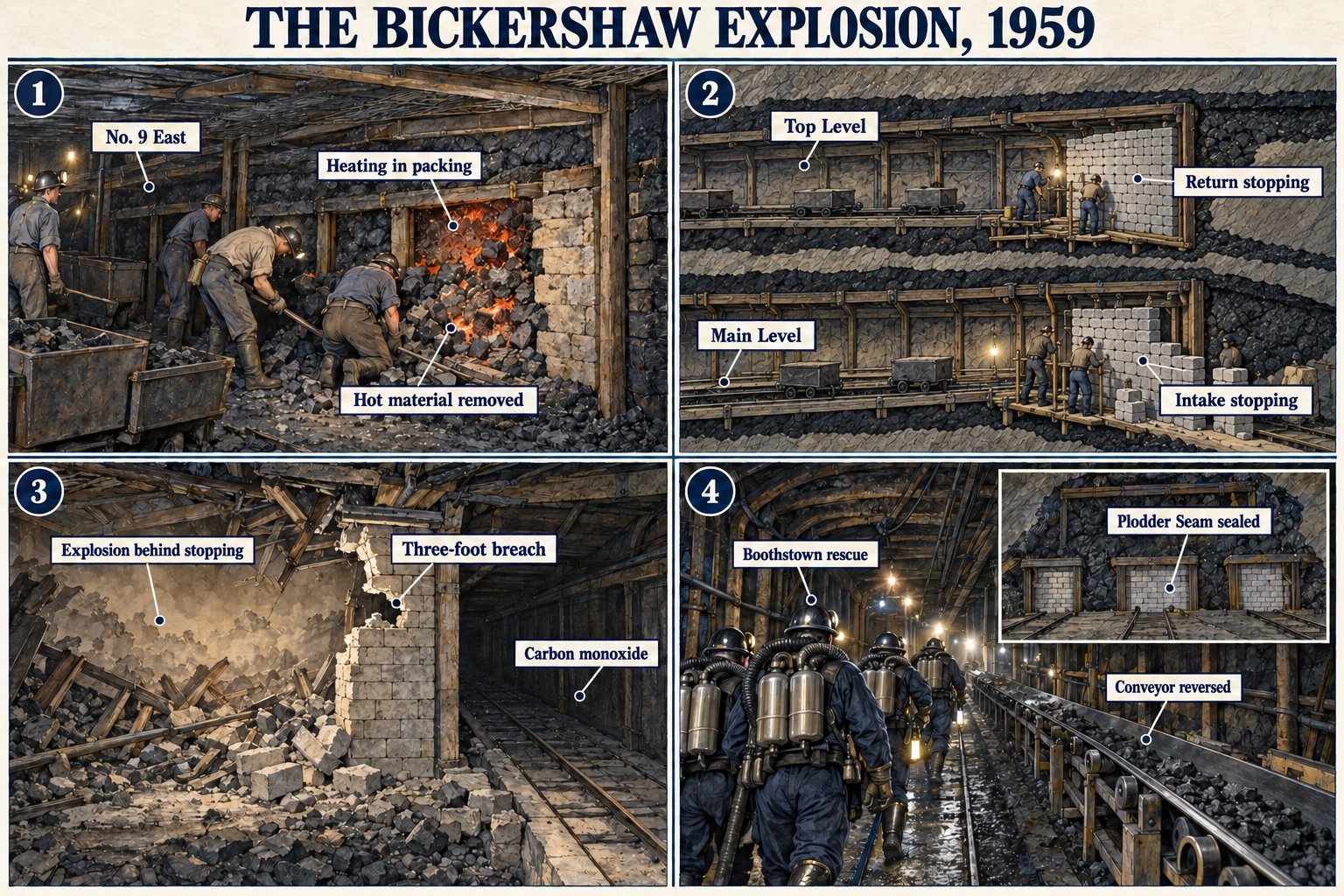
By the autumn of 1959 only two faces were still working in Bickershaw's Plodder Seam, a seam notorious in the Wigan and Leigh district for spontaneous combustion. No. 9 East face had stopped producing on 14 August and was being salvaged when, on Sunday 4 October, a deputy found signs of heating in the packing on the left-hand side of No. 9 Top Level. Men dug the hot material out over that afternoon and the three following shifts and re-sealed the pack, and the manager, J. M. Lawson, satisfied that the heating had been dealt with, decided the district should be stopped off. Building of the two stoppings, in the Main Level and the Top Level, began on the morning shift of Friday 9 October, with members of the Boothstown Permanent Rescue Corps helping because they were trained in the work. The intake stopping was sealed at 12.15 p.m. on Saturday 10 October and the return half an hour later. Because the intake stopping was a few yards short of the usual eleven, a small afternoon shift of thirteen men was kept on to lengthen it.
At about 4 p.m. five men were at the face of the stopping: John McLeod, the overman, Frederick Brian Sargent, the deputy, the rescue men Jeremiah Dawber and Reginald Evans, and Henry Thomason, a haulage hand. Men at the Transfer Point outbye heard a thud, and going through the separation doors met a cloud of dust and fumes with a smell of burning. They telephoned the surface and reversed the conveyor in case anyone could ride it out. A five-man Boothstown rescue team was underground by 4.25 and reached No. 9 East by 4.50; wearing apparatus they found the five men near the Main Level stopping, four together and one a few yards away, and carried them to a fresh-air base on the belt, where artificial respiration and oxygen failed. The Area Medical Officer, Dr J. F. Erskine, pronounced them dead at 6 p.m. Two rescue men, W. Sturgeon and K. Shaw, then examined the stoppings: flame safety lamps still hung from the roof supports, extinguished, there was little sign of violence and no flame, and a hole about three feet wide had been blown in the top of the Main Level stopping. The sample Shaw took at the return stopping held nearly 3 per cent carbon monoxide and 5 per cent firedamp. The mine was evacuated, the bodies carried 2,000 yards up the No. 4 Brow, and everyone was out by about 9 p.m. The Plodder Seam was never re-entered: on the Area General Manager's decision it was sealed at the top of its three airways, the last stopping closed at 11 a.m. on Tuesday 13 October.
Rescue & recovery
A five-man team from Boothstown Central Rescue Station was underground within about twenty-five minutes and reached the district by 4.50 p.m. The five men were found near the Main Level stopping, brought out on the reversed conveyor to a fresh-air base, and given artificial respiration and oxygen without effect; they were pronounced dead at 6 p.m. The whole mine was then evacuated, the bodies carried some 2,000 yards up the No. 4 Brow, and the Plodder Seam sealed off for good over the following three days rather than explored, because of the danger of a second explosion.
Investigation & inquiry
An inquest recorded a verdict of misadventure in each case; medical evidence showed all five men died of carbon monoxide gas poisoning. A statutory inquiry was subsequently conducted by R.H. Clough and reported to the Minister of Power under section 121 of the Mines and Quarries Act 1954.
Changes to practice & legislation
The inquiry pointed out that the 1944 Institution of Mining Engineers memorandum on sealing off fires underground, and the fire-sealing regulations re-enacted in 1956, required all persons to be withdrawn while a fire was sealed, and that the same danger of an explosive atmosphere arises whenever a district in a seam liable to spontaneous combustion is stopped off, fire or no fire. It recommended that stoppings in such seams be completed to an explosion-proof state as quickly as possible, and noted that the Institution had appointed a committee to revise the memorandum.
Recorded claims
Individual factual claims, each attached to the source(s) that support it below. Where sources disagree, both are kept.
- An explosion in an abandoned district of the Plodder Seam released carbon monoxide that reached working areas of the mine. 1,2
- Five men died of carbon monoxide gas poisoning; an inquest recorded a verdict of misadventure in each case. 2
- A statutory inquiry was conducted by R.H. Clough and reported to the Minister of Power under section 121 of the Mines and Quarries Act 1954. 2
Related terminology
Mining terms this disaster is structurally linked to, with the nature of the relationship.
- Deputy (contextual relationship)
Named twice in this record, first in the narrative: “…on 14 August and was being salvaged when, on Sunday 4 October, a deputy found signs of heating in the packing on the left-hand side of No. 9…” - Fresh Air Base (contextual relationship)
Named twice in this record, first in the narrative: “…four together and one a few yards away, and carried them to a fresh-air base on the belt, where artificial respiration and oxygen failed. The…” - Overman (contextual relationship)
Named in this record’s narrative: “…4 p.m. five men were at the face of the stopping: John McLeod, the overman, Frederick Brian Sargent, the deputy, the rescue men Jeremiah Dawber…” - Return Airway (contextual relationship)
Named twice in this record, first in the narrative: “…Rescue Corps helping because they were trained in the work. The intake stopping was sealed at 12.15 p.m. on Saturday 10 October and the…” - Spontaneous Combustion (contextual relationship)
Named 3 times in this record, first in the narrative: “…Plodder Seam, a seam notorious in the Wigan and Leigh district for spontaneous combustion. No. 9 East face had stopped producing on 14 August and was being…”
Sources
- (secondary) Bickershaw Colliery — Wikipedia
- (secondary) Bickershaw Colliery Explosion - Leigh - 1959 — Northern Mine Research Society
Record created: 27 August 2026 · Last researched: 16 September 2026