 MineArchive
Deputy
| Category | Labour & Roles |
|---|
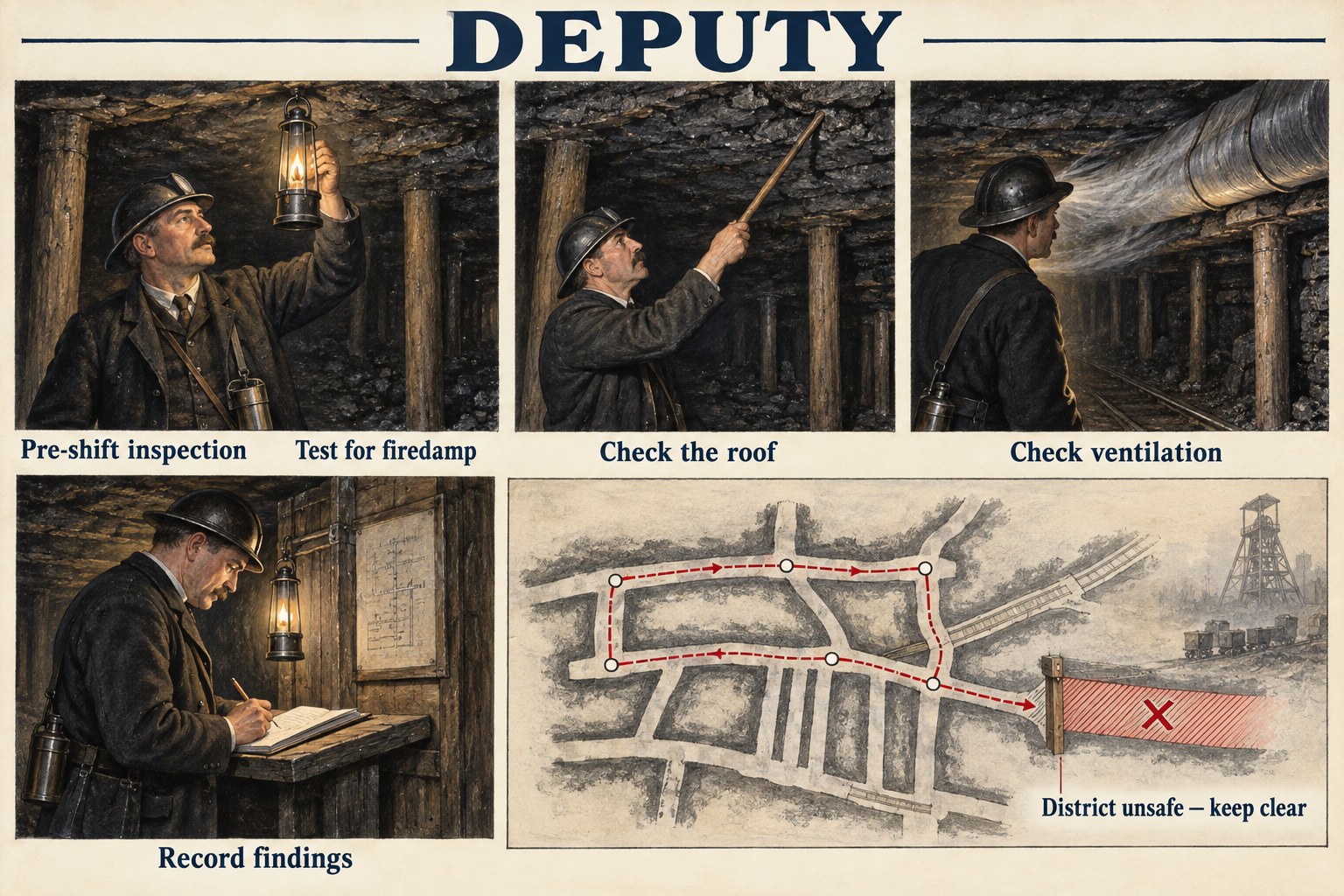
A certificated coal-mine official responsible for the safety of a specific district underground — examining for gas, checking ventilation and the state of the roof and sides before each shift began. Also known, depending on period and district, as a fireman or examiner; the English coalfield's statutory counterpart to the Cornish mine Captain.
Historical usage
The role was placed on a statutory footing by successive Coal Mines Regulation Acts, culminating in the Coal Mines Act 1911, which required every mine to appoint one or more competent, certificated persons — deputies, firemen or examiners, the terms were used interchangeably — to inspect their assigned district for gas, ventilation, roof and side conditions, and general safety before work began each shift, and to record what they found. Deputies formed their own trade body, the National Federation, in 1910, representing deputies alongside the related roles of overman and shotfirer.
How it worked
A deputy examined an assigned district of the mine before each shift, testing specifically for firedamp with a safety lamp and checking the state of the roof, sides and ventilation, before certifying the district fit for men to work; anything found unsafe had to be reported and, where necessary, the area kept clear until made safe.
Risks & limitations
A deputy's authority carried real weight, but also real responsibility when something went wrong: at Haig Colliery in 1931, an official inquiry found that the deputy responsible for the affected district had not checked for gas immediately before a shotfiring charge was fired, only some time beforehand.
Related terminology
Fireman, Naked Light, Overman, Putter, Roof Fall, Shot-firing, Stoneman
Mines associated with this term
5 examples chosen from 31 linked records — the term page is not an index.
- Acomb Colliery — Northumberland (well documented example)
Named in this record’s history: “…and 1947, most by falls of stone or crushed by tubs, including a deputy overcome by gas in 1940 and a shifter killed in a gas explosion in…” - Allerton Bywater Colliery — West Yorkshire (well documented example)
Named in this record’s workings: “…drilled shot holes from the roof at eighteen-inch intervals, which a deputy charged with six ounces of explosive apiece and fired. Coal that…” - Avenue Colliery — Derbyshire (well documented example)
Named in this record’s history: “…County Police Court under the Coal Mines Act for refusing a deputy's lawful command, a case the Derbyshire Times thought of very…” - Axwell Park Colliery — Tyne and Wear (well documented example)
Named in this record’s history: “…ground, and two of the three men burned died, one of them the deputy. Priestman Collieries took the colliery in 1903, raising coking and…” - B Winning Colliery — Derbyshire (well documented example)
Named in this record’s history: “…off its rope in the upcast shaft and fell to the bottom, killing two deputies, Henry Wood of Hucknall and Joseph Moore of Pinxton. The…”
Disasters associated with this term
5 examples chosen from 119 linked records, most direct relationship first.
- Barnsley Main Colliery explosion, 1947 (contributing factor)
His examination was judged not thorough enough. - Clay Cross Colliery inundation, 1861 (contributing factor)
The warning reached the deputy two hours late. - Haig Colliery explosion, 1931 (contributing factor)
The disaster's own recorded investigation findings explicitly describe the responsible deputy not checking for gas immediately before the shell was fired. - West Stanley Colliery explosion, 1882 (contributing factor)
An illiterate deputy did not always record gas. - West Stanley Colliery explosion, 1909 (relevant method/equipment)
Mark Henderson was a deputy — the official responsible for the safety of a district, and the reason twenty-six men came out of the Tilley seam alive.
Sources
- (primary) Durham Mining Museum - Coal Mines Act 1911 — Durham Mining Museum
- (secondary) Colliery Deputies in the British Coal Industry Before Nationalization — International Review of Social History (Cambridge Core)
Record created: 24 August 2026 · Last researched: 24 August 2026