 MineArchive
Firedamp
| Category | Ventilation & Mine Gases |
|---|
The explosive gas — chiefly methane — that seeps naturally out of coal seams into a working mine, distinct from afterdamp (the toxic gas mixture left behind once firedamp, or the coal dust it disturbs, has actually exploded).
Historical usage
The term is essentially specific to coal mining, where methane is trapped within the coal itself and released as the seam is cut; it was the single greatest cause of the explosions and mass fatalities that make up so much of British coalfield history, from early Tyneside disasters like 102 dead at Wallsend in 1835 to the era of large-scale 19th and 20th century pit explosions.
How it worked
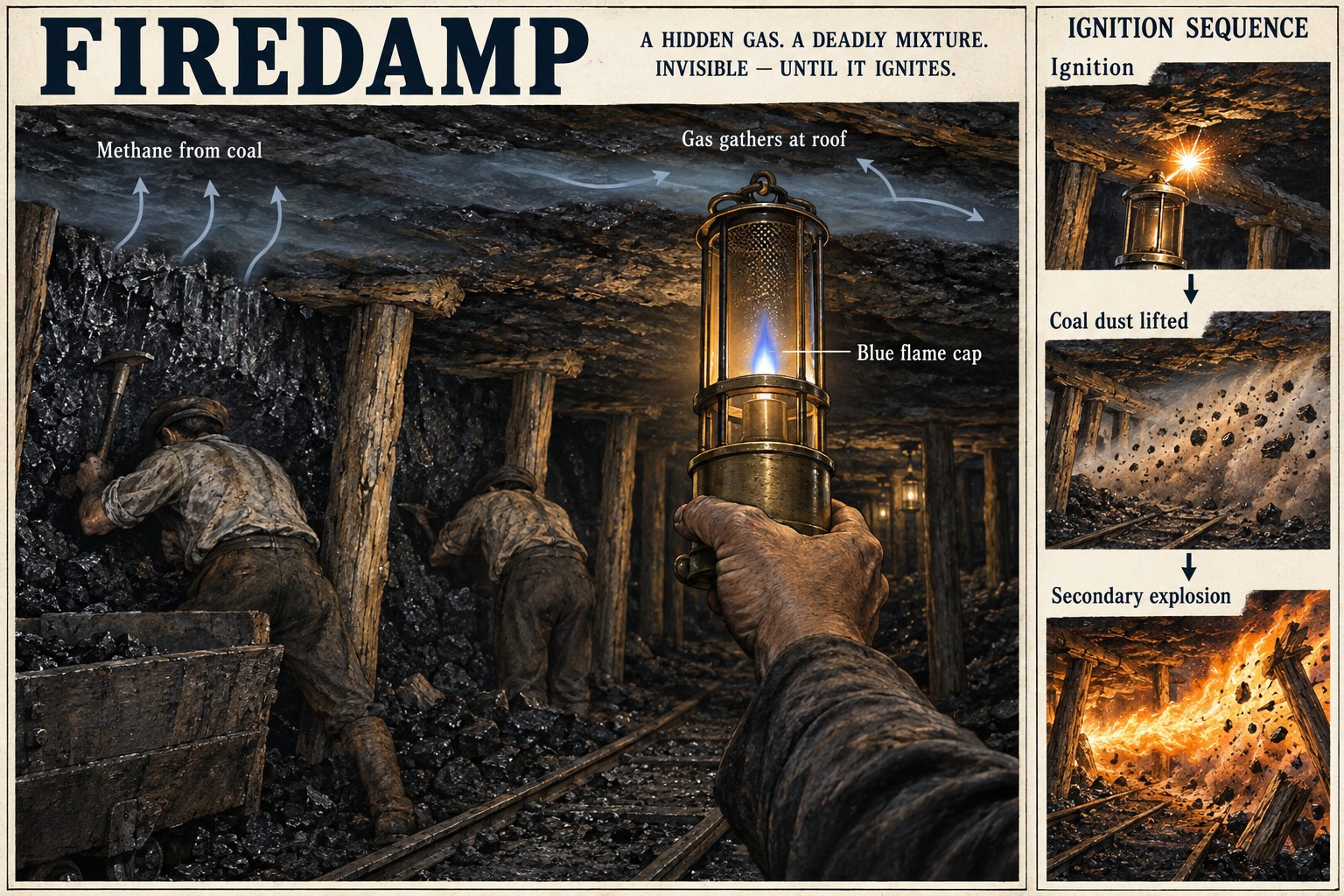
Firedamp is explosive when mixed with air in roughly a 5-14% concentration, most violently around 10%, and needs only a spark or naked flame to ignite. Once alight, a firedamp explosion commonly disturbs and ignites fine coal dust suspended in the air, triggering a much larger and more destructive secondary explosion — the mechanism behind several of this site's own recorded disasters. This was not properly understood until the 1890s: a Royal Commission reporting in 1894, following research by mines inspector William Galloway, established that coal dust dramatically worsens an explosion that firedamp alone starts.
Why it was used
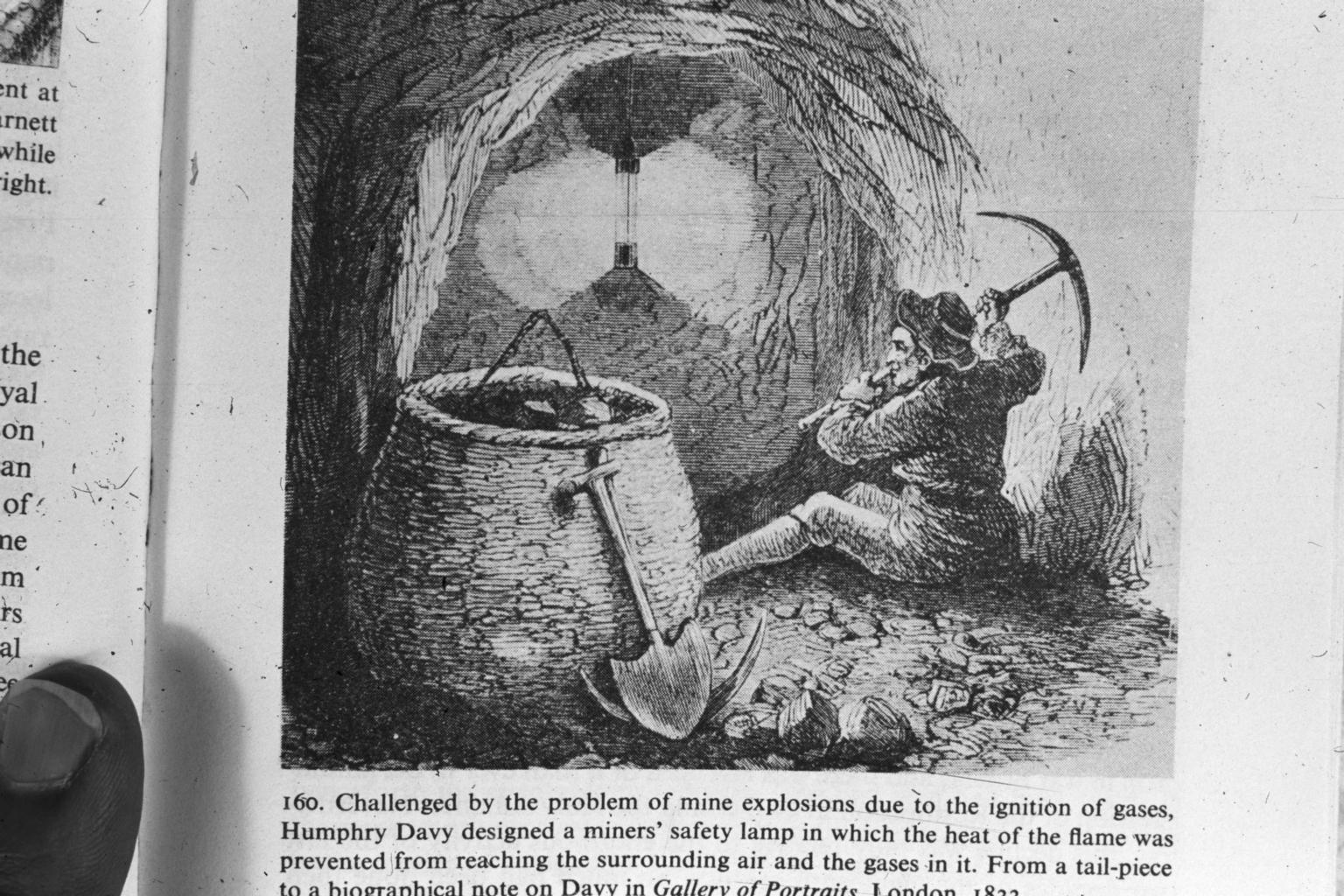
Recognising firedamp as the trigger, rather than the whole danger, shaped over a century of mine safety practice. Naked-flame candles and oil lamps, the standard underground light before the 1810s, could ignite firedamp directly, and a series of catastrophic explosions — including 92 deaths at Felling colliery near Gateshead in 1812 — drove Humphry Davy and, separately, George Stephenson to develop safety lamps that enclosed the flame behind fine wire gauze, letting light out but stopping the flame reaching gas outside. The Davy lamp doubled as a crude detector: methane in the air made its flame grow a visible bluish cap, warning miners before a dangerous concentration built up.
Risks & limitations
Firedamp cannot be smelled or seen, so relied entirely on instruments — first the safety lamp's flame cap, later mechanical and electronic gas detectors — to give any warning at all; ventilation to dilute and carry the gas away, rather than any means of eliminating it at source, remained the primary defence throughout the working life of Britain's deep coal mines.
Regional variation
"Damp" is a generic historical term for a dangerous mine atmosphere (from the German Dampf, vapour), giving a family of related terms: firedamp (methane, explosive), afterdamp (the toxic aftermath of a firedamp or dust explosion), blackdamp/chokedamp (oxygen-deficient, carbon dioxide-rich air) and whitedamp (carbon monoxide specifically) — this site's own Afterdamp term page covers the aftermath gas in detail. The coalfield glossaries add their own words for its states. Healey Hero records wildfire as an early name for ignited firedamp burning below the explosive range — gas alight but not going off — and Barrowman's 1886 Scottish glossary preserves the firing-line, an appliance used in former times for clearing a room of firedamp, from the period when clearing a place of gas meant burning it out deliberately. Scottish usage keeps fire-styth or fire-stink for the burning smell of spontaneous combustion, a different hazard that shares the vocabulary.
Related terminology
Blower, Downcast Shaft and Upcast Shaft, Fireman, Naked Light, Outburst, Return Airway, Shot-firing, Stone Dusting, Thirling
Mines associated with this term
5 examples chosen from 80 linked records — the term page is not an index.
- Lewis Merthyr Colliery — Rhondda Cynon Taf (notable incident)
Firedamp was the trigger for the colliery's 1956 explosion, recorded in the mine's own history. - Wern Colliery, Cwmafan — Neath Port Talbot (notable incident)
The December 1844 explosion that killed four men here (see Disasters, below) was a firedamp ignition. - Ynys Dafydd Colliery — Neath Port Talbot (notable incident)
The 1856 explosion that killed twelve here (see Disasters, below) was a firedamp ignition in the Big Vein. - Bank Hall Colliery — Lancashire (well documented example)
Named twice in this record, first in the summary: “…iron pyrites nodules in coal balls and sparking ignitions of firedamp.” - Cardowan Colliery — North Lanarkshire (well documented example)
Named in this record’s geology: “…roof and hard floor; the colliery's coal was notoriously high in firedamp, a persistent hazard across its working life.”
Disasters associated with this term
5 examples chosen from 239 linked records, most direct relationship first.
- Annagher Pit fireball, 1898 (direct cause)
Gas accumulated and ignited some sixty metres down the shaft. - Apedale Colliery Explosion, 1878 (direct cause)
The explosion is attributed to firedamp ignited during the pit's furnace-ventilation operation, most likely by a shot, the return air path over the furnace itself, or a defective lamp. - Apedale Colliery Explosion, 1885 (direct cause)
The nine deaths resulted from an explosion of gas, per the jury's inquest finding. - Arkwright Town Methane Evacuation, 1988 (direct cause)
Methane from the abandoned workings migrated through the strata into the houses and built towards explosive levels. - Astley Green Colliery explosion, 1939 (direct cause)
The explosion was caused by firedamp igniting during underground firefighting, the disaster's own recorded cause.
Sources
- (primary) Glossary of Mining and Geordie Words — Durham Mining Museum
- (primary) Glossary of Scotch Mining Terms — James Barrowman (1886), via Scottish Mining Website
- (primary) Sir Humphry Davy and the coal miners of the world: a commentary on Davy (1816) — Philosophical Transactions of the Royal Society A
- (secondary) Firedamp — Encyclopaedia Britannica
- (secondary) Mine Explosions — ScienceDirect
- (secondary) Miner using Humphry Davy's safety lamp, 1833 — Digital Public Library of America
- (secondary) Pit Terminology — Healey Hero
- (secondary) The life-saving lamp: Humphry Davy's fight against firedamp — Royal Institution

Record created: 20 August 2026 · Last researched: 11 September 2026