 MineArchive
Arkwright Town Methane Evacuation, 1988
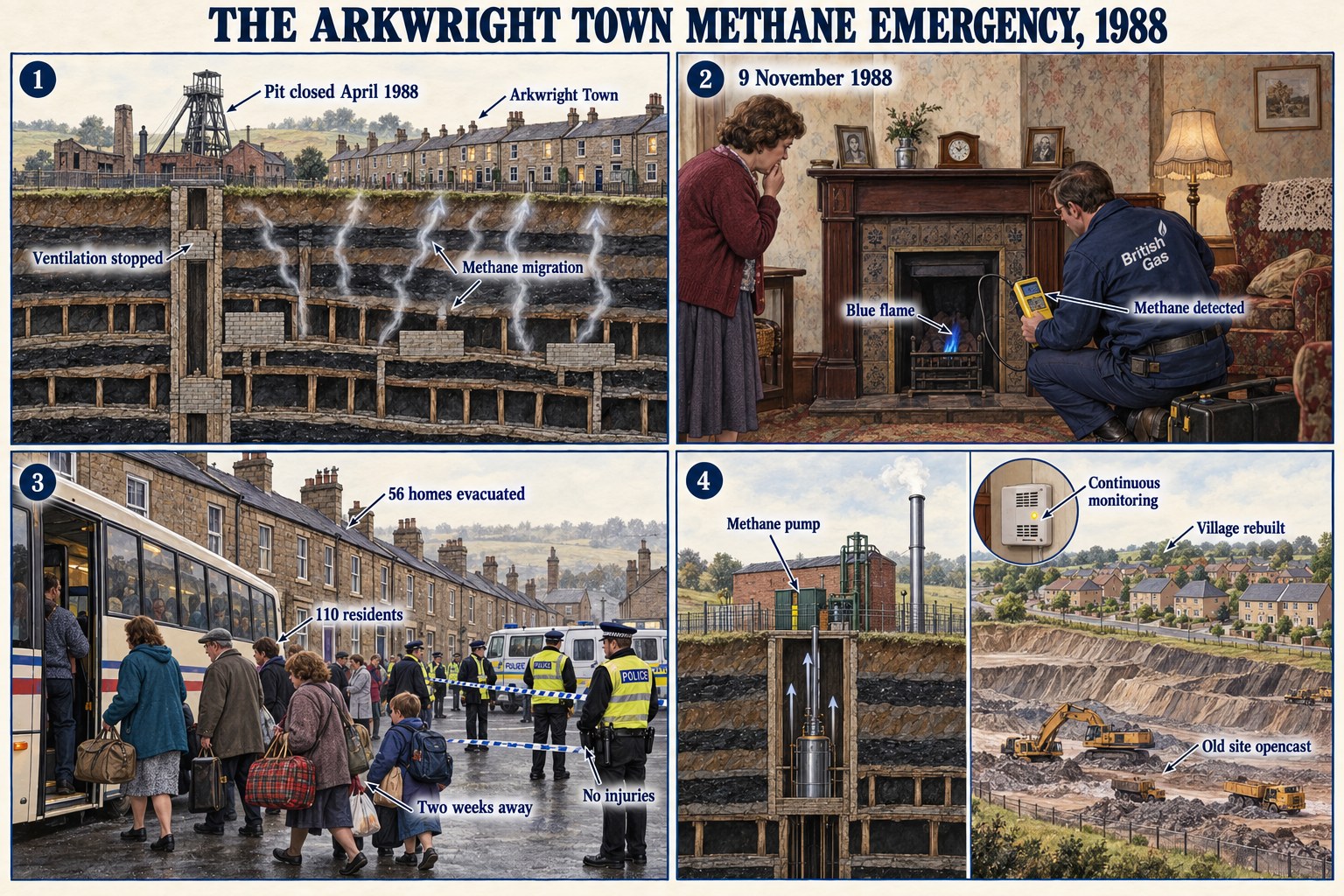
Methane rising from the abandoned workings of Arkwright Colliery was found at explosive levels in the terraces of Arkwright Town six months after the pit closed; 110 people from 56 homes were evacuated for a fortnight, a pump was set in the old shaft, and British Coal eventually rebuilt the entire village on a new site and opencast the old one away.
| Date | 9 November 1988 |
|---|---|
| Mine | Arkwright Colliery |
| Region | Derbyshire |
| Type | Gas / Asphyxiation |
| Fatalities | 0 (No deaths or injuries.) |
| Injuries | None; the danger was of explosion in confined rooms. |
| Context | Post-closure — member(s) of the public (Six months after Arkwright Colliery closed, methane from the abandoned workings migrated through the strata into the houses of the pit village.) |
Cause
Migration of methane from abandoned coal workings beneath the village through the rock strata into houses, after the colliery's ventilation stopped at closure.
Contributing factors
The pit had closed in April 1988 and its drifts were sealed, so the workings were no longer ventilated; older workings also lay beneath the village, which British Coal cited in declining to accept liability.
What happened
On the evening of 9 November 1988 a villager saw a flash of blue flame in an unlit fireplace and called British Gas. The technician found the gas was methane, seeping up through the strata beneath the village and building towards explosive concentrations. A state of emergency was declared and half of the 174 houses were evacuated at once; residents recalled being told to leave everything and get out. In all 110 people from 56 homes were housed with friends, in schools and in hotels for two weeks before being allowed home. As a temporary measure a pumping station was installed in the disused colliery shaft to draw methane out of the workings and vent it to the atmosphere, and the affected houses were fitted with methane detectors and monitored continuously.
Rescue & recovery
Immediate evacuation of half the village on the night, with residents rehoused for a fortnight; a methane pumping station in the disused shaft and continuous monitoring afterwards.
Investigation & inquiry
British Coal disputed liability, pointing to other, older workings in the area, and a compensation claim supported by North East Derbyshire District Council and the local MP, Dennis Skinner, dragged on for almost two years.
Legal & regulatory aftermath
In October 1990 British Coal, still not accepting liability, offered to build an entirely new village with fitted homes, moving expenses and an index-linked relocation fee of £2,500 a household, a package costing about £15 million, in return for planning permission to opencast four million tons of coal from a thousand acres around old and new Arkwright. The residents accepted; the new village of 56 properties north of the A632 was completed and the old one demolished in 1995, and the opencast, worked from November 1993, removed the old deep workings and strata that were the source of the gas.
Changes to practice & legislation
A methane vent pipe still stands near the site, and Arkwright became the reference case for methane migration from abandoned workings into housing.
Memorials & commemoration
A monument to the colliery workforce was unveiled in the new village for the thirtieth anniversary of the relocation.
This account describes a post-closure incident in abandoned workings. It is not an access guide, and deliberately omits route detail beyond what's needed to understand what happened.
Recorded claims
Individual factual claims, each attached to the source(s) that support it below. Where sources disagree, both are kept.
- On 9 November 1988 methane escaping from underground workings was discovered in the village and 110 people from 56 homes were evacuated for two weeks. 1,2
- In October 1990 British Coal, without accepting liability, offered a new village and a £2,500 relocation fee per household, a package of about £15 million, in return for permission to opencast around the village; the new village was completed and the old one demolished in 1995. 2,3,4
Related terminology
Mining terms this disaster is structurally linked to, with the nature of the relationship.
- Firedamp (direct cause)
Methane from the abandoned workings migrated through the strata into the houses and built towards explosive levels. - National Coal Board (contextual relationship)
Named 4 times in this record, first in the summary: “…were evacuated for a fortnight, a pump was set in the old shaft, and British Coal eventually rebuilt the entire village on a new site and opencast the…” - Old Workings (contextual relationship)
Named twice in this record, first in the summary: “Methane rising from the abandoned workings of Arkwright Colliery was found at explosive levels in the terraces…” - Opencast Working (contextual relationship)
The settlement was an opencast scheme that removed the old workings which were the source of the gas. - Terrace (contextual relationship)
Named in this record’s summary: “…workings of Arkwright Colliery was found at explosive levels in the terraces of Arkwright Town six months after the pit closed; 110 people from…”
Sources
- (secondary) Arkwright Town, 1897-1995 (oldminer.co.uk) — oldminer.co.uk (Andrew Bridgewater)
- (secondary) Why will the village cross the road? (Simon Beckett, The Independent on Sunday, 17 April 1994; transcribed on oldminer.co.uk) — The Independent on Sunday
- (secondary) Arkwright Town (Wikipedia) — Wikipedia
- (secondary) Arkwright Town (Wikishire) — Wikishire
Record created: 9 September 2026 · Last researched: 9 September 2026