 MineArchive
National Coal Board
| Also known as | NCB (the usual abbreviation, and how most records write it), British Coal Corporation (the same body, renamed in 1987), British Coal (shorthand for the corporation after 1987) |
|---|---|
| Category | Law & Custom |
The state corporation that owned and ran almost all of British coal mining from 1947 to 1987. Created by the Coal Industry Nationalisation Act 1946, it took the industry over on vesting day — 1 January 1947 — was renamed the British Coal Corporation in 1987, and was wound up when the industry was privatised in 1994.
Historical usage
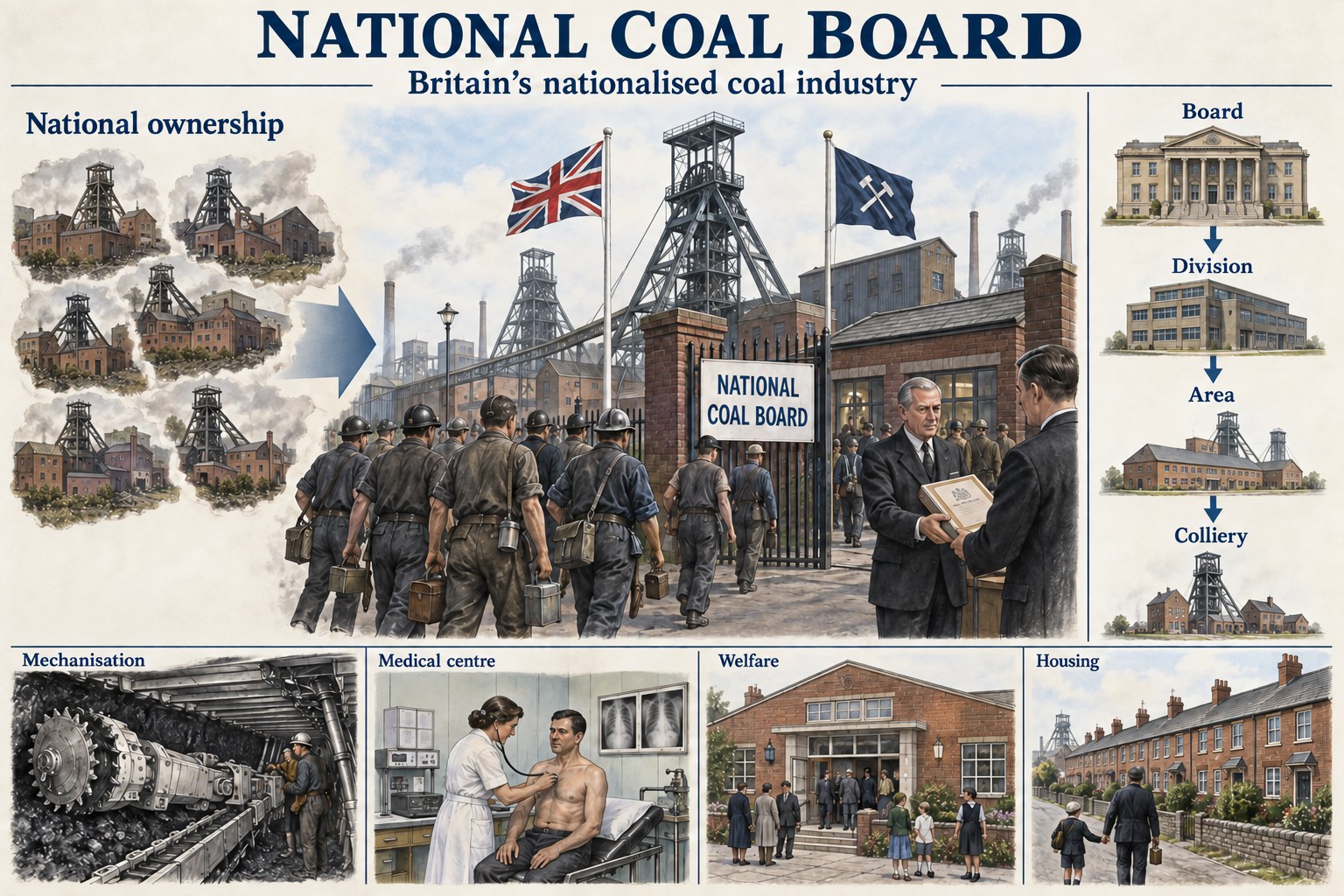
The NCB is the most common institution named in 20th-century British colliery records: after 1947 practically every deep mine's later history is NCB history, and a record saying a pit 'passed to the National Coal Board at nationalisation' is describing the same day at every one of them. It took over some 1,647 mines, more than a million acres of land and around 100,000 dwellings from hundreds of separate companies. The handover itself was almost comically brief — a ceremony in London lasting two seconds, in which the first chairman, Lord Hyndley, was handed a bound copy of the Act — but at pit level it was marked: flags flown from headgears, and a notice mounted outside each colliery stating that it was now managed by the National Coal Board on behalf of the people. Coal mining employed over 700,000 people at its peak around 1950. By privatisation in 1994 there were fifteen pits left.
How it worked
A single management structure over an industry that had been split between hundreds of owners: the Board above, divisions and areas beneath it, collieries beneath those — which is why a colliery record from this period names an Area rather than a company. It set wages nationally, and its remit went well past extraction. The Coal Industry Social Welfare Organisation took on some 700 halls, 600 recreation grounds, convalescent homes and holiday centres; the Coal Industry Housing Association built nearly 20,000 homes between 1952 and 1955 to replace substandard colliery housing; a pension scheme was set up for retiring miners; and where eight medical centres had existed before 1947, there were 373 by 1960. The Board sponsored research into mining diseases, ran its own brickworks and coking plants, recruited through campaigns and its own magazine, and brought in the five-day week to make the industry worth joining.
Why it was used
Private ownership had left the industry fragmented, under-invested and unable to attract men. Nationalisation was meant to fix all three at once — Attlee's vesting-day message claimed the Act offered great possibilities of social advance — and it put capital behind mechanisation, safety and welfare on a scale no individual colliery company could have found. By 1950 mining had become one of Britain's better-paid industries.
Risks & limitations
One owner also means one decision-maker. The same body that built the housing and the medical centres ran the closure programmes, and when it announced the closure of Cortonwood in March 1984 it became the counterparty in the year-long strike that followed. Its record-keeping has outlived it more usefully: the abandonment plans the NCB and its predecessors deposited are why the Coal Authority — now the Mining Remediation Authority — can say where the workings are, and are what most of this archive's coal records ultimately rest on.
Regional variation
A Great Britain body, organised into divisions and later areas, so 'the NCB' in a colliery record usually means a particular Area with its own management and its own closure decisions. It is worth reading the date too: the same organisation is the National Coal Board before 1987 and the British Coal Corporation after it, and records use whichever name was current.
Operator record
Related terminology
Care and Maintenance, Coal Mines Act 1911, Colliery Brickworks, Man-riding, Miners' Strike, Miners' Welfare Fund, Mines Rescue Station, Power Loading, Shaft Capping, Wartime Requisitioning
Mines associated with this term
5 examples chosen from 414 linked records — the term page is not an index.
- Auchengeich Colliery — North Lanarkshire (well documented example)
Named in this record’s history: “…of around 650, and a peak of 860 in 1956 — and it passed to the National Coal Board on nationalisation in 1947. It was also known to be gassy, and it…” - Bank Hall Colliery — Lancashire (well documented example)
Named in this record’s workings: “…with a Walker Brothers steam fan engine for ventilation. Under the NCB the haulage roads were rebuilt for battery locomotives pulling…” - Bedford Colliery — Greater Manchester (well documented example)
Named twice in this record, first in the history: “…Pit collieries and put in new headgear and screens. It passed to the National Coal Board in 1947 and closed in 1967, still employing 518 underground and 131…” - Bedwas Navigation Colliery — Caerphilly (well documented example)
Named 6 times in this record, first in the history: “…It was nationalised on 1 January 1947, and in the late 1950s the National Coal Board approved a £4 million reorganisation: electrified winding, a new…” - Bickershaw Colliery — Greater Manchester (well documented example)
Named 3 times in this record, first in the history: “…The pit amalgamated with Abram Collieries in 1933 and passed to the National Coal Board on the 1947 nationalisation of the coal industry. Bickershaw worked…”
Disasters associated with this term
5 examples chosen from 15 linked records, most direct relationship first.
- Aberfan disaster, 1966 (contextual relationship)
Named 4 times in this record, first in the investigation: “…in 1967. It placed the blame for the disaster squarely on the National Coal Board, finding 'ignorance, ineptitude and a failure in communications' at…” - Addison Colliery explosion, 1946 (contextual relationship)
Named in this record’s summary: “…and a sixteen-year-old driver, months before the pit passed to the National Coal Board.” - Arkwright Town Methane Evacuation, 1988 (contextual relationship)
Named 4 times in this record, first in the summary: “…were evacuated for a fortnight, a pump was set in the old shaft, and British Coal eventually rebuilt the entire village on a new site and opencast the…” - Barony Colliery shaft collapse, 1962 (contextual relationship)
Named twice in this record, first in the narrative: “…between 1906 and 1910, and the colliery was rebuilt by the National Coal Board between 1937 and 1949, the reconstruction giving it the steel…” - Brynlliw Colliery roof fall, 1963 (contextual relationship)
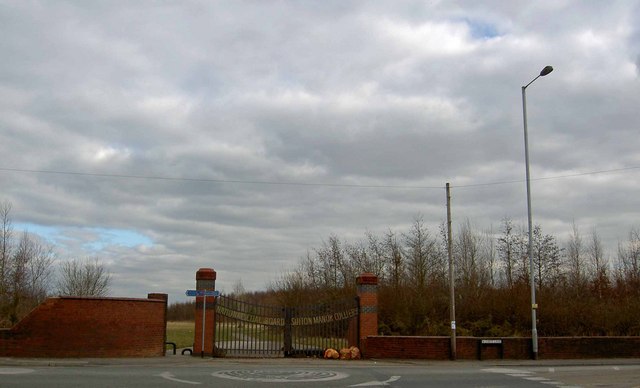
An NCB colliery.
Sources
- (primary) Nationalisation of coal — The National Archives
- (secondary) Nationalisation — By the People, For the People — National Coal Mining Museum for England
Record created: 25 August 2026 · Last researched: 25 August 2026