 MineArchive
Miners' Strike
| Category | Law & Custom |
|---|
A collective withdrawal of labour by mineworkers, usually organised through their union, in a dispute with employers or government over wages, working conditions or pit closures — as distinct from a lockout, in which management shuts a workforce out rather than the men walking out voluntarily, though the two words were often used almost interchangeably by miners themselves in 1893 and 1926.
Historical usage
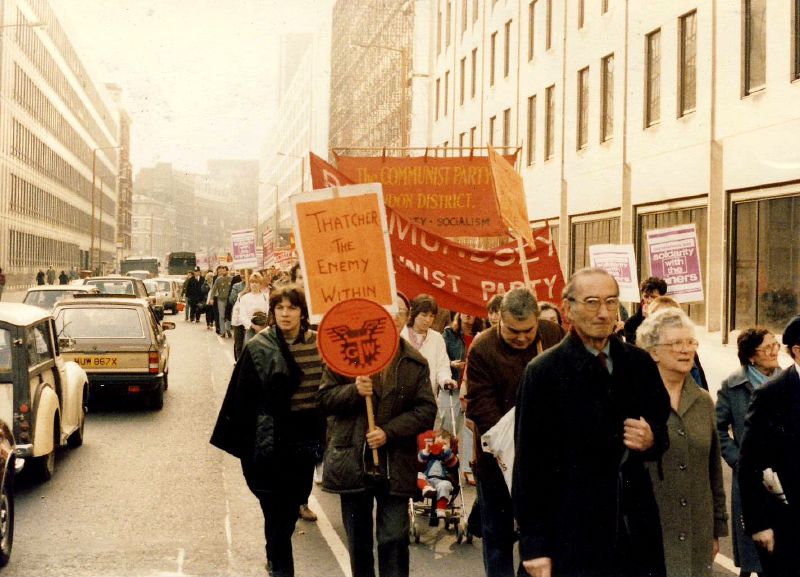
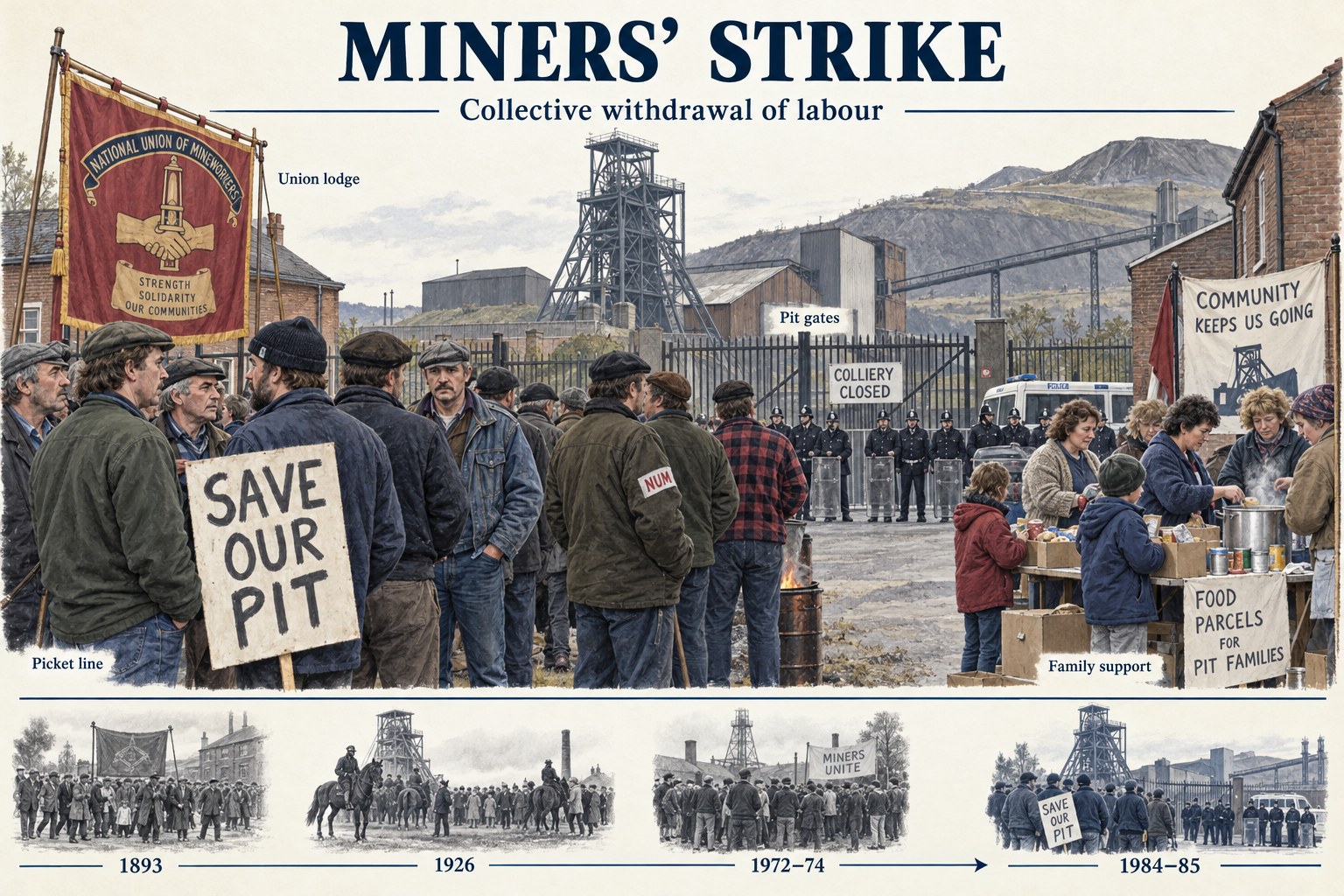
British coalfields saw four national-scale disputes across the 20th century's opening and closing decades, each reshaping the industry's industrial relations. The 1893 lockout, provoked by coal owners in the Federated District cutting wages by 25% as prices fell, drew in around 300,000 miners across Yorkshire, Lancashire, Staffordshire and the Midlands; troops sent to protect coal stocks and safeguard non-striking labour opened fire on a crowd at Ackton Hall Colliery on 7 September 1893, killing two men — the Featherstone Massacre (see Disasters). The dispute ended with a Board of Conciliation and no immediate wage cut, a partial win for the men. The 1926 General Strike began as national solidarity action in support of miners resisting a wage cut and longer hours, but collapsed after nine days when the TUC called it off; miners fought on alone for a further six months before being forced back on worse terms, and the defeat left a bitterness that shaped coalfield politics for generations — Maerdy Colliery's miners' lodge, radicalised by the dispute, was expelled from the South Wales Miners' Federation and earned the pit the nickname 'Little Moscow'. Shorter, more narrowly-fought national strikes followed in 1972 and 1974, both led by the National Union of Mineworkers (NUM) over pay; the 1974 strike, timed against a national three-day week and a general election called on the question 'Who governs Britain?', ended in a clear union victory and the fall of Edward Heath's government. The best-known dispute, the year-long 1984-85 strike, began on 6 March 1984 when the National Coal Board announced the closure of 20 pits with the loss of 20,000 jobs — a figure NUM leader Arthur Scargill argued, correctly as cabinet papers released in 2014 confirmed, understated a real plan to close some 75 pits. The strike began at Cortonwood Colliery in South Yorkshire, whose men walked out on hearing their own pit was on the closure list, and spread nationally within days without a preceding national ballot — a decision that divided the union itself, since the Nottinghamshire coalfield largely kept working throughout. It became the longest and most bitter industrial dispute in modern British history, marked by mass picketing, violent confrontations with police (most notoriously at Orgreave coking plant) and the eventual return to work, without a settlement, in March 1985. Its defeat broke the NUM's industrial power and accelerated pit closures across the coalfields for the rest of the century.
Why it was used
A strike's purpose was leverage: withdrawing the one thing a colliery workforce controlled — its labour — to force concessions an employer or government would not otherwise grant, most often over pay, hours, safety conditions or, from the 1960s onward, the closure of pits judged uneconomic. A lockout inverted this, an employer withholding work to force a workforce to accept new terms rather than waiting to be asked.
Risks & limitations
A long strike could be as damaging to the workforce as to the employer: miners on strike drew no wages and, in 1984-85, no state strike pay, forcing many families onto hardship funds, food parcels and soup kitchens for a year. A strike could also hasten the very closure it opposed — Ackton Hall Colliery's Barnsley Bed seam caught fire from spontaneous combustion during the idle months of the 1984-85 strike, destroying the pit's economic prospects and making it the first colliery in the country to close once the dispute ended.
Related terminology
Mines associated with this term
5 examples chosen from 34 linked records — the term page is not an index.
- Abercynon Colliery — Rhondda Cynon Taf (well documented example)
Named in this record’s closure notes: “…Windsor/Abercynon colliery closed in 1988, following the 1984–85 miners' strike, leaving an estimated twenty-five years of workable coal untouched.…” - Bedwas Navigation Colliery — Caerphilly (well documented example)
Named in this record’s closure notes: “Vital maintenance was not carried out during the 1984–85 miners' strike, and when the strike ended on 3 March 1985 the NCB declared the pit…” - Cortonwood Colliery — South Yorkshire (well documented example)
The 1984-85 miners' strike began here: Cortonwood's own men walked out on 5 March 1984 on hearing their pit was on the closure list, and the dispute spread nationally from this colliery within days. - Cronton Colliery — Merseyside (well documented example)
Named twice in this record, first in the history: “…closed on 2 March 1984, shortly before the start of the 1984–85 miners' strike.” - Frances Colliery — Fife (well documented example)
Named twice in this record, first in the summary: “…neighbouring Seafield in 1980 — only to close during the 1984-85 miners' strike after underground fires broke out and destroyed its only working…”
Sources
- (secondary) 1893 United Kingdom miners' strike — Wikipedia
- (secondary) 1984-85 United Kingdom miners' strike — Wikipedia
- (secondary) Miners' Strike 1984 to 1985 — People's History Museum
Record created: 29 August 2026 · Last researched: 29 August 2026