 MineArchive
Abercynon Colliery
| Also known as | Dowlais Cardiff Colliery |
|---|---|
| Location | Abercynon, at the junction of the Taff and Cynon valleys, Rhondda Cynon Taf — 51.6409, -3.3280 (exact) |
| Commodity | Coal |
| Type | Coal |
| Worked | July 1896–1988 |
| Maximum depth | 753 yards (about 689 m) at the North (downcast) shaft; the South shaft reached 740 yards (about 677 m). |
| Operators | Dowlais Iron Company (1889–1903), Guest, Keen and Nettlefolds Limited (1903–1931), Welsh Associated Collieries Limited (1931–1936), Powell Duffryn Steam Coal Company (1936–1947), National Coal Board (1947–1988) |
Overview
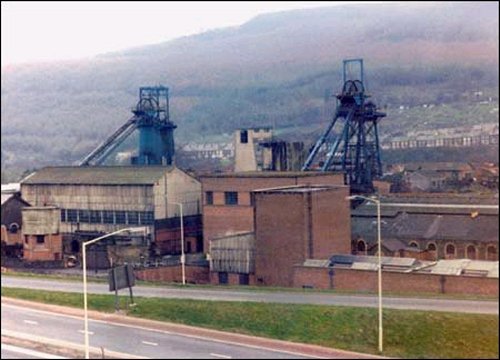
The last colliery sunk in the Cynon Valley, begun in December 1889 by the Dowlais Iron Company at a cost of £270,000 to feed its new steel works at Cardiff, and known at first as the Dowlais Cardiff Colliery. The sinking took nearly seven years and killed eighteen men. It worked for almost a century, its bright blue headgear a landmark on the A470, and closed in 1988 with an estimated twenty-five years of workable coal left underground.
History
The sod was cut on 1 December 1889 and sinking began two days later, at the junction of the Taff and Cynon valleys. The Dowlais Iron Company was spending £270,000 to supply its new Cardiff steel works, and this was the last sinking the Cynon Valley saw. Two shafts went down to the Nine Feet seam — South, the upcast, at 740 yards and North, the downcast, at 753 yards — their winding gear carried on unusually long backstays supported by transitional struts. The first coal came up in July 1896.
Eighteen men died sinking those shafts, eight of them in one accident on 23 January 1893 and six in another on 9 September 1895 (see Disasters, below). Five more were killed in an underground haulage accident on 28 April 1906.
The pit passed to Guest, Keen and Nettlefolds in 1903, when it employed 2,502 men; there were 2,491 in 1918 and 2,794 by 1923, working the Six Feet, Nine Feet and Upper Four Feet seams. Welsh Associated Collieries took control in 1931 and were absorbed into Powell Duffryn in 1936, who held it until nationalisation in 1947, by which time the workforce was down to 1,001. After nationalisation its bright blue headgear became a landmark for travellers on the A470 between Cardiff and Merthyr.
Abercynon was linked underground to the Lady Windsor Colliery and the two thereafter worked as a single unit; through the mid-1970s some 1,150 men produced 303,000 tons a year from the Nine Feet, Seven Feet and Five Feet seams. Following the 1984–85 strike the combined Lady Windsor/Abercynon colliery closed in 1988.
Geology
The colliery worked the South Wales steam coals at the junction of the Taff and Cynon valleys, the shafts sunk through to the Nine Feet seam at around 740 to 753 yards. Over its life it took the Six Feet, Nine Feet and Upper Four Feet seams, and latterly the Nine Feet, Seven Feet and Five Feet — the standard named succession of the coalfield, worked progressively as the better ground was exhausted.
Geological setting: Sedimentary Beds and Seams (well documented example)
Workings
Two shafts, South (upcast) at 740 yards and North (downcast) at 753 yards, both sunk to the Nine Feet seam between 1889 and 1896. Their winding gear was distinctive for very long backstays carried on transitional struts. From the 1970s the colliery was connected underground to Lady Windsor and the two were worked as one unit.
Closure
The combined Lady Windsor/Abercynon colliery closed in 1988, following the 1984–85 miners' strike, leaving an estimated twenty-five years of workable coal untouched. Sources differ on when the two collieries were linked: Welsh Coal Mines gives 1973 at a cost of £450,000, Wikipedia gives 1975.
What remains
The colliery was cleared after closure in 1988 and the site is now Navigation Park, an industrial estate on the west side of the A470. Its memorial, marking the working life of the pit from 1889 to 1988, is recorded in the collections of Amgueddfa Cymru — Museum Wales, and AditNow holds an album of historic photographs of the colliery.
None recorded; a colliery memorial commemorates the site.
Related mines
- Aberaman Colliery — Aberaman's men were transferred here when the National Coal Board closed it on 23 November 1962 with its reserves exhausted.
- Lady Windsor Colliery — The two were worked as a single colliery in their last years and British Coal closed them together in February 1988.
Nearby mines
- Carne Park Colliery — 0.0 miles (0.1 km) NW
- Albion Colliery — 1.1 miles (1.8 km) S
- Lady Windsor Colliery — 1.2 miles (1.9 km) W
- Mynachdy Colliery — 2.0 miles (3.3 km) W
- Penrikyber Colliery — 2.1 miles (3.4 km) NW
Straight-line distance, within 9 miles (15 km). Show on the map.
Disasters & major incidents
-
Abercynon Colliery Sinking Accident, 1893
23 January 1893 · Collapse / Roof Fall · 8 fatalities
Eight sinkers were killed by a fall while the shafts of Abercynon Colliery — then the Dowlais Cardiff Colliery — were being sunk on 23 January 1893. A ninth man, David Jones, died a month later of injuries from the same fall. -
Abercynon Colliery Shaft Accident, 1895
9 September 1895 · Winding / Shaft Accident · 6 fatalities
Six sinkers were killed at Abercynon Colliery on 9 September 1895 when the bowk they were riding struck a projection in the shaft and they were precipitated to the bottom. -
Abercynon Colliery Haulage Accident, 1906
28 April 1906 · Haulage / Transport · 5 fatalities
On the afternoon of Saturday 28 April 1906, about fifteen minutes before the end of the shift, a journey of twenty-four full trams of coal ran away underground at Abercynon Colliery and into the men waiting at the pit bottom to go up. Five were killed and at least six seriously injured. -
Abercynon Colliery roof fall, 1913
10 June 1913 · Collapse / Roof Fall · 2 fatalities
A fall of about twenty-five drams of roof killed two repairers clearing an earlier fall at Abercynon Colliery on 10 June 1913.
What's uncertain
Points where sources disagree or the record could not be settled; both accounts are kept. All open questions in the archive.
- Abercynon was linked to the Lady Windsor Colliery and the two worked as a single unit; Welsh Coal Mines dates the link to 1973 at a cost of £450,000, while Wikipedia gives 1975. (disputed) 1,2
Recorded claims
Individual factual claims, each attached to the source(s) that support it below. Where sources disagree, both are kept.
- The sod was cut on 1 December 1889 and sinking began on 3 December; the Dowlais Iron Company spent £270,000 on the colliery to supply its new Cardiff steel works, and it was the last sinking in the Cynon Valley. 1,2
- Two shafts were sunk to the Nine Feet seam — South (upcast) at 740 yards and North (downcast) at 753 yards — their winding gear carried on very long backstays supported by transitional struts. The first coal was raised in July 1896. 1,2
- Eighteen men lost their lives during the sinking, including eight in one accident on 23 January 1893 and six on 9 September 1895. 1,2
- The pit passed to Guest, Keen and Nettlefolds in 1903, to Welsh Associated Collieries in 1931, and with them into Powell Duffryn in 1936, until nationalisation in 1947. 1,2
- 2,502 men were employed in 1903, 2,491 in 1918 and 2,794 by 1923, working the Six Feet, Nine Feet and Upper Four Feet seams; by nationalisation in 1947 the figure was 1,001. 2
- Abercynon was linked to the Lady Windsor Colliery and the two worked as a single unit; Welsh Coal Mines dates the link to 1973 at a cost of £450,000, while Wikipedia gives 1975. (disputed) 1,2
- The combined Lady Windsor/Abercynon colliery closed in 1988 following the 1984–85 strike, leaving an estimated twenty-five years of workable coal untouched. 1
Photographs & further reading
Shaft depths, ownership and workforce year by year, with the names and ages of the men killed sinking the shafts in 1893 and 1895 and in the haulage accident of 1906.
View sourceThe national monuments record entry for the colliery, giving its location, its alternative name and its associated archive material.
View sourceThe colliery's development by the Dowlais Iron Company, its succession of owners and its closure after the 1984–85 strike.
View sourceSources
- (secondary) Abercynon Colliery — Wikipedia
- (secondary) Abercynon Colliery — Welsh Coal Mines
- (primary) Abercynon Colliery; Dowlais Cardiff Colliery (NPRN 33442) — Royal Commission on the Ancient and Historical Monuments of Wales
Record created: 3 September 2026 · Last researched: 3 September 2026