 MineArchive
Penrikyber Colliery
| Also known as | Penrhiwceiber Colliery, Penrhiwceibr Colliery |
|---|---|
| Location | Penrhiwceiber, in the Cynon valley, Rhondda Cynon Taf — 51.6647, -3.3592 (exact) |
| Commodity | Coal |
| Type | Coal |
| Worked | 1872–1985 |
| Maximum depth | 651 yards (the No. 2 shaft); the No. 1 was 585 yards |
| Operators | Penrikyber Navigation Collieries Company (1872–1947), National Coal Board (1947–1985) |
Overview
A Cynon valley colliery whose sinking began in 1872 under a Mr Thomas of Cwmbach for the businessmen who formed the Penrikyber Navigation Collieries Company. Soft sand beds and running water held the work up for six years and cost £130,000 before the first commercial coal came out in 1879, raised on a crude wooden headgear with a single rope. It employed 1,463 men by 1896 and 1,787 by 1908, passed to Cory Brothers, and worked on until 1985, closing after the year-long strike of 1984-85.
History
Known as Penrikyber, the sinking began in 1872 by a Mr Thomas of Cwmbach on behalf of a group of businessmen who formed the Penrikyber Navigation Collieries Company. The work was repeatedly held up by soft sand beds and running water, and it was 1879 before the first commercial coal came out of the pit — raised, at first, by a crude wooden headgear with a single rope, later replaced by steel. The two shafts, Nos. 1 and 2, were 585 and 651 yards deep.
By 1890 the colliery was in the hands of the Penrikyber Navigation Coal Company Ltd, part of Cory Brothers. The Inspector of Mines list for 1896 gives 1,463 men employed; by 1908 the workforce had grown to 1,787.
In 1909 the colliery had a narrow escape. Over four days at the end of October and beginning of November there were two disasters and one near-disaster in the South Wales coalfield: the Darran explosion of Friday 29 October killed 24 men and five of the rescuers, and five died in the Tarenni flooding on Monday 1 November. In between, early on the Saturday morning of 30 October, with between 250 and 300 men underground on the night shift, a fire broke out at the bottom of the Penrhiwceiber shaft, caused by an electric motor overheating. It was discovered by a pit lad.
Geology
The South Wales coalfield in the Cynon valley, the colliery sunk roughly in the centre of the coal basin — the sinking itself troubled by soft sand beds and running water in the upper measures.
Workings
Two shafts, No. 1 at 585 yards and No. 2 at 651 yards. The first coal was raised on a crude wooden headgear with a single rope, later replaced with steel.
Closure
The colliery closed in 1985, after the year-long dispute of March 1984 to March 1985. Sources give different dates within that year for the closure itself, and this record does not pick between them.
What remains
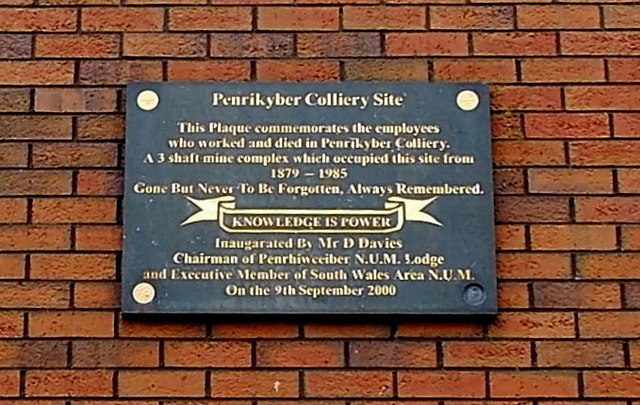
The colliery site is now open ground with playing fields and a sports pavilion, and a plaque marks where the pit stood.
A commemorative plaque on the colliery site; no colliery structure is known to survive.
Nearby mines
- Cwm Cynon Colliery — 0.8 miles (1.3 km) NW
- Glyngwyn Colliery — 1.1 miles (1.9 km) NW
- Nixon's Navigation Colliery — 1.4 miles (2.2 km) NW
- Mynachdy Colliery — 1.6 miles (2.7 km) SW
- Lady Windsor Colliery — 1.7 miles (2.8 km) S
Straight-line distance, within 9 miles (15 km). Show on the map.
Recorded claims
Individual factual claims, each attached to the source(s) that support it below. Where sources disagree, both are kept.
- The sinking began in 1872 by a Mr Thomas of Cwmbach on behalf of a group of businessmen who formed the Penrikyber Navigation Collieries Company. Despite many problems caused by frequent encounters with soft sand beds and running water, the first commercial coal was coming out of the pit by 1879. 1
- The first coal was raised by a crude wooden headgear with a single rope, later replaced by steel. 1
- The two shafts, Nos. 1 and 2, were 585 and 651 yards deep respectively. 1
- By 1890 the colliery was in the hands of the Penrikyber Navigation Coal Company Ltd, part of Cory Brothers. The Inspector of Mines list for 1896 records 1,463 men employed, and by 1908 the workforce had grown to 1,787. 1
- Early on the morning of Saturday 30 October 1909, with between 250 and 300 men underground on the night shift, a fire broke out at the bottom of the shaft, caused by an electric motor overheating; it was discovered by a pit lad. It fell between two disasters elsewhere in the coalfield that week — the Darran explosion of 29 October, which killed 24 men and five rescuers, and the Tarenni flooding of 1 November, which killed five. 1
Photographs & further reading
The colliery record: the troubled sinking from 1872, the shaft depths, the succession of owners to Cory Brothers, the workforce figures and the 1909 shaft fire.
View sourceSources
- (secondary) Penrhiwceiber Colliery — Welsh Coal Mines
- (primary) Penrhiwceiber Colliery (Coflein site 80475) — Coflein, Royal Commission on the Ancient and Historical Monuments of Wales
Record created: 8 September 2026 · Last researched: 8 September 2026