 MineArchive
Coal
| Category | Commodities |
|---|---|
| Commodity page | Coal → |
A combustible sedimentary rock formed from ancient compressed plant matter, worked underground or by opencast methods and burned as fuel — Britain's dominant industrial fuel from the 18th century until well into the 20th.
Historical usage
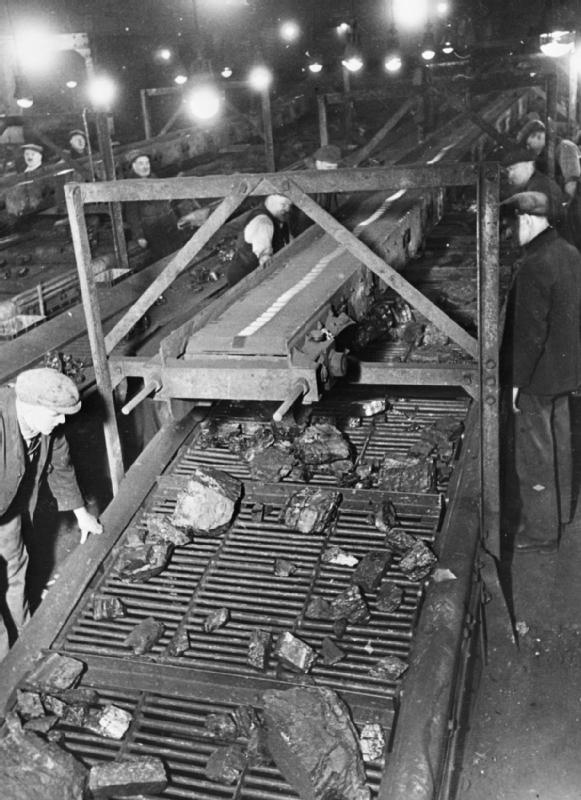
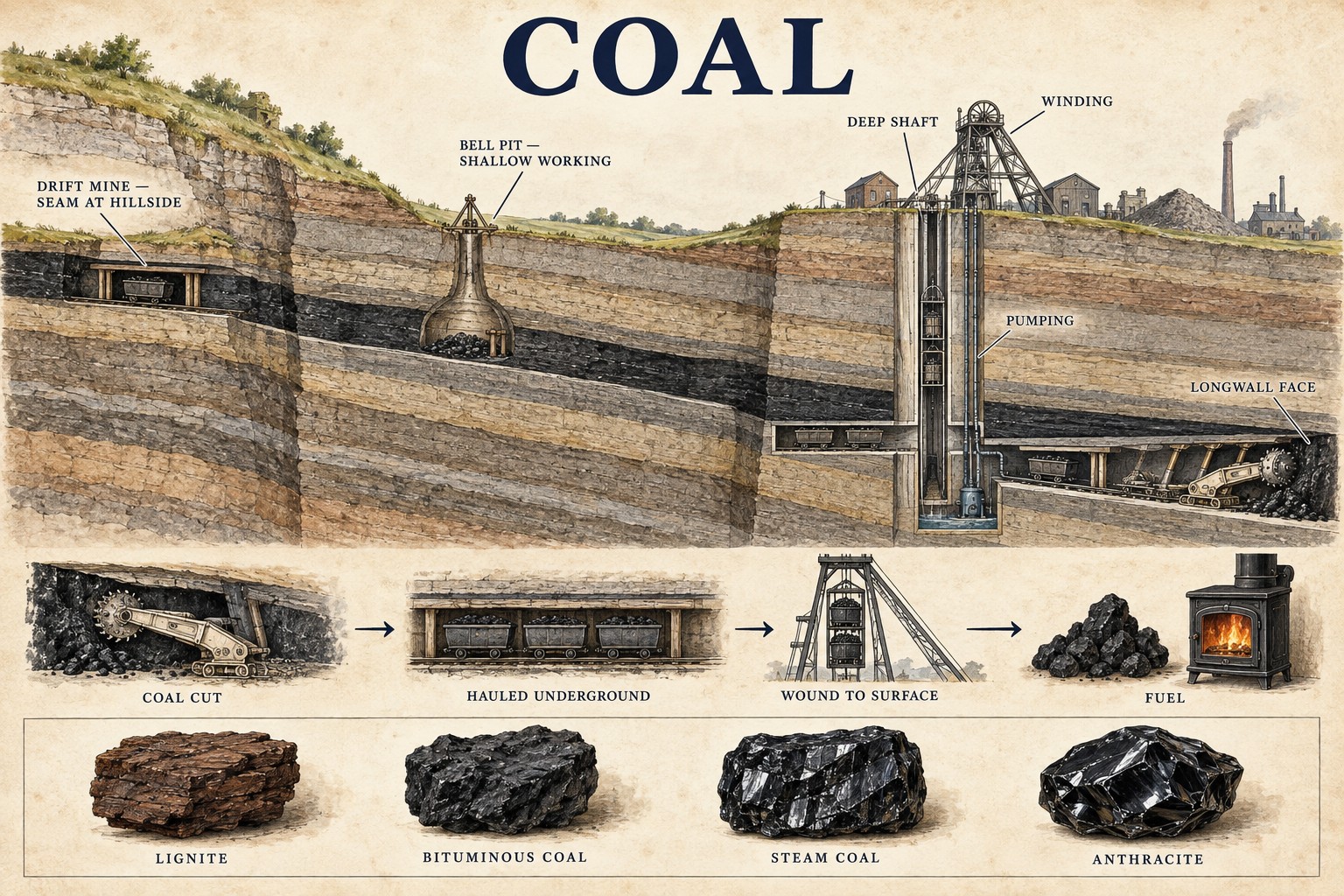
Coal has been dug in Britain in a small way since Roman times, but deep, industrial-scale mining developed through the 18th and 19th centuries alongside the steam engine it made possible — Thomas Savery's 1698 steam pump and Thomas Newcomen's 1712 engine were both built specifically to drain flooding coal mines, letting shafts go far deeper than earlier drift mines and bell pits ever could. By 1700 Britain already produced around 80% of Europe's coal, and coal went on to fuel the steam engines that powered the wider Industrial Revolution — in factories, in transport and, later, in electricity generation.
How it worked
Early coal was worked from shallow drift mines and bell pits — a single shaft with coal dug outward from its base — before deep shaft mining, made possible by steam-powered pumping and winding, took over through the 19th and 20th centuries; underground, coal was cut from a seam using room-and-pillar working (with pillars of coal left to support the roof) or, later, mechanised longwall faces.
Why it was used
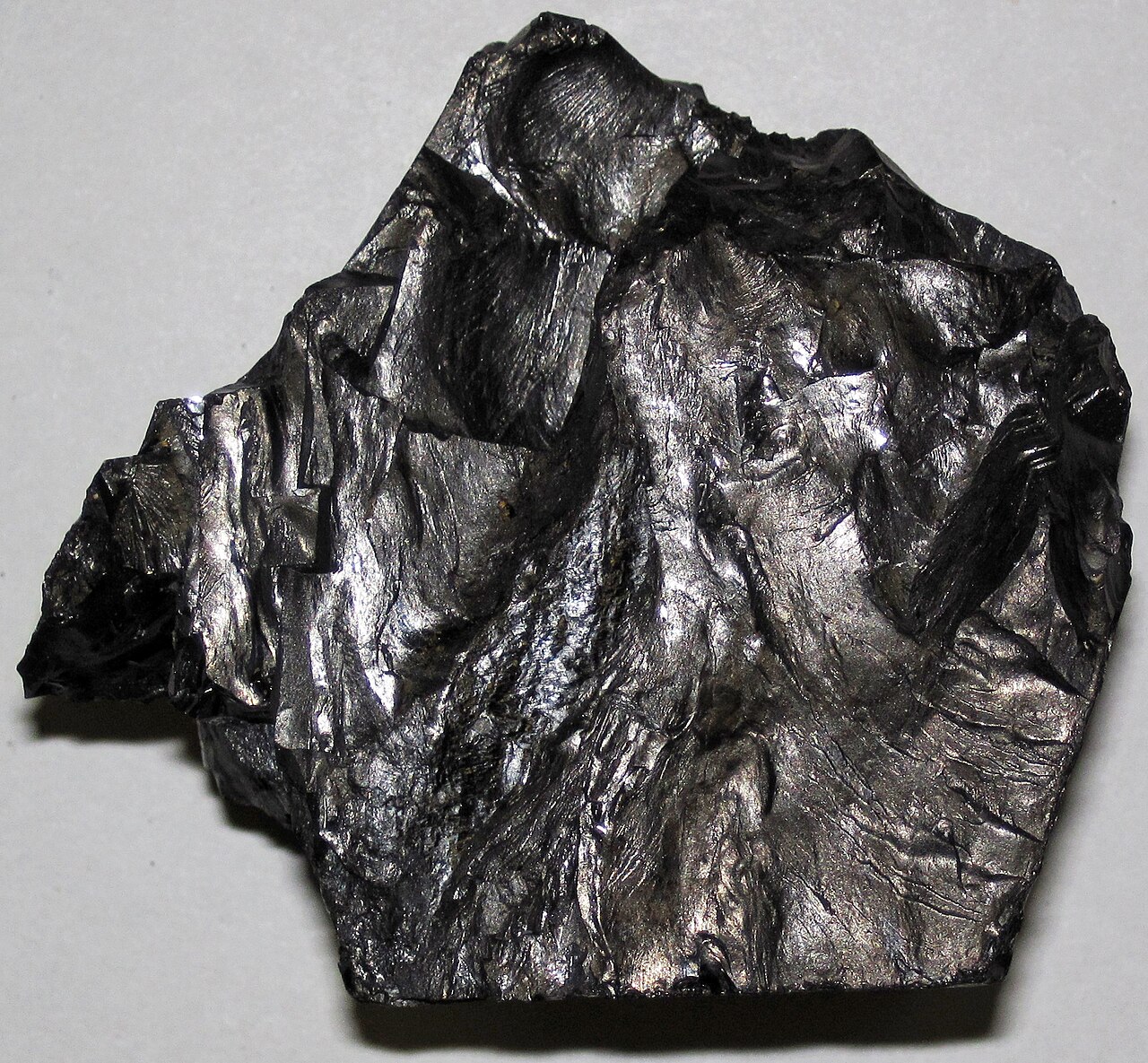
Coal's abundance in Britain and its high, reliable energy content made it the obvious fuel to power steam engines, blast furnaces and, eventually, power stations at a scale no other contemporary fuel could match, making it the literal engine of British industrialisation. Not all coal is the same, either, and this site's own coal mines show the range: coal is ranked by how far natural heat and pressure have converted the original plant matter, running from peat through lignite (brown coal, the lowest rank, high in moisture) to sub-bituminous, then bituminous coal (the general-purpose grade that powered most of Britain's industry, worked at mines like Kellingley) and finally anthracite, the highest rank — hard, glossy black, 86-97% carbon, and the cleanest-burning of all coal grades. Hook Colliery in Pembrokeshire, on this site, specifically worked anthracite, prized for burning almost smokeless — reputedly favoured for that reason in royal palaces — where a bituminous-coal colliery like Kellingley or Lewis Merthyr worked ordinary steam and household coal instead. "Steam coal", a grade between bituminous and anthracite once burned specifically to raise steam in locomotives and ships, sits in between.
Value over time
The British coal industry's value collapsed from a scale almost impossible to picture today: nationalised in 1947 with 720,000 miners employed, the workforce had fallen to 230,000 by 1980 even before the political battles of the 1980s. The 1984-85 miners' strike, fought over a government plan to close 20 pits, ended in defeat for the National Union of Mineworkers and cleared the way for the industry's rapid contraction: production fell from around 90 million tonnes in 1990 to roughly 48 million tonnes and just 7,000 jobs by the time of privatisation in 1994-95. Kellingley Colliery's closure in December 2015 — recorded on this site — ended deep coal mining in Britain outright, closing a chapter that had defined the country's industrial economy for two centuries.
Hazards & challenges
Underground coal mining carries some of the most severe hazards of any kind of mining, most of them arising directly from the coal itself: firedamp (methane) released from the coal seam can explode on contact with a flame or spark, and a firedamp explosion can in turn ignite the coal dust that pervades a working mine, causing a much larger secondary explosion — exactly the mechanism recorded in this site's own Lewis Merthyr disaster. Afterdamp, the toxic gas left behind after such an explosion, has killed as many miners as the blast itself in many disasters (see this site's own term page). Long-term, continuous exposure to coal dust causes pneumoconiosis ("black lung"), and miners cutting through sandstone strata to reach a seam were additionally exposed to silicosis-causing silica dust, formally recognised for coal miners from 1928; by 1933-1948 some 17,000 miners in Wales alone had left underground work because of pneumoconiosis or silicosis.
Risks & limitations
Coal is bulky and low-value per tonne relative to metal ores, so its economics depend heavily on cheap, high-volume transport to market and on seams thick and consistent enough to work efficiently at scale; as the most accessible seams in a given coalfield were worked out, mining progressively deeper, thinner or more geologically disturbed ground made British coal steadily more expensive to produce relative to newer coalfields abroad and, eventually, to other fuels entirely.
Regional variation
Coal was worked across almost every British coalfield — South Wales, the North East, Yorkshire, the Midlands, Scotland, Kent, and the small, isolated Pembrokeshire coalfield among them — with coal rank varying by field: South Wales in particular produced everything from steam coal to true anthracite, while most English coalfields were predominantly bituminous.
Related terminology
Anthracite, Bell Pit, Coke Oven, Colliery Brickworks, Gale and Gaveller, Ganister, Putter, Spontaneous Combustion, Washery
Mines associated with this term
5 examples chosen from 732 linked records — the term page is not an index.
- Bank Hall Colliery — Lancashire (well documented example)
Named 7 times in this record, first in the summary: “…the mechanised cutter picks kept striking iron pyrites nodules in coal balls and sparking ignitions of firedamp.” - Bickershaw Colliery — Greater Manchester (well documented example)
Named 3 times in this record, first in the history: “…passed to the National Coal Board on the 1947 nationalisation of the coal industry. Bickershaw worked a long sequence of Lancashire coalfield…” - Blaenserchan Colliery — Torfaen (well documented example)
Named 4 times in this record, first in the history: “…The shaft was deepened to 362 yards in 1899 to reach the Steam Coal seams, and a second shaft, around 354-363 yards deep, was sunk in…” - Bullcroft Colliery — South Yorkshire (well documented example)
Named 9 times in this record, first in the summary: “…— and had to be stopped and the ground frozen instead. It reached coal in December 1911, worked for sixty years, and in 1968 was joined…” - Cardowan Colliery — North Lanarkshire (well documented example)
Named 6 times in this record, first in the history: “…No.1 and No.2 shafts began in 1924, reaching the Kilsyth Coking Coal seam at 614 metres by 1928; production of coking coal for Nimmo &…”
See every mine that worked coal →
Disasters associated with this term
5 examples chosen from 147 linked records, most direct relationship first.
- Aberaman Colliery fall of coal, 1862 (contextual relationship)
Named 4 times in this record, first in the summary: “A fall of coal killed two colliers holing in the Nine Feet seam at Aberaman…” - Aberbaiden Colliery Pentre Slant explosion, 1944 (contextual relationship)
Named in this record’s narrative: “…Thomas and Baldwins, followed the Rock Fawr seam of prime coking coal north of Kenfig Hill. On the night shift of 10 November 1944, with…” - Abercynon Colliery Haulage Accident, 1906 (contextual relationship)
Named 3 times in this record, first in the summary: “…before the end of the shift, a journey of twenty-four full trams of coal ran away underground at Abercynon Colliery and into the men waiting…” - Abercynon Colliery Shaft Accident, 1895 (contextual relationship)
Named in this record’s narrative: “…been sinking since December 1889 and were within a year of reaching coal. On 9 September 1895 the bowk struck a projection in the shaft side…” - Abercynon Colliery Sinking Accident, 1893 (contextual relationship)
Named in this record’s narrative: “…been under way since December 1889 and were still some years from coal. On 23 January 1893 a fall in the shaft killed eight of the sinkers…”
Sources
- (primary) Coal mining, silicosis and lung cancer: IIAC position paper 41 — Industrial Injuries Advisory Council (UK Government)
- (primary) What are the different types of coal? — United States Geological Survey
- (secondary) Coal - Anthracite, Bituminous, Lignite — Encyclopaedia Britannica
- (secondary) Coal Mining in the British Industrial Revolution — World History Encyclopedia
- (secondary) Coal | Types of Coal: Peat, Lignite, Bituminous Coal & Anthracite Coal — PMF IAS
- (secondary) King Coal dethroned: the decline and fall of the British coal industry — Oxera
- (secondary) The Deadly Dust – Industrial Disease in the Coalfield — Glamorgan Archives
- (secondary) The Spectacular Decline of the UK Coal Industry — Economics Help
Record created: 20 August 2026 · Last researched: 20 August 2026