 MineArchive
Coke Oven
| Also known as | Beehive Oven (the domed form developed in the Durham coalfield), Beehive Coke Oven (as scheduled by Historic England) |
|---|---|
| Category | Ore Processing |
An oven in which coal was heated with only limited air admitted, to drive off the volatile matter and leave behind lumps of carbon — coke — for ironmaking and other uses that raw coal would not serve.
Historical usage
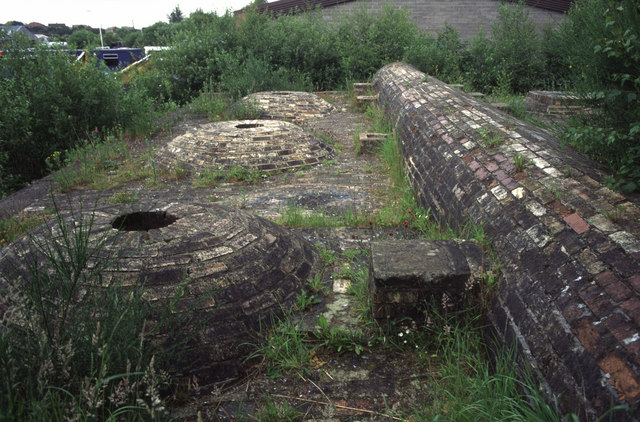
Coking was done at first in open heaps, sometimes on prepared stone bases, but from the middle of the eighteenth century purpose-built ovens were used. By the middle of the nineteenth two main forms had developed, the beehive and the long oven, thought to have been operationally similar and to have differed mainly in shape. The beehive was pioneered in and became characteristic of the North East coalfield. Collieries raising coking coal built their ovens on the pit bank in long banks of many tens: Auckland Park at Bishop Auckland had 430 of them turning the whole of its output into coke for Bolckow, Vaughan & Co.'s own ironworks, and Pease & Partners' ovens at Bank Foot near Crook made the coke that was sold as Pease's West.
How it worked
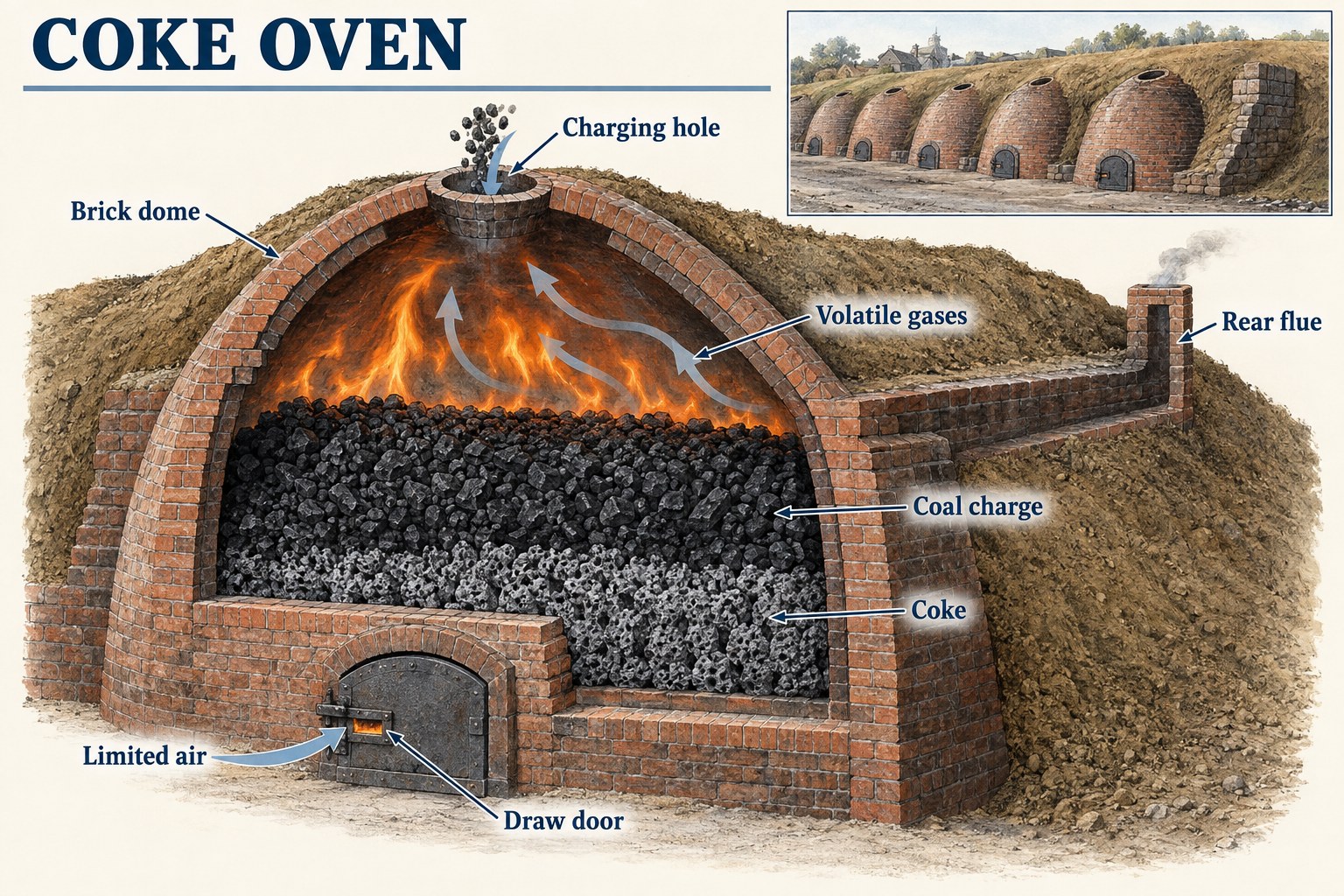
A beehive oven is a brick dome, typically about 3.6 metres across, insulated by a bank of earth heaped over and around it, with a charging hole in the crown and a flue at the back. Coal was dropped in through the top hole, levelled, and fired; the door was bricked up to all but a small opening so that only enough air entered to burn the volatile matter given off, the heat of that combustion carrying the process on. After a day or two the coke was quenched and drawn. Later byproduct ovens recovered what the beehive threw away: at Pease's West the gases from Simon-Carves ovens were worked up into sulphate of ammonia, benzol oil and coal tar, and Greenwell's glossary already notes the flame being led through flues to raise steam under boilers.
Why it was used
Blast furnaces need a fuel that is strong enough to carry the burden and clean enough not to poison the iron, and raw coal is neither. A colliery with good coking coal and an ironworks to supply had every reason to coke on site rather than sell the coal raw, and the ovens became as much a part of the colliery as the winding engine.
Risks & limitations
The beehive oven wasted everything it drove off, and burned part of the charge to do it; byproduct ovens displaced it from the late nineteenth century onward. The ovens were also filthy neighbours — smoke, fumes and the ponds into which the residual products were run, one of which drowned a four-year-old child at Roddymoor in 1901. Most oven banks were demolished when their collieries closed, and intact beehive ovens now survive at only a small number of scheduled sites.
Regional variation
The beehive form was developed in and typical of the Durham coalfield, where the great oven banks stood; long ovens were commoner elsewhere. Both are found under the general name coke oven, and the surviving Durham examples are what Historic England schedules as nationally important survivals of the type.
Related terminology
Coal, Colliery Brickworks, Patent Fuel, Retort
Mines associated with this term
5 examples chosen from 131 linked records — the term page is not an index.
- Grassmoor Colliery — Derbyshire (well documented example)
Named in this record’s summary: “…24,000 tons a week from sixty miles of underground roadway, with coke ovens whose gas was piped to Chesterfield, Shirebrook and Mansfield.…” - Great Western Colliery — Rhondda Cynon Taf (well documented example)
Named twice in this record, first in the history: “…years he was in financial difficulty and sold the colliery and its coke ovens to his largest customer, the Great Western Railway, which bought…” - Sirhowy Ironworks — Blaenau Gwent (well documented example)
Named twice in this record, first in the history: “…by 1869 there were nine blast furnaces on site, served by 300 coke ovens and five blowing engines, alongside four forge trains worked by 80…” - Trimdon Grange Colliery — County Durham (well documented example)
Named in this record’s workings: “…the Pit Narrow Board district on the northern edge of a large goaf. Coke ovens operated on the site until 1962.” - Tynewydd Colliery, Porth — Rhondda Cynon Taf (well documented example)
Named twice in this record, first in the history: “…Porth's fourth mine. It soon struck the No. 3 Rhondda seam, and coke ovens were built at the surface. Welsh Coal Mines records two shafts, each…”
Sources
- (primary) G. C. Greenwell, A Glossary of Terms used in the Coal Trade of Northumberland and Durham (first published 1849; 1888 edition) — G. C. Greenwell, colliery viewer; digitised by the Internet Archive
- (primary) Hedleyhill Colliery coke works, Hedleyhope, County Durham: scheduled monument list entry 1018230 — Historic England, read via ancientmonuments.uk
- (primary) W. S. Gresley, A Glossary of Terms used in Coal Mining (1883) — W. S. Gresley; digitised by the Internet Archive
Record created: 4 September 2026 · Last researched: 4 September 2026