 MineArchive
Retort
| Also known as | Pumpherston Retort (The specific 1894 design that gave the industry its name), Bryson Retort (Alternative name after co-inventor James Bryson) |
|---|---|
| Category | Structures & Machinery |
The sealed vessel at the heart of an oil-shale or gasworks — a chamber in which raw material is heated in the absence of open air so that it breaks down into gas, oil and a residue, rather than simply burning away.
Historical usage
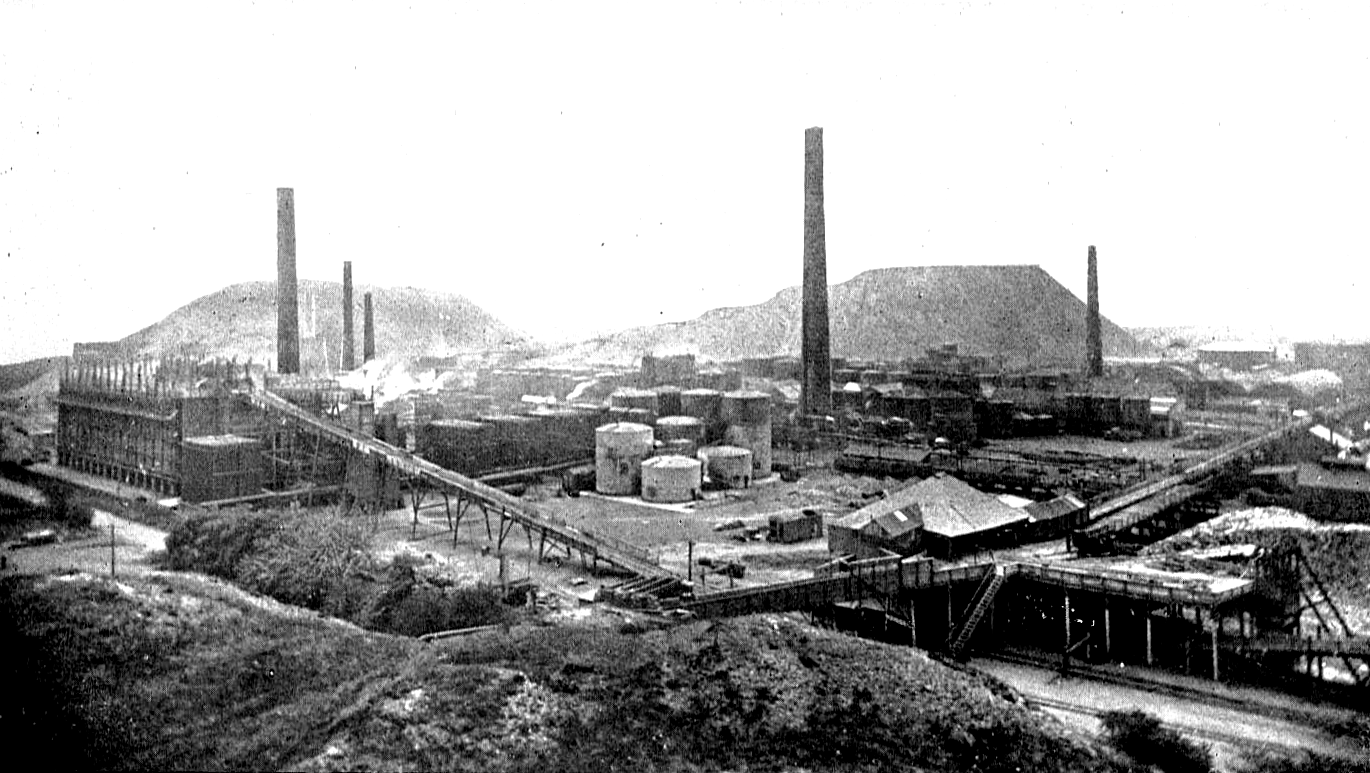
Retorting shale for oil began in Scotland in the 1850s using designs borrowed directly from the coal-gas industry, but a purpose-built shale retort — the Pumpherston, or Bryson, retort — was patented in 1894 by William Fraser, James Bryson and James Jones of the Pumpherston Oil Company, and is generally reckoned to mark the point at which oil-shale retorting became a distinct technology in its own right rather than a borrowed gasworks method. The design spread fast: by 1910 some 1,528 Pumpherston retorts were in use across the Scottish shale fields, and the design was exported and adapted abroad, including a modified 'Fell' version used in Australia.
How it worked
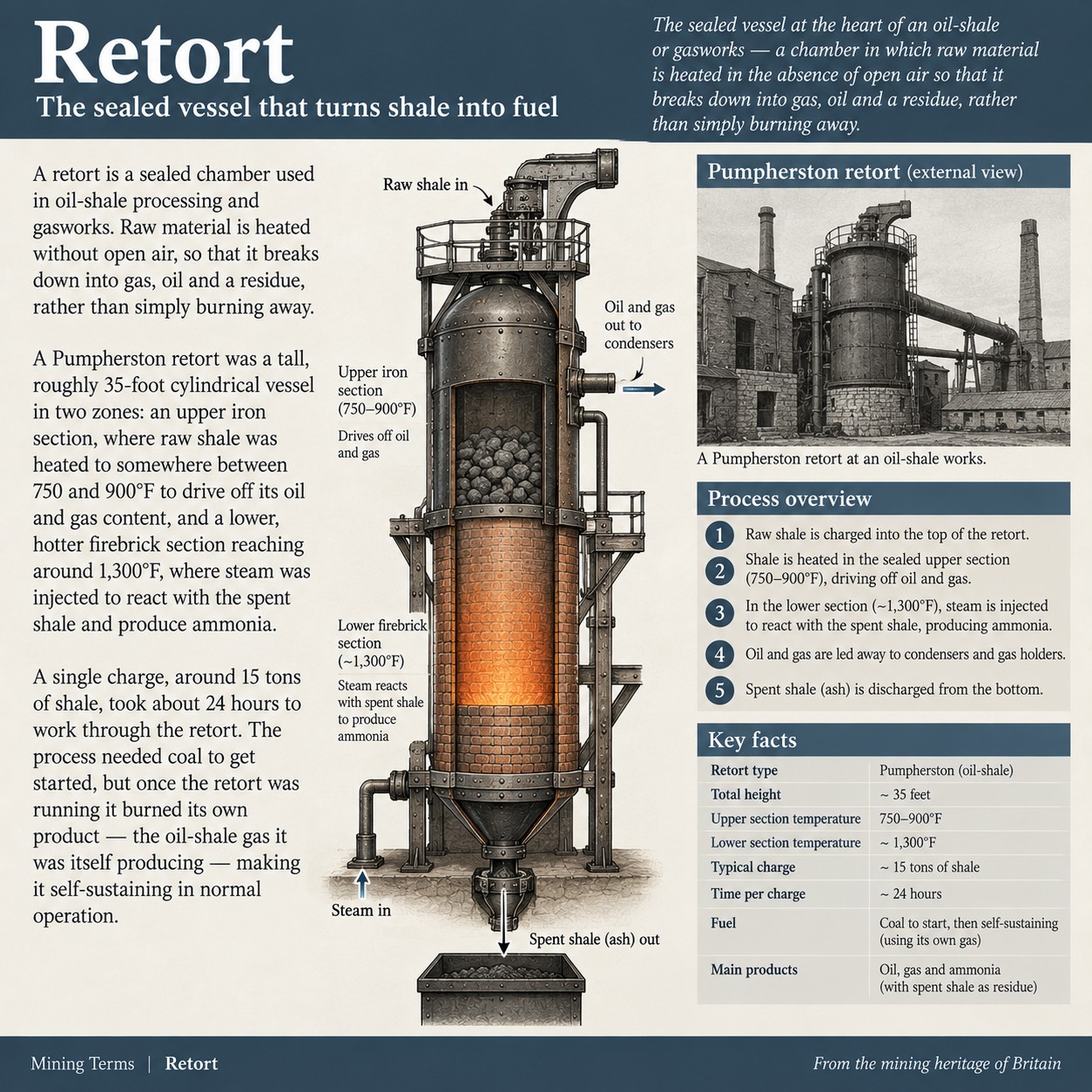
A Pumpherston retort was a tall, roughly 35-foot cylindrical vessel in two zones: an upper iron section, where raw shale was heated to somewhere between 750 and 900°F to drive off its oil and gas content, and a lower, hotter firebrick section reaching around 1,300°F, where steam was injected to react with the spent shale and produce ammonia. A single charge, around 15 tons of shale, took about 24 hours to work through the retort. The process needed coal to get started, but once the retort was running it burned its own product — the oil-shale gas it was itself producing — making it self-sustaining in normal operation.
Why it was used
Retorting let shale oil works and gasworks alike extract valuable products — oil, gas and ammonia for fertiliser — from raw material that could not simply be burned for the same result, since open combustion would have destroyed the oil and gas rather than releasing them intact.
Risks & limitations
Retort design and efficiency directly set how much oil a given tonnage of shale could yield, which is why the shift from borrowed gasworks retorts to the purpose-built Pumpherston design in the 1890s made a real difference to the industry's economics rather than being a merely incremental improvement.
Regional variation
Pumpherston retorts and their descendants were the standard technology across the whole West Lothian shale field; broadly similar retorting principles, under different specific designs, were also used in gasworks producing town gas from coal rather than shale.
Related terminology
Mines associated with this term
5 examples chosen from 11 linked records — the term page is not an index.
- Addiewell Oil Works — West Lothian (well documented example)
Named in this record’s history: “…the candle-making plant, and another in August 1915 damaged retort machinery and wooden platforms badly enough that the works faced…” - Baads Colliery — West Lothian (well documented example)
Named twice in this record, first in the summary: “…near West Calder, driven about 1908 into the Hurlet coal to fire the retorts at Pumpherston and the boilers of the Scottish Oils plants. Two…” - Binnend Oil Works — Fife (well documented example)
Named twice in this record, first in the history: “…22 miles from Cobbinshaw. The works comprised shale mines, retorts, and factories making oil and wax products: burning and lubricating…” - Brettell Lane Colliery — West Midlands (well documented example)
Named twice in this record, first in the summary: “…refractories trade on the strength of its fireclay: firebricks, gas retorts and glass-house pots. The company’s 1888 office and weigh house…” - Kilrenny Oil Works — Fife (well documented example)
Named twice in this record, first in the history: “…at West Pitcorthie was in full operation with about a dozen retorts on the ground. The Kilrenny Oil Works was built close to the mines…”
Disasters associated with this term
Included only where MineArchive's own research gives a reasonable evidential basis, with the nature of the relationship stated — not every disaster where this term might plausibly apply.
- Felling Colliery explosion, 1847 (contextual relationship)
Named in this record’s summary: “…fire had been banked with the damper shut so that it made gas like a retort. The jury found accidental death and asked for the damper to be…”
Sources
- (primary) Pumpherston retort — Wikipedia
- (secondary) History of the oil shale industry — Wikipedia
Record created: 25 August 2026 · Last researched: 25 August 2026