 MineArchive
Addiewell Oil Works
| Location | Addiewell, near West Calder, West Lothian — 55.8450, -3.6140 (approximate) |
|---|---|
| Commodity | Oil Shale |
| Type | Mineral |
| Worked | 1866–c.1921 |
| Operators | Young's Paraffin Light and Mineral Oil Company (1866–1919) |
Overview
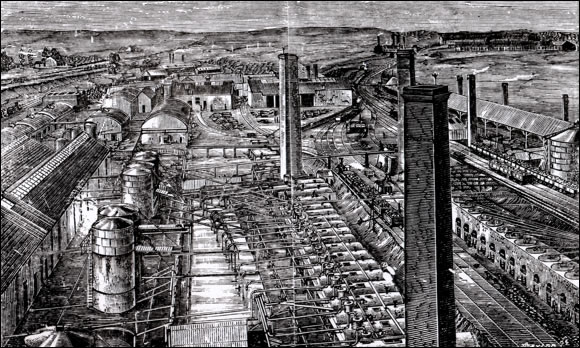
Built in 1866 by James 'Paraffin' Young, Addiewell was for a time the biggest oil works in the world — a 28ha shale-oil refinery and candleworks that anchors West Lothian's claim to be the birthplace of the global shale-oil industry. Its retorts processed local oil shale into paraffin, naphtha and lubricating oils for over half a century before the site was cleared and eventually redeveloped as a prison.
History
James Young, a Glasgow chemist who had already patented a process for distilling oil from coal and from naturally occurring oil shale, set up Young's Paraffin Light and Mineral Oil Company in 1866 and built a new, purpose-designed works at Addiewell, near West Calder, engineered by Alexander Carnegie Kirk. The foundation stone was laid by the explorer David Livingstone. At its opening Addiewell was the largest chemical works of its kind anywhere, covering some 28.3ha and eventually employing around 1,500 workers at a site that combined shale retorting with a full paraffin-candle works. By 1872 the works held 354 retorts capable of treating over 3,000 tons of shale a week; by 1873 it was processing around 134,000 tons of shale a year to yield over 2.28 million gallons of illuminating oil alongside crude paraffin and naphtha. Young himself withdrew from active management soon after the company floated, but the works he built went on to anchor West Lothian's decades-long dominance of the world's first large-scale shale-oil industry — at its regional peak the Lothian shale field was yielding some 3 million tons of shale a year. Young's Paraffin Light and Mineral Oil Co. absorbed the Uphall Oil Company in 1883 and won a gold medal for improvements in shale-derived products in 1885; by 1887, across its three works (Addiewell, Bathgate and Uphall), the combined business was turning out 6.5 million gallons of burning oil, 800,000 gallons of naphtha, 10,000 tons of heavy oil, 6,500 tons of solid paraffin and 3,000 tons of sulphate of ammonia a year. The works suffered two serious fires in this period: one in July 1909 destroyed the Greenhill department and its paraffin storage tanks and threatened the candle-making plant, and another in August 1915 damaged retort machinery and wooden platforms badly enough that the works faced being idled for weeks; no fatalities are recorded from either. The company was absorbed into the new combine Scottish Oils Ltd in 1919, ending its independent existence, and the vertical retorts that had defined the original works were cleared away as operations modernised.
Geology
The works drew its shale from the West Lothian oil-shale field, part of the Lower Carboniferous West Lothian Oil-Shale Formation — a sequence of organic-rich marine and lagoonal mudstones (the workable bands locally named for their appearance and yield, such as 'Dunnet' and 'Curly') laid down in shallow, periodically restricted basins across the Midland Valley of Scotland roughly 330 million years ago. The kerogen-rich shale bands sit within an otherwise ordinary Carboniferous coal-measures sequence, and were worked much as coal was — by shaft and mine — but retorted rather than burned directly, since destructive distillation, not combustion, was what released the oil.
Workings
Addiewell was a surface processing works rather than a single mine: shale was brought in from a cluster of pits and mines worked across the surrounding West Calder district and distilled on site through batteries of retorts, at their peak 354 of them, each charge yielding crude oil, ammoniacal liquor and spent shale. The crude oil was then fractionated on site into burning oil, naphtha, lubricating oils and solid paraffin wax, the latter fed straight into the works' own candle-making plant. Spent shale — already burnt out by the retorting process — was tipped nearby, building the distinctive red shale bings that still dominate the local landscape.
Closure
Addiewell's refinery closed around 1921 once the newly formed Scottish Oils Ltd concentrated refining at its central plant at Pumpherston; the candleworks followed in 1923, though a scaled-down crude oil operation continued on the site until around 1956. The site then stood derelict for three decades before the last works buildings were finally cleared around 1986.
What remains
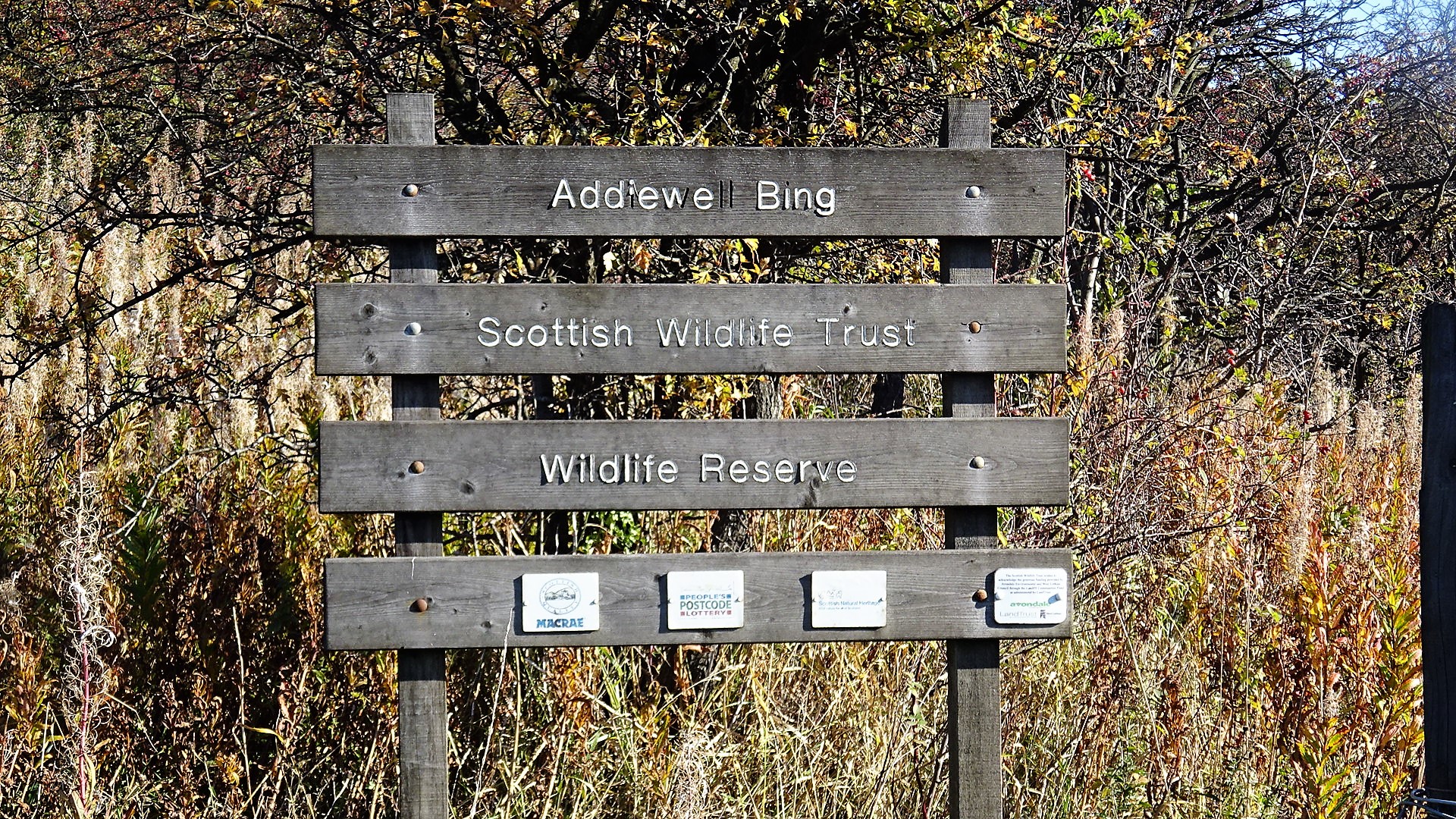
Nothing of the works itself survives above ground. The site was redeveloped as HMP Addiewell, a privately run prison that opened in 2008, together with an adjoining recycling centre. The spent-shale bing raised by the works' retorting process survives immediately alongside as the Addiewell Bing Local Nature Reserve, now colonised by grassland and scrub and managed for wildlife rather than worked.
The red shale bing north of the former works site is the principal visible legacy, walkable via local paths and now a designated nature reserve; nothing of the retort houses, refinery buildings or candleworks remains standing.
Related mines
- Baads Colliery — Baads coal fuelled the Addiewell chemical works and other Scottish Oils plants.
- Burngrange Oil Shale Mine — Burngrange shale went by rail to the Addiewell works to be retorted; the bridge that carried it over the West Calder Burn still stands.
- Foulshiels Colliery — Neighbouring works; the Foulshiels branch railway ran towards Addiewell.
Nearby mines
- Foulshiels Colliery — 1.0 miles (1.6 km) NW
- Loganlea Colliery — 1.0 miles (1.6 km) W
- Baads Colliery — 1.2 miles (1.9 km) SE
- Woodmuir Colliery — 1.6 miles (2.5 km) SW
- Whitrigg Colliery — 1.9 miles (3.1 km) NW
Straight-line distance, within 9 miles (15 km). Show on the map.
Recorded claims
Individual factual claims, each attached to the source(s) that support it below. Where sources disagree, both are kept.
- Young's Paraffin Light and Mineral Oil Co. built Addiewell in 1866, engineered by Alexander Carnegie Kirk with its foundation stone laid by David Livingstone; by 1872 it held 354 retorts processing over 3,000 tons of shale a week, and employed around 1,500 workers at its peak. 1,2
- A July 1909 fire destroyed the Greenhill department and paraffin storage tanks, threatening the candle works; an August 1915 fire damaged retort machinery and wooden platforms badly enough to risk idling the works for weeks. No fatalities are recorded from either fire. 1
- The refinery closed c.1921 once Scottish Oils Ltd centralised refining at Pumpherston; the candleworks closed in 1923; a reduced crude-oil operation continued to c.1956, and the last buildings were cleared c.1986. 1
- The Mining Remediation Authority holds abandonment plans for Addiewell workings (catalogue S2873, S2874, S2875) under West Lothian, confirming the site's status as a formally recorded former mineral working. 3
Sources
- (secondary) Addiewell Chemical Works — Scottish Shale (Almond Valley Heritage Trust)
- (secondary) Young's Paraffin Light and Mineral Oil Co — Grace's Guide to British Industrial History
- (primary) BGS/Mining Remediation Authority mine plans — Addiewell (S2873/S2874/S2875) — British Geological Survey / Mining Remediation Authority
Record created: 26 August 2026 · Last researched: 26 August 2026