 MineArchive
Woodmuir Colliery
| Also known as | The Blinky |
|---|---|
| Location | Breich, West Lothian — 55.8291, -3.6424 (exact) |
| Commodity | Coal |
| Type | Coal |
| Worked | By 1859–1963 |
| Maximum depth | 91 m (No. 6 Pit, upcast); No. 5 Pit 90 m |
| Operators | Woodmuir Coal Company (1896–1902), United Collieries Limited (1902–1947), National Coal Board (1947–1963) |
Overview
The Woodmuir Coal Company's Nos. 5 and 6 Pits, sunk in 1896 some 600 metres east-south-east of Breich in West Lothian and run by United Collieries from 1902 until nationalisation. Known locally as the Blinky, it closed in 1963, and its washery and the shell of its pithead baths still stand.
History
Woodmuir lies about 600 metres east-south-east of the village of Breich, in the parish of West Calder. Pits under the Woodmuir name were at work long before the colliery of 1896: two colliers were suffocated by chokedamp in an old pit there in May 1859 (see Disasters, below), and the Lists of Mines return 96 people there in 1894. The Woodmuir Coal Company sank Nos. 5 and 6 Pits in 1896, a downcast of 90 metres and an upcast of 91 metres, and the colliery was locally called the Blinky, after Blinkbonny, a nearby mining hamlet where some of its miners lived.
United Collieries took the colliery over in 1902. It worked coking, house, manufacturing and steam coals from the China and Smithy seams, the China being abandoned in 1915, and later the Lady Morton and Wilsontown Main. A branch of the Caledonian Railway joined the main Edinburgh to Glasgow line about 800 metres north-east of the pits, and a range of beehive coke ovens stood nearby. Employment ran at 130 to 245 between 1905 and 1940.
In 1948 the National Coal Board's Woodmuir raised 285 tons a day, 73,500 tons a year, by longwall working with 210 employees. It had two screen tables and a Dickson and Mann jig and feldspar washer, a canteen and a first-aid room but no baths, and drew all its electricity from Loganlea Colliery. The workforce peaked at 273, and the colliery closed in 1963, when the Smithy, Jewel, China and Wilsontown Main workings were abandoned.
Geology
West Lothian coalfield: the China, Smithy (Woodmuir Smithy), Lady Morton, Wilsontown Main, Jewel and Woodmuir Splint seams, with the Balbardie Gas and the Curdly Ironstone worked from earlier Woodmuir pits.
Workings
Nos. 5 (downcast, 90 m) and 6 (upcast, 91 m) Pits, longwall worked; a washery and screens; beehive coke ovens nearby; the Woodmuir branch of the Caledonian Railway.
Closure
Closed by the National Coal Board in 1963; the Woodmuir Smithy, Jewel, China and Wilsontown Main seams were abandoned that year.
What remains
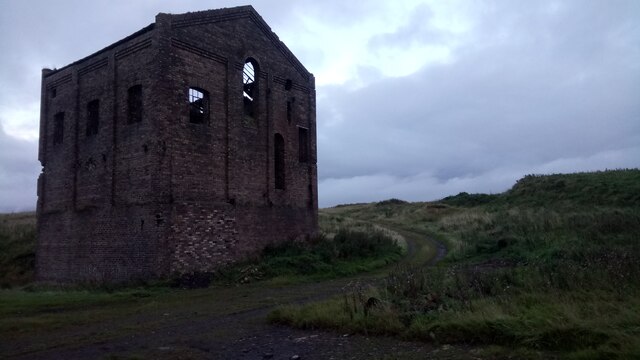
The washery still stands to roof height against a large spoil heap that has been partly removed, beside the shell of the pithead baths, which has lost its roof but keeps its steel frame and some floor and wall tiling. The shafts have been filled, and the site lies among farmland.
Washery building, the shell of the pithead baths, a spoil heap and ruined beehive coke ovens nearby.
Redevelopment
Unknown.
Related mines
- Foulshiels Colliery — Both worked by United Collieries Ltd until nationalisation.
- Loganlea Colliery — Both United Collieries pits; Woodmuir took all its electricity from Loganlea in 1948.
Nearby mines
- Loganlea Colliery — 0.8 miles (1.4 km) N
- Addiewell Oil Works — 1.6 miles (2.5 km) NE
- Foulshiels Colliery — 1.7 miles (2.7 km) N
- Baads Colliery — 1.9 miles (3.0 km) E
- Crofthead Colliery — 1.8 miles (3.0 km) W
Straight-line distance, within 9 miles (15 km). Show on the map.
Disasters & major incidents
-
Woodmuir chokedamp deaths, 1859
18 May 1859 · Gas / Asphyxiation · 2 fatalities
On 18 May 1859 two colliers clearing out an old pit at Woodmuir, near Breich in West Lothian, were overcome by chokedamp and suffocated. Thomas Greenwood and William Thornton died at a working of Thomas Thornton's, decades before the Woodmuir colliery of 1896 was sunk.
Recorded claims
Individual factual claims, each attached to the source(s) that support it below. Where sources disagree, both are kept.
- Nos. 5 and 6 Pits were sunk in 1896 by the Woodmuir Coal Company and taken over by United Collieries in 1902. 1,2,3
- No. 5 Pit was a 90 m downcast and No. 6 a 91 m upcast. 1,4
- The colliery was nicknamed the Blinky, after Blinkbonny, a nearby hamlet that housed some of its miners. 3
- In 1948 Woodmuir produced 285 tons a day, 73,500 tons a year, with 210 employees, and took all its electricity from Loganlea Colliery. 1
- Woodmuir Colliery closed in 1963. 1,2,4,5
- The washery stands to roof height beside the roofless shell of the pithead baths. 1,4
Photographs & further reading
Photographs and a description of the washery and baths as they stood in 2015.
View sourceThe national record of the colliery, its surviving buildings and 1948 details, with aerial photographs.
View sourceThe colliery's dates and its branch of the Caledonian Railway.
View sourceOwners, employment, seams and those killed at the colliery.
View sourceSources
- (secondary) Woodmuir Colliery, Pits Nos. 5 and 6 (NRHE 100387) — Historic Environment Scotland (trove.scot, formerly Canmore)
- (secondary) Woodmuir Colliery — RAILSCOT
- (secondary) Woodmuir Colliery — historybits
- (observational) Report - Woodmuir Colliery, Breich, West Lothian, May 2015 — 28DaysLater
- (primary) BGS mine plan: Woodmuir, Woodmuir Smithy, abandoned 1963 — BGS / Mining Remediation Authority mine plans
- (primary) Woodmuir Colliery — Durham Mining Museum
Record created: 4 October 2026 · Last researched: 4 October 2026