 MineArchive
Crofthead Colliery
| Also known as | Stonehead Colliery, Thornton's Pits, Victoria Pit, Crofthead, North Pole Pit |
|---|---|
| Location | Crofthead and Stonehead, north of Fauldhouse, West Lothian — 55.8367, -3.6881 (approximate) |
| Commodities | Coal, Ironstone |
| Type | Coal |
| Worked | 1840s–1923 |
| Operators | Coltness Iron Company (1845–?), Crofthead Coal Company Limited (1885–?), Peter Thornton (?–1923) |
Overview
The Coltness Iron Company's group of ironstone and coal pits on the Crofthead and Stonehead lands north of Fauldhouse, begun for the Slatyband ironstone in the 1840s and developed for coal by Peter Thornton and the Crofthead Coal Company. Seven numbered pits came and went; No. 3 was abandoned about 1900 and the last two, the Victoria (Nos. 5 and 6) and the North Pole (No. 7) out on Fauldhouse Moor, worked until 1923.
History
Ironstone was found under the moors at Fauldhouse in 1830, and the Coltness and Shotts iron companies built the isolated settlements of Crofthead, Drybridge and Greenburn for their workers. The ground north of the village was first worked for the Crofthead Slatyband ironstone in the 1840s to feed the Coltness furnaces at Newmains; Crofthead No. 1, later called Stonehead, was probably sunk then and was at work on the 1856 map, and the Durham Mining Museum's earliest deaths at the colliery are two men struck by falling stone and chain in 1852. The Wilsontown, Morningside and Coltness Railway opened Crofthead station in 1845 and a mineral branch ran north from it to the pits. Peter Thornton acquired the mineral rights and developed the coal pits; the 1885 list has No. 1 under the Crofthead Coal Company with William Clelland as manager, worked stoop and room by twenty men underground, a non-fiery pit with a 60-foot downcast, a 255-foot upcast and furnace ventilation. The Lists of Mines give 310 employed across the colliery in 1894, 203 in 1896, 218 in 1900 and 211 in 1910, in the Furnace, Main, Ball and Mill coals, and by 1915 only Nos. 5 and 7, raising coal and ironstone, with No. 5 down to 28 hands in 1915 and up to 100 in 1920. No. 3 was abandoned about 1900; No. 7, sunk about then far out on Fauldhouse Moor, was nicknamed the North Pole and joined to the Victoria pit by a long straight tramway. Fourteen deaths are recorded from 1852 to 1912, among them a girl of ten crushed by wagons in 1891, a boy coal picker of fourteen killed at the shaker in 1897 and a washery attendant suffocated in the pearl hopper in 1908. Both remaining pits closed in 1923, and their plant was sold.
Geology
Central coalfield, Fauldhouse: the Crofthead Slatyband ironstone of the 1840s, then the Furnace, Main, Ball, Mill and Lower Drumgray coals returned in the Lists of Mines. The ironstone waste bing at No. 1 is bare and the later coal bing green.
Geological setting: Sedimentary Beds and Seams (historical documentary reference)
Workings
Seven numbered pits: No. 1 (Stonehead, downcast 60 feet, upcast 255 feet, stoop and room, furnace ventilated, 1885), No. 2, No. 3 (abandoned about 1900), Nos. 5 and 6 (the Victoria) and No. 7 (the North Pole, about 1900). Longwall working by 1876. A washery with a pearl hopper and shaker screens by 1897. Employment from the Lists of Mines: 310 in 1894, 218 in 1900, 211 in 1910, 168 at Nos. 5 and 7 in 1915, 225 in 1920 and 1923.
Closure
The Victoria (Nos. 5 and 6) and North Pole (No. 7) pits survived until 1923, when the plant was sold; the reason is not given in the sources read.
What remains
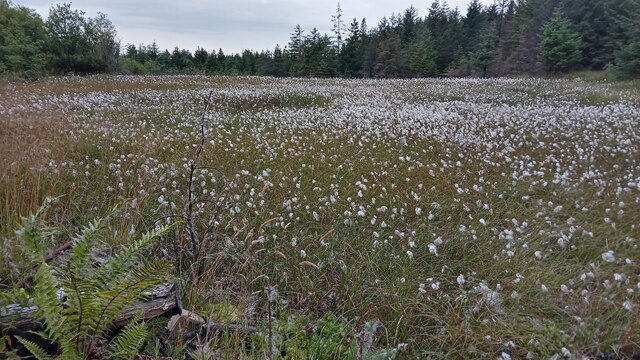
Rough grazing and moor. The No. 1 pithead is marked by a rectangle of scorched grass over the shaft between a bare ironstone bing and a green coal bing; the bings of Nos. 3 and 5 stand in heather; three reservoirs by No. 5 are now a marsh and a pond.
Bings of Nos. 1, 3 and 5, the No. 1 shaft site, the Victoria to North Pole tramway line and the branch railway earthworks.
Related mines
- Fallahill Colliery — Neighbouring Fauldhouse pits; Fallahill was Peter Thornton's other colliery.
- Fauldhouse Colliery — The two company groups of Fauldhouse: Dixon's pits south of the village, Coltness's Crofthead pits to the north.
- Knowes Colliery — Neighbouring Fauldhouse pits.
Nearby mines
- Knowes Colliery — 2.2 km SW
- Fallahill Colliery — 2.5 km W
- Southrigg Colliery — 2.5 km NW
- Fauldhouse Colliery — 2.6 km SW
- Polkemmet Colliery — 2.6 km NW
Straight-line distance, within 15 km. Show on the map.
Recorded claims
Individual factual claims, each attached to the source(s) that support it below. Where sources disagree, both are kept.
- Worked for Slatyband ironstone from the 1840s; the last pits, Nos. 5/6 and 7, survived until 1923. 1,2,3
- Coltness Iron Company, the Crofthead Coal Company and Peter Thornton, who acquired the mineral rights and developed the coal pits. 1,2,3
- Crofthead No. 1 was worked stoop and room by twenty men underground, non-fiery, furnace ventilated, with a 60-foot downcast and 255-foot upcast. 2
- 310 employed in 1894, 218 in 1900, 211 in 1910 and 225 across Nos. 5 and 7 in 1920. 1
- A mineral branch from the Levenseat junction east of Fauldhouse and Crofthead station served the colliery to the north. 4
Photographs & further reading
Pit grid references, owners, seams and employment by pit and year, and fourteen named deaths from 1852 to 1912.
View sourceThe museum's illustrated story of the Crofthead pits and Eastfield brickworks as they survive in the landscape today.
View sourceThe 1885 List of Mines entry for No. 1 and the state of its pithead site.
View sourceSources
- (primary) Crofthead Colliery — Durham Mining Museum — Durham Mining Museum
- (secondary) Crofthead (Stonehead) No.1 pit — Scottish Shale — Scottish Shale (Museum of the Scottish Shale Oil Industry)
- (secondary) A Fauldhouse Landscape — Scottish Shale — Scottish Shale (Museum of the Scottish Shale Oil Industry)
- (secondary) Fauldhouse and Crofthead — RAILSCOT — RAILSCOT
- (secondary) Coltness Iron Co. Ltd — Scottish Shale — Scottish Shale (Museum of the Scottish Shale Oil Industry)
- (secondary) Crofthead railway station — Wikipedia — Wikipedia
Record created: 12 September 2026 · Last researched: 12 September 2026