 MineArchive
Furnace Ventilation
| Also known as | Ventilation furnace, Cold furnace (North East England), Dumb drift (North East England) |
|---|---|
| Category | Ventilation & Mine Gases |
Ventilating a mine by keeping a large coal fire burning at or near the foot of the upcast shaft, so that the heated column of air rising up the shaft draws fresh air down the downcast and through the workings.
Historical usage
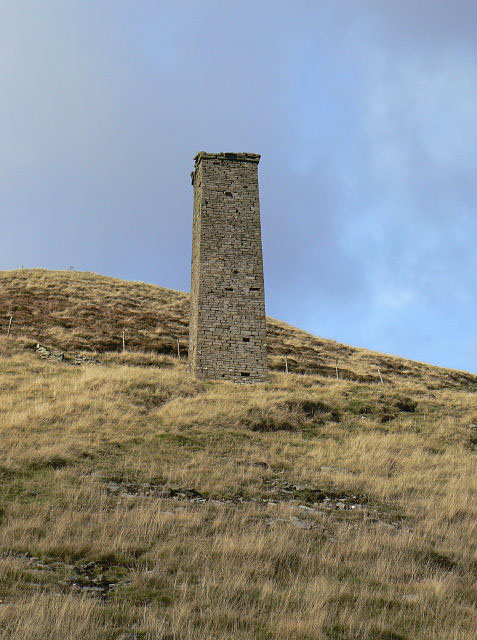
The furnace was the standard means of ventilating a deep colliery from the 18th century until the mechanical fan displaced it in the later 19th. Gresley's 1883 glossary still rated it highly: where shafts were 600 yards deep and over, the power of a furnace was probably greater than that of a fan as then built, and as much as 400,000 cubic feet of air a minute had been passed up a single shaft by furnace ventilation. Small mines used a cruder version, an iron basket of burning coals, the fire-lamp, hung in a shallow shaft to start a draught. The same principle drew air through the levels of lead and coal mines in the hills, where the fire sat at the foot of a flue running up the slope to a chimney: the stone chimney above Danebower Colliery in the Goyt valley, built in the early 19th century for the furnace ventilating one of its shafts, is one of only nine such ventilation chimneys surviving in England.
How it worked
Air heated by the fire is lighter than the air outside, so the upcast shaft acts as a chimney: the warm column rises and the pressure difference pulls fresh air down the downcast shaft and along the roadways to replace it. The deeper the shafts, the taller the column and the stronger the draught. Because return air from the workings might carry firedamp, better-managed pits did not pass it over the fire at all: a dumb drift carried the return round the furnace and into the shaft above it, and the fire drew on fresh air only, a practice known in the north as a cold furnace. A furnaceman, whose sole job was to keep the fire going, tended it day and night.
Why it was used
It needed no machinery beyond a grate and a shaft, cost only coal at a coal mine, and scaled with depth: the deep pits of the north-east and South Wales could move very large volumes of air with a furnace alone. Until reliable fans came in the 1860s and after, there was no practical alternative for a large colliery.
Risks & limitations
Gresley listed the disadvantages: sparks from the fire could ignite an explosive mixture in the upcast and blow up the mine; the heat made the upcast shaft unfit for winding or anything but ventilation; the fires could get low through the furnaceman's neglect; and the heat could set fire to coal or shaft fittings near the furnace, or weaken the tubbing. Furnace ventilation fed several of the great explosions of the coalfields and was displaced by the fan, which moved air without an open fire underground.
Regional variation
A colliery practice of every coalfield, with its own vocabulary in the north-east — dumb drift, cold furnace, furnaceman. In the metal-mining and upland coal districts the furnace stood at the foot of a surface flue and chimney rather than a shaft.
Related terminology
Downcast Shaft and Upcast Shaft, Fan House, Guibal Fan
Mines associated with this term
5 examples chosen from 19 linked records — the term page is not an index.
- Hyde Colliery — Greater Manchester (well documented example)
Named in this record’s workings: “…mines entering the upcast twenty-six yards above the furnace by a dumb drift. A metal brow, a stone drift 209 yards long, left the pit-bottom…” - Bartonholm Colliery — North Ayrshire (well documented example)
Named in this record’s summary: “…1871 firedamp met the naked lamp of a man going down to light the ventilation furnace, and the explosion killed four, or five by one newspaper's count…” - Bwllfa Dare Colliery — Rhondda Cynon Taf (well documented example)
Named in this record’s workings: “…200 yards deep, originally worked with water-balance winding and furnace ventilation; merged operationally with the neighbouring Merthyr Dare pit from…” - Cawdor Colliery — Carmarthenshire (well documented example)
Named in this record’s history: “…was working the Red Vein by pillar and stall with naked lights and furnace ventilation; the mine was abandoned in 1894. In 1896 a new opening, also called…” - Clifton Hall Colliery — Greater Manchester (well documented example)
Named in this record’s history: “…worst disasters in the Lancashire coalfield (see Disasters, below). Furnace ventilation, which the inquiry had criticised, was replaced the following year.…”
Disasters associated with this term
5 examples chosen from 12 linked records, most direct relationship first.
- Abercwmboi Colliery Explosion, 1870 (contextual relationship)
Named in this record’s changes to practice: “None specific to this explosion has been found; the replacement of furnace ventilation by a Waddle fan four years later removed the hazard that caused it.” - Apedale Colliery Explosion, 1878 (contextual relationship)
Named in this record’s changes to practice: “…it took place amid the wider nineteenth-century move away from furnace ventilation and toward mechanical fans in British collieries.” - Bartonholm Colliery explosion, 1871 (contextual relationship)
Named in this record’s summary: “…McQuade went down No. 3 Bartonholm Pit near Irvine to light the ventilation furnace, the 'cube', which he was said to have neglected the day before. He…” - Black Vein Colliery explosion, 1860 (contextual relationship)
Named in this record’s aftermath: “…for the families. The arbitrator ordered a return from mechanical to furnace ventilation.” - Caprington Colliery Inrush (contextual relationship)
Named in this record’s summary: “…ground, five escaped through the new air pit after raking out the ventilation furnace that blocked their way, and one was carried by the flood into the…”
Sources
- (primary) A Glossary of Terms Used in Coal Mining, by William S. Gresley, 1883 — Internet Archive
- (primary) Danebower Colliery ventilation chimney, 750m north east of Holt (List entry 1018820) — Historic England
Record created: 22 September 2026 · Last researched: 22 September 2026