 MineArchive
Bartonholm Colliery
| Location | Bartonholm, between Irvine and Kilwinning, North Ayrshire — 55.6316, -4.6932 (exact) |
|---|---|
| Commodity | Coal |
| Type | Coal |
| Worked | By 1871–1920 |
| Maximum depth | Unknown. |
| Operators | Eglinton Iron Company, William Baird & Company |
Overview
Bartonholm was an Eglinton Iron Company pit on the low ground between Irvine and Kilwinning, worked for the Ell, Main and Turf coals and later held by William Baird and Company. It was standing idle through the 1890s and was being re-sunk in 1900, after which it employed around 110 to 130 people. On 30 October 1871 firedamp met the naked lamp of a man going down to light the ventilation furnace, and the explosion killed four, or five by one newspaper's count (see Disasters, below). The pit was discontinued in 1920, with the neighbouring Bogside kept on as a pumping pit, and worked again briefly into the 1920s. Its bing still stands north of Bogside racecourse.
History
Bartonholm belonged to the Eglinton Iron Company, one of the great Ayrshire iron and coal concerns, and passed with the rest of that business to William Baird and Company. The Lists of Mines show it discontinued in 1894 and 1896, being re-sunk in 1900, and back at work by 1905 with 112 people raising household and manufacturing coal from the Ell, Main and Turf seams. Employment reached 130 in 1910 and 126 in 1923, with a near-shutdown in 1915 when only five people were returned and the Bartonholm No. 1 pit was discontinued. The colliery's worst day was 30 October 1871, when firedamp fired at the naked lamp of a man going down to light the ventilating furnace, killing four (see Disasters, below).
Geology
Bartonholm worked the Ell, Main and Turf coals of the Ayrshire Coalfield on the flat carse ground where the Garnock and the Irvine meet the sea, country wet enough that a neighbouring pit was retained purely for pumping when the colliery itself stopped.
Geological setting: Sedimentary Beds and Seams (well documented example)
Workings
Ventilation in 1871 was by furnace — the 'cube' at the bottom of the upcast shaft, lit daily — and naked lights were still carried underground. The colliery had at least three numbered pits, No. 3 being where the 1871 explosion happened and No. 1 being discontinued by 1915; the neighbouring Bogside pit was kept as a pumping pit from 1920.
Closure
The Lists of Mines record the colliery discontinued in 1920, with Bogside kept on as a pumping pit from 1 May that year, but 126 people were still returned in 1923. The Bartonholm No. 1 pit had already been discontinued by 1915. The closure date is not known.
What remains
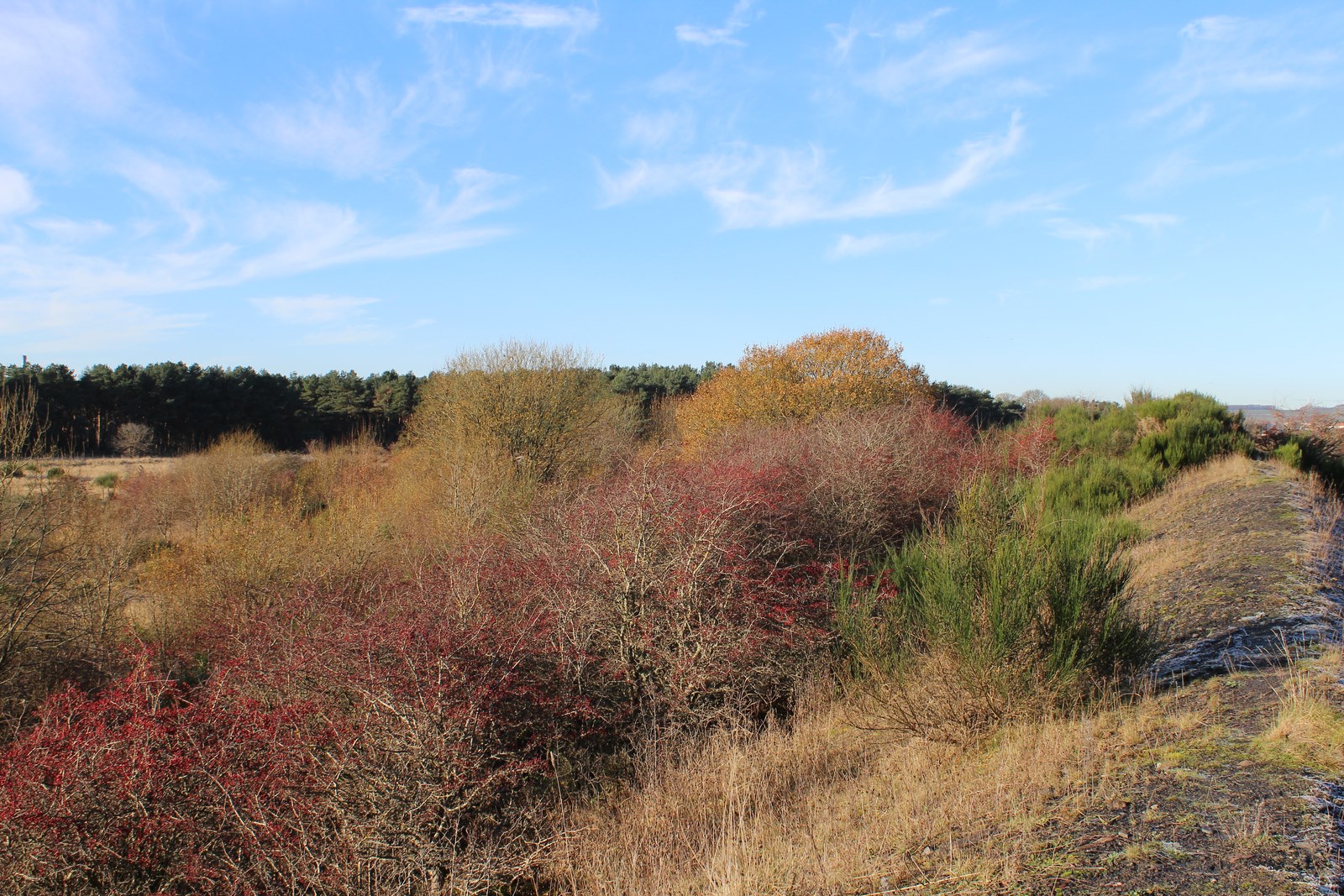
The colliery is gone and its ground is now cycle path, wildlife reserve and a waste and recycling centre that still carries the Bartonholm name. The pit bing survives as a wooded mound north of the disused Bogside racecourse, photographed in 2013.
The pit bing survives as a wooded mound north of the disused Bogside racecourse.
Related mines
- Highhouse Colliery — Two of William Baird and Company's Ayrshire collieries, worked under the same management after Baird absorbed the Eglinton Iron Company's pits.
- Hindsward Colliery — Collieries of the Eglinton Iron Company.
- Kames Colliery — Both were Eglinton Iron Company pits that passed with the rest of that business to William Baird and Company.
Nearby mines
- Ladyha Colliery — 1.2 miles (1.9 km) NE
- Fergushill Colliery — 2.2 miles (3.5 km) NE
- Warrix Colliery — 2.3 miles (3.7 km) SE
- Auchenharvie Colliery — 3.0 miles (4.9 km) W
- Montgomeryfield Colliery — 3.3 miles (5.3 km) SE
Straight-line distance, within 9 miles (15 km). Show on the map.
Disasters & major incidents
-
Bartonholm Colliery explosion, 1871
30 October 1871 · Explosion · 4 fatalities
At about three on Monday morning, 30 October 1871, Thomas McQuade went down No. 3 Bartonholm Pit near Irvine to light the ventilation furnace, the 'cube', which he was said to have neglected the day before. He carried a Davy lamp and a naked one, and twelve miners went with him. At the end of the main roadway a strong blast of firedamp met his open light and exploded. McQuade and the three men behind him were killed; the Hamilton Advertiser counted a fifth.
Recorded claims
Individual factual claims, each attached to the source(s) that support it below. Where sources disagree, both are kept.
- Bartonholm was worked by the Eglinton Iron Company and then by William Baird and Company. 1
- The colliery was discontinued in 1894 and 1896, being re-sunk in 1900, employed 112 people in 1905 and 130 in 1910, and was discontinued again in 1920 with Bogside kept as a pumping pit from 1 May. 1
- The colliery worked the Ell, Main and Turf seams, raising household and manufacturing coal. 1
- The BGS mine-plans catalogue holds a Mining Remediation Authority abandonment plan titled 'Bartonholm' (catalogue 7440, Main, dated 1922). 2
Photographs & further reading
The names and ages of the men killed, with the Scotsman and Hamilton Advertiser reports of the explosion printed in full — including their disagreement over the death toll.
View sourceOwners, output, employment and seams for each Lists of Mines year, showing the pit idle in the 1890s, re-sunk in 1900 and discontinued in 1920.
View sourceSources
- (primary) Durham Mining Museum: Bartonholm Colliery — Durham Mining Museum, from the Lists of Mines
- (primary) BGS / Mining Remediation Authority mine plans: BARTONHOLM — British Geological Survey / Mining Remediation Authority
- (observational) Bartonholm Pit Bing north of Bogside Racecourse (photographed 2013) — Geograph Britain and Ireland, Leslie Barrie
- (primary) Bartonholm, 31 October 1871 — Scottish Mining Website, reproducing the Scotsman of 1 November 1871 and the Hamilton Advertiser of 4 November 1871
Record created: 10 September 2026 · Last researched: 10 September 2026