 MineArchive
Auchenharvie Colliery
| Also known as | Auchenharvie Pit, Stevenston Coalfield, Auchenharvie No. 4 Pit, Stevenston Colliery |
|---|---|
| Location | Stevenston, between Saltcoats and Ardeer, North Ayrshire — 55.6339, -4.7705 (approximate) |
| Commodity | Coal |
| Type | Coal |
| Worked | From 1678–Early 20th century |
| Maximum depth | Nos. 1 and 4 Pits reached the main coal at 75 and 73 fathoms |
| Operators | The Cunninghame family of Auchenharvie (1678–1850), Glengarnock Iron and Steel Company (1880–1915) |
Overview
One of the earliest steam-pumped collieries anywhere: a Newcomen engine was lifting water here in 1719, seven years after the first one was built. It ended in 1895 by drowning nine people, four of them brothers, when a heading was driven through a dyke both landlords' leases forbade anyone to touch.
History
Commercial mining of the Stevenston coalfield began shortly after 1678, when Robert Cunninghame succeeded to the Auchenharvie estate. He developed the pits and built what they needed around them — saltpans and a harbour at Saltcoats to ship coal to Ireland, and a canal to bring it down from the pit-heads. In 1719 an engine house was built to hold a Newcomen atmospheric engine with an 18-inch cylinder, brought up from London to pump the No. 2 pit; it is believed to be the second Newcomen engine in Scotland, put to work only seven years after Newcomen's first at Conygree. John Cuninghame of Windyhall was appointed factor and manager in 1732 and installed a 38-inch engine at the Deep Shank mine, and a Boulton and Watt engine followed in the 1770s, discharging four tons of water a minute. By the end of the 19th century the colliery belonged to the Glengarnock Iron and Steel Company. On 2 August 1895 water burst in from abandoned workings beyond the colliery's eastern boundary and nine people drowned.
Geology
The Ayrshire coalfield reaches the sea at Stevenston, and the ground here is cut by a whin dyke — an intrusion of igneous rock through the coal measures — known as the Capon Craig Gaw. It formed the boundary between Auchenharvie and the abandoned workings of Stevenston Colliery to the east, and both estates' leases forbade their tenants to cut it, precisely because nobody knew what was standing behind it. Water was in fact standing behind it in old stoop and room workings, and the Deep Shank shaft 800 yards beyond had long run water from its mouth.
Geological setting: Dykes and Sills (notable incident), Faults and Fractures (well documented example)
Workings
Nos. 1 and 4 Pits were the only shafts sunk to the main coal, 75 and 73 fathoms deep respectively. Rise workings ran 600 yards north of No. 4 Pit and were reached by two self-acting inclines — locally called cousies — the first at 1 in 6 and the second at 1 in 9; the dook to the dip workings ran 750 yards south of the shaft. Pumping was the colliery's defining problem throughout, which is why it took a Newcomen engine so remarkably early.
Closure
The colliery did not long survive the disaster. Coal Authority abandonment plans for Auchenharvie carry dates of 1875, 1876, 1895, 1900, 1909, 1911 and 1915.
What remains
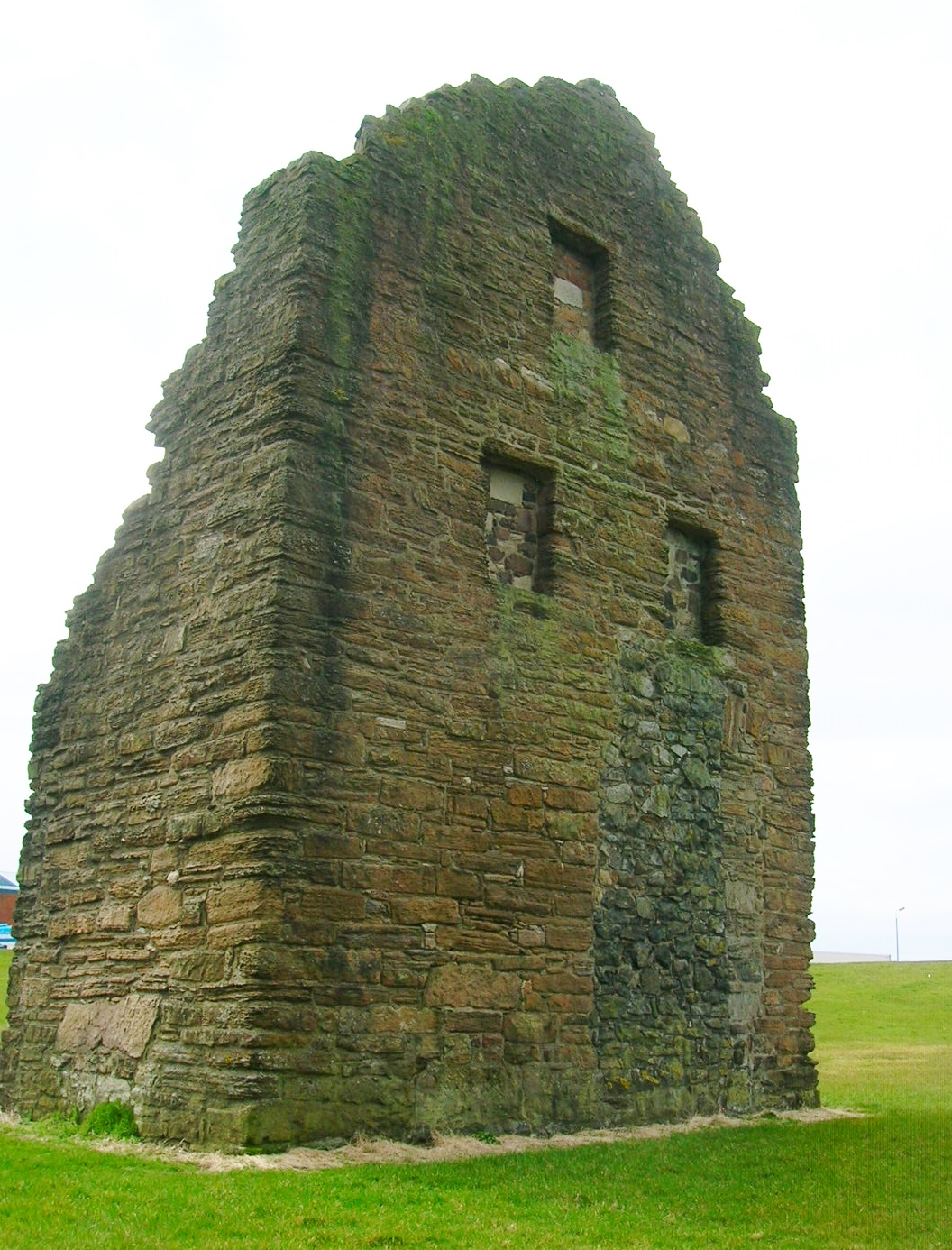
The workings are gone and the ground is a golf course. The 1719 engine house survives as a ruin — most of one wall and the remains of three others — and is the oldest surviving structure of its kind in Scotland.
The ruined Newcomen engine house at Auchenharvie, standing on the golf course, and traces of the Deep Shank pit nearby.
Redevelopment
Golf course and open ground between Stevenston and Saltcoats.
Related mines
- Rankinston Colliery — Owned by the Glengarnock Iron and Steel Company.
Nearby mines
- Bartonholm Colliery — 3.0 miles (4.9 km) E
- Fergushill Colliery — 4.8 miles (7.7 km) E
- Warrix Colliery — 5.0 miles (8.0 km) E
- Doura Colliery — 5.7 miles (9.1 km) NE
Straight-line distance, within 9 miles (15 km). Show on the map.
Disasters & major incidents
-
Auchenharvie Colliery inrush, 1895
2 August 1895 · Flooding / Inundation · 9 fatalities
At about three in the afternoon on 2 August 1895, water burst out of old workings into the rise of Auchenharvie's No. 4 Pit and swept down the inclines to the shaft and on into the dook. Nine people drowned, four of them brothers and two of them children. Five more were entombed behind a blockage and dug out alive two days later.
Recorded claims
Individual factual claims, each attached to the source(s) that support it below. Where sources disagree, both are kept.
- Commercial mining of the Stevenston coalfield began shortly after 1678, when Robert Cunninghame succeeded to the Auchenharvie estate and built saltpans, a harbour at Saltcoats and a canal from the pit-heads. 1
- An engine house was built in 1719 for a Newcomen atmospheric engine with an 18-inch cylinder, brought from London to pump the No. 2 pit; it is believed to be the second Newcomen engine in Scotland. 1
- John Cuninghame of Windyhall was appointed factor and manager in 1732 and installed a 38-inch cylinder engine at the Deep Shank mine; a Boulton and Watt engine followed in the 1770s, discharging four tons of water a minute. 1
- Nos. 1 and 4 Pits were the only shafts sunk to the main coal, 75 and 73 fathoms deep; rise workings ran 600 yards north of No. 4 Pit up two self-acting inclines, and the dook ran 750 yards south. 2
- The colliery was bounded on the east by a whin dyke, the Capon Craig Gaw, separating it from the abandoned workings of Stevenston Colliery; leases on both sides prohibited the tenants from penetrating it. 2
- On 2 August 1895 water burst in from old workings beyond the Capon Craig Gaw, drowning nine people; five more were entombed and rescued after two days. 2
- Coal Authority abandonment plans for Auchenharvie carry dates of 1875, 1876, 1895, 1900, 1909, 1911 and 1915. 3
- The 1719 engine house survives as a ruin — most of one wall and the remains of three others — on what is now a golf course. 1
Photographs & further reading
The old pit whose flooded workings drained into Auchenharvie.
View sourceSources
- (primary) Newcomen Engine House, Auchenharvie — North Ayrshire Heritage
- (primary) Auchenharvie 1895 — Scottish Mining Website — Scottish Mining Website
- (primary) Mine and spoil heap plans S1007-S3242, TS25 and SP1163: Kinneil — British Geological Survey / Mining Remediation Authority mine plans catalogue
Record created: 24 August 2026 · Last researched: 24 August 2026