 MineArchive
Room and Pillar
| Also known as | Pillar-and-Stall (Midlands and South Wales), Pillar and Stall (Midlands and South Wales), Stoop and Room (Scottish), Bord and Pillar (North East England) |
|---|---|
| Category | Mine Workings & Access |
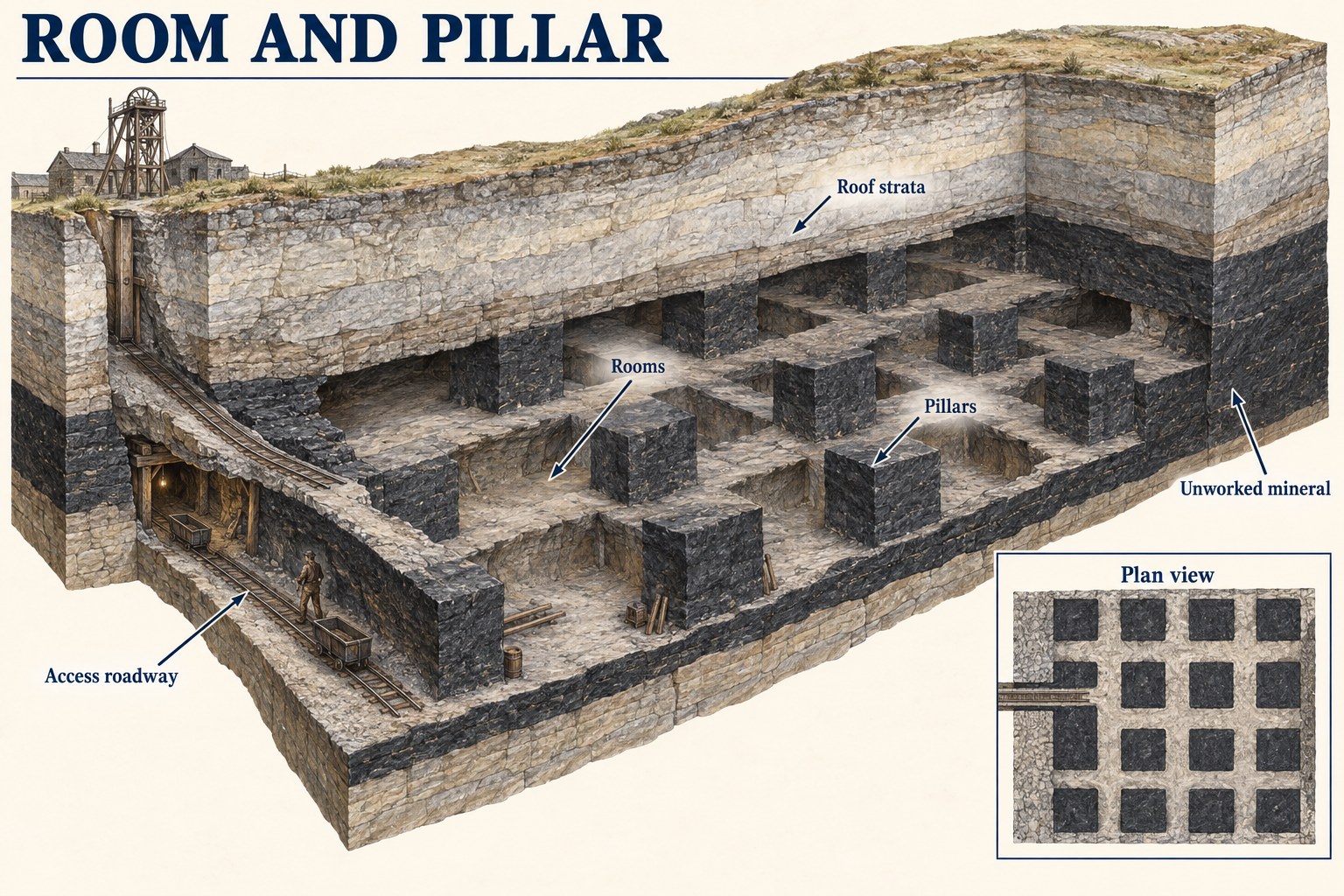
An underground mining method in which the target material is cut away in a grid of open 'rooms', while regularly spaced 'pillars' of unworked rock are deliberately left standing to hold up the roof above — one of the two basic philosophies of underground extraction, alongside total-extraction methods like longwall mining, and the method behind some of the largest man-made underground spaces in Britain.
Historical usage
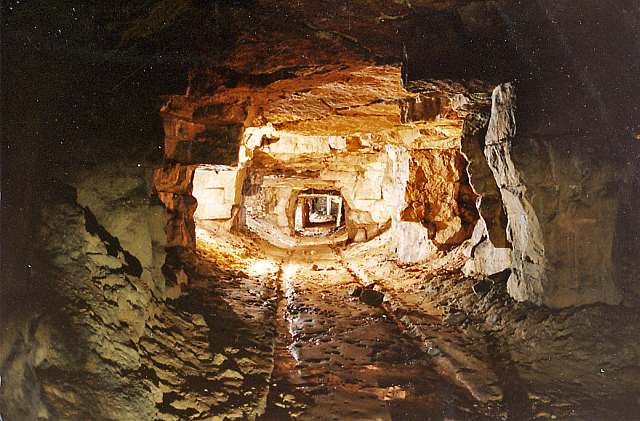
Room-and-pillar working — called 'pillar and stall' or 'bord and pillar' in different British coalfields — has genuinely ancient roots, in use across Europe from at least the 13th century and adopted for British coal mining from its earliest large-scale days in the 18th century. It was never confined to coal: the same basic method was used wherever a mineral deposit was thick and roughly horizontal enough to be worked as a grid of chambers rather than followed as a narrow vein. Cae Coch's pyrites were worked as pillar-and-stall, with pillars 2-3 yards square spaced 8-10 yards apart; Combe Down's Bath stone was cut by hand saw and pick into parallel chambers; and Winsford's rock salt is worked in galleries around 20 metres wide and 7.5 metres high, among the largest room-and-pillar openings anywhere in the country. Mechanisation from the late 1920s, reaching full effect by the late 1940s, sped up the method considerably without changing its basic principle.
How it worked
Working proceeded outward from an access point in a regular grid pattern, cutting away the target material in 'rooms' while leaving 'pillars' of the same material standing at calculated intervals to carry the weight of everything above; the size and spacing of the pillars depended on the strength of the material being worked and the depth and weight of the overlying ground, with weaker rock or deeper workings demanding larger, more closely spaced pillars.
Why it was used
Compared with total-extraction methods, room and pillar left a stable underground void behind it rather than a collapsing one, reducing the risk of surface subsidence, and — because pillars, roadways and rooms could all be worked with fairly simple equipment — it suited both hand-worked 18th- and 19th-century operations and, later, mechanised ones equally well.
Risks & limitations
A method that depends on leaving enough material behind to hold the roof up only works if that discipline is maintained: at Combe Down, 19th-century quarrymen frequently cut pillars back for extra stone once the site's original disciplined operator was no longer overseeing the work, weakening the very supports the whole system depended on. The resulting instability became so severe that a major stabilisation scheme running from 2004 to 2009 had to pump some 600,000 cubic metres of foamed concrete into 25 hectares of the old workings, at a cost of around £150 million, to save the houses built above — the largest single application of foamed concrete ever undertaken in the UK. Retreat mining, deliberately removing pillars themselves as a working is abandoned to recover the last of the material, recovers more of the resource but sharply increases the risk of subsidence, especially in shallow workings.
Regional variation
Used wherever a deposit suited it rather than tied to one region — British coalfields generally called it 'bord and pillar' or 'pillar and stall', while stone and salt workings more often used 'room and pillar' itself, but the terms describe the same basic method under different regional and industry vocabulary.
Related terminology
Bell Pit, Retreat Mining, Stall, Tophole System
Mines associated with this term
5 examples chosen from 83 linked records — the term page is not an index.
- Reigate Caves — Surrey (surviving physical example)
Worked by post-and-stall — the southern English name for the same method — leaving sandstone pillars standing in shallow galleries that can still be walked. - Auchenharvie Colliery — North Ayrshire (well documented example)
The water that drowned nine people in 1895 was standing in old stoop and room workings — the Scottish name for room and pillar, and the reason abandoned ground held so much of it. - Combe Down Stone Mines — Somerset (well documented example)
Bath stone was worked by the room-and-pillar ('pillar and stall') method, cut by hand saw and pick — later instability from pillar-robbing required a £150 million stabilisation scheme. - Eckington Mine — Derbyshire (well documented example)
Named twice in this record, first in the workings: “…than a shaft pit: two drifts driven into the hillside, worked by the pillar and stall method. That method turned out to matter at the end. When the mine…” - Godstone Mine — Surrey (well documented example)
Named twice in this record, first in the history: “…and provided the family a useful income. They were worked on the pillar and stall system, by which up to eighty per cent of the stone could be and was…”
Disasters associated with this term
5 examples chosen from 15 linked records, most direct relationship first.
- Auldhouseburn Colliery inundation, 1898 (relevant method/equipment)
The pit was worked stoop and room, the Scottish name for room and pillar, and the steep rise workings left by it were where the sixteen survivors sheltered. - Auchenharvie Colliery inrush, 1895 (contextual relationship)
Named twice in this record, first in the cause: “An irruption of water from abandoned stoop and room workings on the far side of the Capon Craig Gaw, a whin dyke forming…” - Broadoak Colliery explosion, 1897 (contextual relationship)
Named in this record’s narrative: “…employed 70 to 80 men, working the Five Feet bituminous seam by the pillar and stall method; ventilation was by a 20-foot Waddle fan and the mine was lit…” - Caprington Colliery Inrush (contextual relationship)
Named 3 times in this record, first in the summary: “At 11.45 on the night of 10 December 1909 the roof of abandoned stoop-and-room workings in the Ell coal at Caprington Colliery, near Kilmarnock,…” - Caradog Vale Colliery inundation, 1906 (contextual relationship)
Named in this record’s narrative: “Caradog Vale was a drift worked by pillar and stall with naked lights, owned since about 1905 by South Wales United…”
Sources
- (secondary) Foamed Concrete Mass Infill, Combe Down Mines, Bath, Somerset — Foamed Concrete Ltd
- (secondary) Retreat mining — Wikipedia
- (secondary) Room and pillar mining — Wikipedia
- (secondary) The Stabilisation of Combe Down Stone Mines — Museum of Bath Stone
Record created: 22 August 2026 · Last researched: 22 August 2026