 MineArchive
Reigate Caves
| Also known as | Tunnel Road Caves, Reigate Sand Mines, Barons' Cave |
|---|---|
| Location | Tunnel Road and Castle Grounds, Reigate, Surrey — 51.2381, -0.2029 (approximate) |
| Commodity | Silica Sand |
| Type | Mineral |
| Worked | 18th century–early 20th century |
Overview
Not caves at all, but silver sand mines cut into the soft sandstone under a Surrey town — entered through doorways in the wall of the oldest road tunnel in Britain, and pressed into service in 1940 as air-raid shelters and a wartime control centre.
History
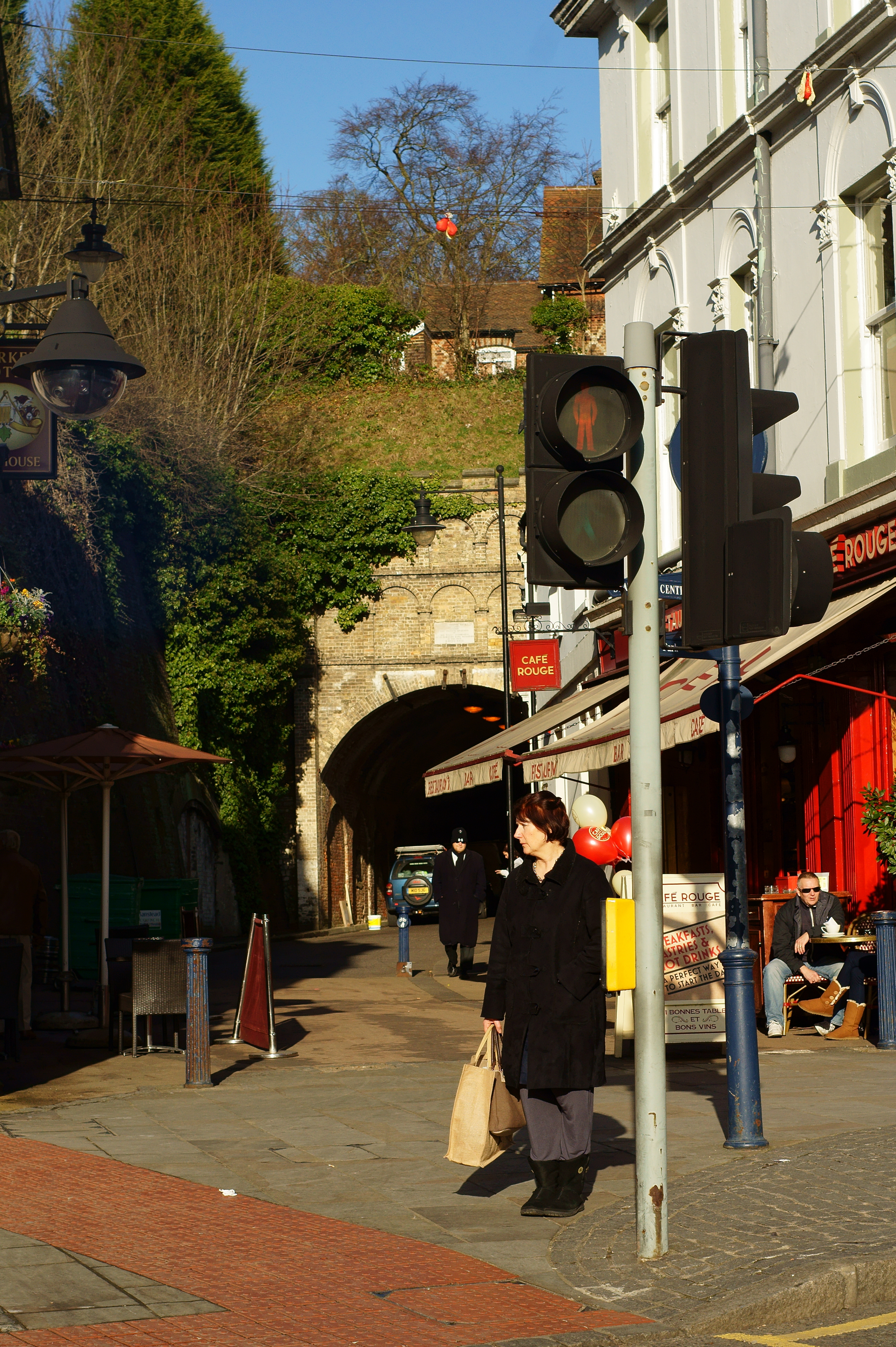
Reigate sits on the Folkestone Beds, and the seams of exceptionally pure silver sand within them have been worked under the town for centuries — part of a wider industry across the Dorking, Reigate and Godstone area that ran from at least the 18th century into the early 20th. The workings under the castle mound may have begun as sand mines before being turned into cellars. The system took its modern shape after 1823, when a road tunnel was driven through the castle mound: at 1823 it is the oldest road tunnel in Britain and among the oldest in Europe, and the mines on either side are entered through doorways cut in its walls. The caverns west of the tunnel were opened as sand mines proper; those on the east were dug for a local hostelry as beer and wine cellars, with the sand taken out sold as a profitable by-product. Both found military use: the East Mine held munitions in the First World War, and in the Second both mines served as public air-raid shelters, the East Mine going on to house the borough's wartime control centre.
Geology
The sand is from the Folkestone Formation of the Lower Greensand — soft enough to be dug with hand tools and to stand in unsupported galleries, and unusually free of iron, which is what made it worth mining rather than simply digging. That purity is what glassmakers wanted, since iron is what turns glass green. Surrey's other underground stone industry worked a different bed entirely: Reigate stone, or firestone, comes from the Upper Greensand along the foot of the North Downs, and was mined by post-and-stall from adits about 4 m wide and 1.5 m high, with grooves worn in the floors where cut blocks were dragged out on sledges.
Geological setting: Sedimentary Beds and Seams (well documented example)
Workings
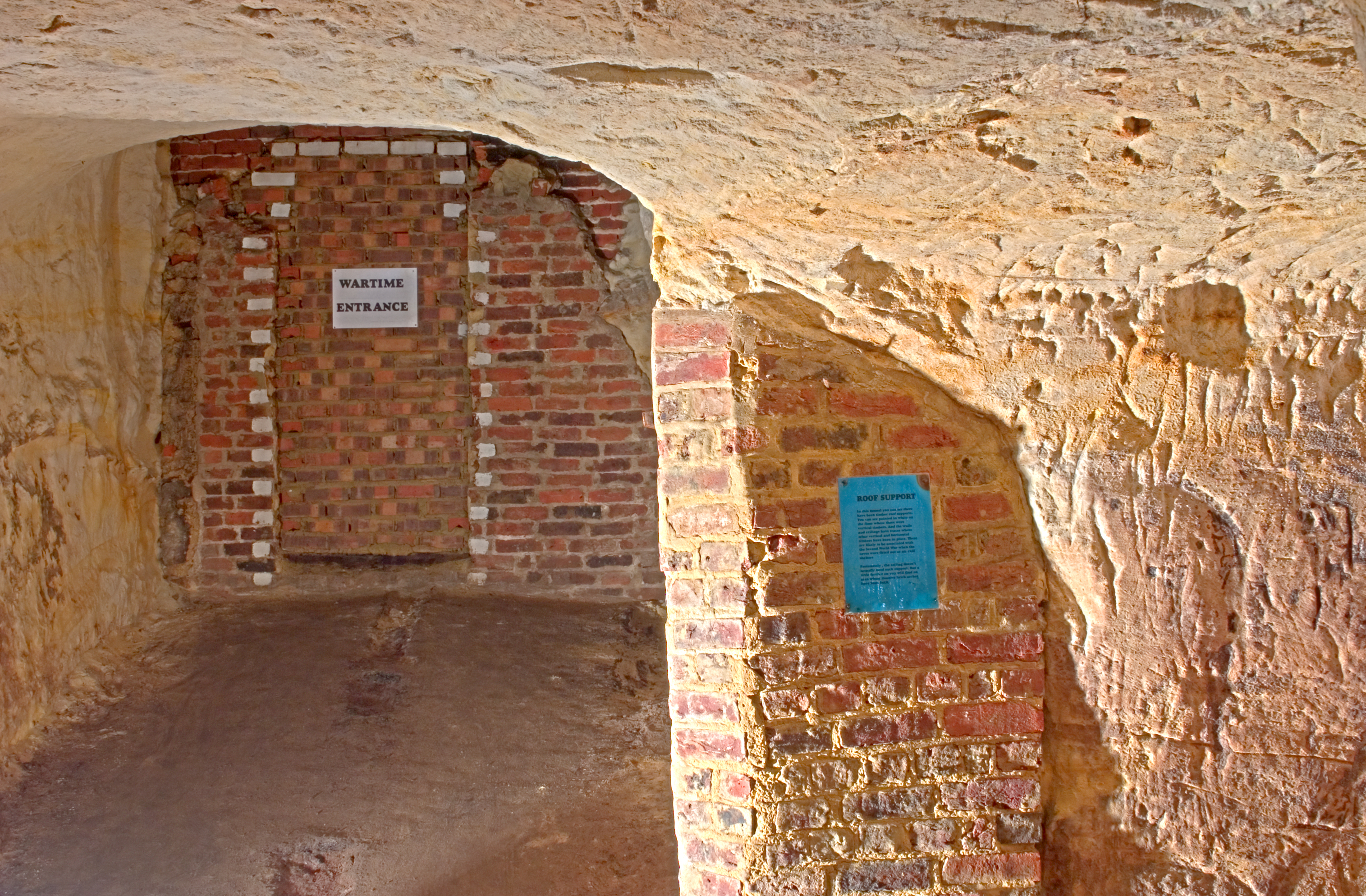
The Tunnel Road workings are shallow galleries cut into the sandstone with pillars left standing, floored in soft sand and reached today by stairs and ramps from the tunnel. Part of the West Mine collapsed during the 19th century. Barons' Cave, under the castle grounds, is a separate and older excavation reached by a steep flight of steps and protected as a Scheduled Ancient Monument.
Closure
Sand mining in the Reigate area had finished by the early 20th century. The related East Surrey stone industry outlasted it: mine plans for the Reigate hearthstone workings record abandonment in 1961, and the last Reigate stone mine closed in the 1960s, the stone having proved vulnerable to frost and to urban pollution — though fresh Reigate stone was quarried again in 2018 for repairs at Westminster Abbey.
What remains
In good order and open on a limited basis. The East Mine is fitted out as a self-guided museum of local and wartime history, with an Anderson shelter among the exhibits; the West Mine is used by a local shooting club and shown on guided tours. The Wealden Cave and Mine Society runs public openings on Saturdays through the summer.
The 1823 tunnel itself, with the mine doorways in its side walls, and the castle mound above.
Redevelopment
None — the site is a heritage attraction rather than a redevelopment, and Barons' Cave's scheduled status means its awkward entrance stair cannot be altered.
Nearby mines
- Nutfield and Redhill Fuller's Earth Mines — 1.8 miles (2.9 km) E
- Merstham Chalk Mines — 3.1 miles (5.0 km) NE
- Brockham Hearthstone Mine — 3.6 miles (5.7 km) W
- Godstone Mine — 6.2 miles (10.0 km) E
- Marden Mine — 6.6 miles (10.6 km) E
Straight-line distance, within 9 miles (15 km). Show on the map.
Recorded claims
Individual factual claims, each attached to the source(s) that support it below. Where sources disagree, both are kept.
- The Reigate Caves are two sets of mined tunnels — the East and West mines — entered through doorways in the walls of the Reigate road tunnel, together with Barons' Cave beneath the castle grounds. 1,2
- The road tunnel was built in 1823 and is the oldest road tunnel in Britain and one of the oldest in Europe. 1
- The workings were cut for silver sand from the Folkestone Beds, used chiefly for glassmaking; the caverns west of the tunnel were opened as sand mines, while those to the east were dug as beer and wine cellars for a local hostelry with the sand sold as a by-product. 1
- High-quality sand deposits in the Dorking, Reigate and Godstone area were mined from at least the 18th century until the early 20th. 3
- The East Mine was used as a munitions store in the First World War; in the Second World War both mines served as air-raid shelters and the East Mine became a wartime control centre. 1
- Part of the West Mine collapsed during the 19th century. 1
- The East Mine is now a self-guided museum including an Anderson shelter and wartime artefacts; the West Mine is used by a local shooting club and shown on guided tours, with public openings run by the Wealden Cave and Mine Society on summer Saturdays. 1,2
- Barons' Cave is a Scheduled Ancient Monument, which is why its steep entrance stair cannot be modified. 2
- Reigate stone, the region's other underground product, is an Upper Greensand freestone mined by post-and-stall from adits about 4 m wide and 1.5 m high, with floor grooves left where blocks were dragged out on sledges; the earliest recorded mine was at Colley Hill near Reigate. 3
- Reigate stone was used in the White Tower, Hampton Court Palace and Canterbury Cathedral, and its use increased after the loss of Normandy in 1204 cut off supplies of Caen stone; the last mine closed in the 1960s, though fresh stone was obtained for Westminster Abbey in 2018. 3
- Mine plans for the Reigate hearthstone workings record abandonment in 1961. 4
Photographs & further reading
The society's survey of the firestone quarries and sand mines of East Surrey more widely.
View sourceSources
- (secondary) Reigate Caves — Subterranea Britannica
- (secondary) Reigate Caves — Wealden Cave & Mine Society — Wealden Cave & Mine Society
- (secondary) Reigate Stone — Wikipedia
- (primary) Mine plans MP23320 and MP23325: Reigate Hearthstone Mine(s) — British Geological Survey / Mining Remediation Authority mine plans catalogue
Record created: 24 August 2026 · Last researched: 24 August 2026