 MineArchive
Brockham Hearthstone Mine
| Also known as | Brockham Lime Works, Old Dorking Lime Works |
|---|---|
| Location | Brockham, near Dorking, Surrey — 51.2457, -0.2845 (approximate) |
| Commodities | Freestone, Hearthstone |
| Type | Mineral |
| Worked | By 1879–February 1925 |
| Maximum depth | Unknown. A drift mine under the chalk. |
| Operators | Brockham Brick Company Ltd (1875–1910), Brockham Lime and Hearthstone Company Ltd (1910–1977), Dorking Greystone Lime Company Ltd |
Overview
A mine under the North Downs at Brockham worked for hearthstone — the soft Upper Greensand stone sold for whitening hearths, floors and window sills. Adits driven into the hillside from the 1870s ran, as one account of the 1890s put it, in all directions and too low for a tall man to stand, with horses in padded headgear hauling out the trolleys. Mining stopped in February 1925; the lime works above it burned on until 1936.
History
Hearthstone had been quarried and mined for centuries along this line of the Downs, at Brockham, Betchworth, Reigate, Gatton and eastwards to Godstone. It had been a building stone first, displaced in the 19th century by brick and harder stones, and from about 1810 a domestic trade grew up in it as a scouring and whitening block for hearths, floors and sills. At Brockham the earliest reference to underground hearthstone working is 1879, by when it was already established in a small way; the mines were entered by adits, with a vertical shaft beside the lime kilns added later, and in 1892 they were described as penetrating for a considerable distance into the hill. They closed about 1898, reopened in 1904 and were worked until final closure in February 1925. The mine belonged to a works that also burned lime and made bricks. A brickfield was here by about 1860 under Batchelor and Fenton while the limeworks was Elsdon, Swain and Day's, both served by a private siding off the South Eastern Railway put in in 1867; in 1875 the Brockham Brick Company Limited was formed to take over the brickworks and, probably, the lime works too. Alfred Bishop became the company's secretary and manager in 1878, reviewed the lime burning, and patented improvements to kiln design — an earlier patent in 1882 and the continuously burning 'Brockham patent' kiln, dated to 1889 by the scheduling and to August 1890 by the village history — to which about a dozen of the existing flare kilns were converted. The brick works closed in 1910 when the company's lease expired and its plant was sold; the chalk quarry, lime works and hearthstone mines passed to the Brockham Lime and Hearthstone Company Limited, later a subsidiary of the Dorking Greystone Lime Company at Betchworth next door. Mining ceased in 1925 and the lime works in 1936.
Geology
The hearthstone worked here is in the Upper Greensand, which lies beneath the Chalk of the North Downs, so that the mine ran in under the chalk quarries and the lime works that used them. Hearthstone is soft enough to cut by hand and was sold for scouring rather than for building; the chalk above it was burnt for lime.
Workings
The mine was entered by adits driven into the hillside, with a brick-lined vertical shaft between the two kiln batteries added later, and the workings were extended beneath the lime works yard, the chalk pits and the spoil tips. An account of hearthstone mining in the 1890s, probably of Brockham, describes an entrance that is just a small hole in the hillside opening into workings that branch in all directions, low enough that a tall man can scarcely stand upright, cold, damp and dark, lit by oil lanterns and candles, the roof liberally propped with timber, and horses — wearing great soft pads on their heads against the roof — pulling out the trolley loads of stone. Output in that account was given as 200 tons a week, though the true figure was probably less than half. Above ground the chalk was dug by hand and run in narrow gauge wagons to two batteries of kilns, east and west, and the lime and coal went out along a steeply graded standard gauge siding worked by a 16 inch by 26 inch steam haulage engine built by Filmer and Mason of Guildford in 1874; much of the haulage in the quarries, mines and brickworks was done by horses.
Closure
Hearthstone mining ceased in February 1925, and the lime works that had outlived the brickworks and the mine closed in 1936. Much of the site was sold to Surrey County Council in 1977.
What remains
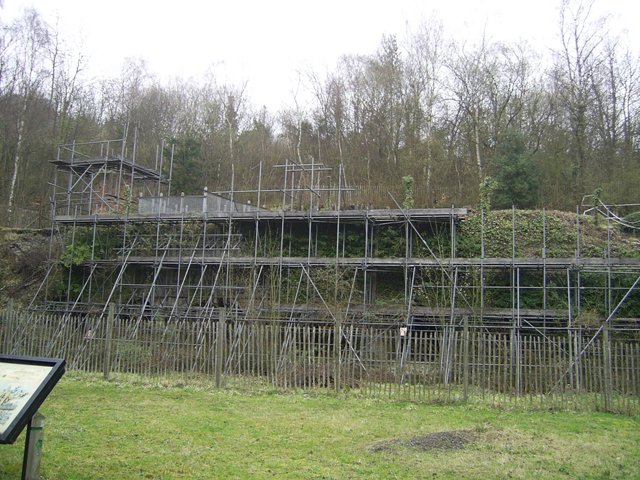
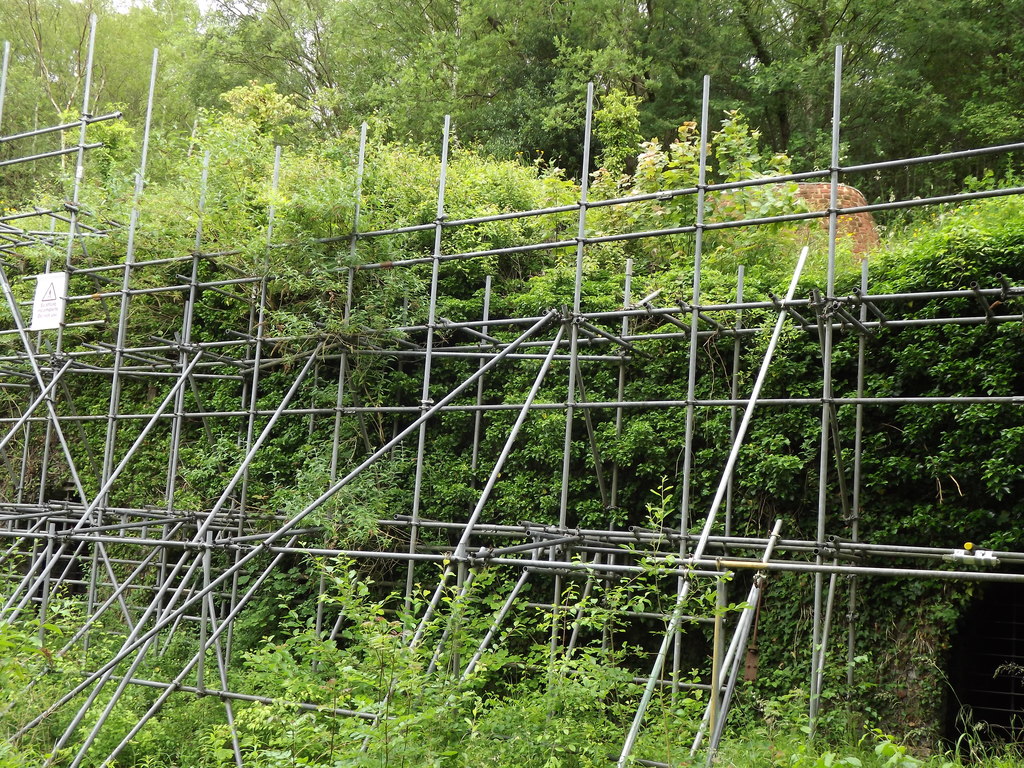
The lime kilns and the shaft to the hearthstone mine are a scheduled monument, the eastern battery of kilns also listed at Grade II, and the site is a 45-hectare nature reserve owned by Surrey County Council within the Mole Gap to Reigate Escarpment SSSI. The kilns have become bat roosts and part of the quarry floor has grown into species-rich chalk grassland with helleborine and several orchids; visitors' accounts describe the kiln batteries as derelict and heavily overgrown, with scaffolding put up to hold them.
The eastern battery of eight kilns — mixed-feed flare kilns and Bishop's patent kilns — and the western battery of two, the platforms and railway beds that fed them, and the brick-lined shaft to the hearthstone mine between them. The brickworks was demolished and its clay pits flooded.
Redevelopment
From 1962 to 1982 the works was home to the Brockham Railway Museum, a collection of narrow gauge locomotives and stock with a short demonstration line; most of the exhibits went to the Amberley museum when it closed, and the site is now a nature reserve.
Nearby mines
- Reigate Caves — 5.7 km E
- Nutfield and Redhill Fuller's Earth Mines — 8.6 km E
- Merstham Chalk Mines — 9.8 km E
Straight-line distance, within 15 km. Show on the map.
What's uncertain
Points where sources disagree or the record could not be settled; both accounts are kept. All open questions in the archive.
- An account of hearthstone mining in the 1890s gives an output of 200 tons a week, though the true figure was probably less than half that. (uncertain) 1
- Alfred Bishop patented the continuously burning 'Brockham patent' lime kiln in 1889, and most of the existing flare kilns were modified to the design. (disputed) 2
- Bishop's patent for the kiln design was taken out in August 1890, following an earlier patent of 1882 for improvements in kiln design. (disputed) 1
Recorded claims
Individual factual claims, each attached to the source(s) that support it below. Where sources disagree, both are kept.
- The earliest reference to hearthstone mining at Brockham is 1879, when underground working of the stone was already established at least in a small way. 1
- The hearthstone mines closed about 1898, reopened in 1904 and were worked until final closure in February 1925; the lime works continued until 1936. 2,1
- The mines were entered by adits, with a vertical shaft by the lime kilns added later, and in 1892 were described as penetrating for a considerable distance into the hill. 1
- An account of hearthstone mining in the 1890s gives an output of 200 tons a week, though the true figure was probably less than half that. (uncertain) 1
- Alfred Bishop patented the continuously burning 'Brockham patent' lime kiln in 1889, and most of the existing flare kilns were modified to the design. (disputed) 2
- Bishop's patent for the kiln design was taken out in August 1890, following an earlier patent of 1882 for improvements in kiln design. (disputed) 1
- The site is a 45-hectare nature reserve owned by Surrey County Council, part of the Mole Gap to Reigate Escarpment SSSI, and the kilns have become bat roosts. 3
Photographs & further reading
A village history of the three trades on the site — hearthstone mining, brick making and lime burning — with the dates, owners, the 1890s description of the mine and details of the haulage horses.
View sourceAn account of the site as it is now: the nature reserve, its designations, the bats in the kilns and the narrow gauge railway museum that occupied the works from 1962 to 1982.
View sourceSources
- (secondary) The Lime Works and Industrial Brockham (Tony Hines and Bob Bartlett) — Brockham History
- (primary) Brockham Lime Works: lime kilns and hearthstone mine, Brockham (List entry 1021322) — Historic England
- (secondary) Brockham Limeworks — Wikipedia
- (observational) Brockham Lime Works — GooseyGoo
Record created: 22 September 2026 · Last researched: 22 September 2026