 MineArchive
Lime Kiln
| Also known as | Limekiln (One-word spelling), Lime works (The larger industrial complex), Draw kiln (The standard continuously-worked form), Hoffmann kiln (The continuous ring-chamber design of the later nineteenth century) |
|---|---|
| Category | Ore Processing |
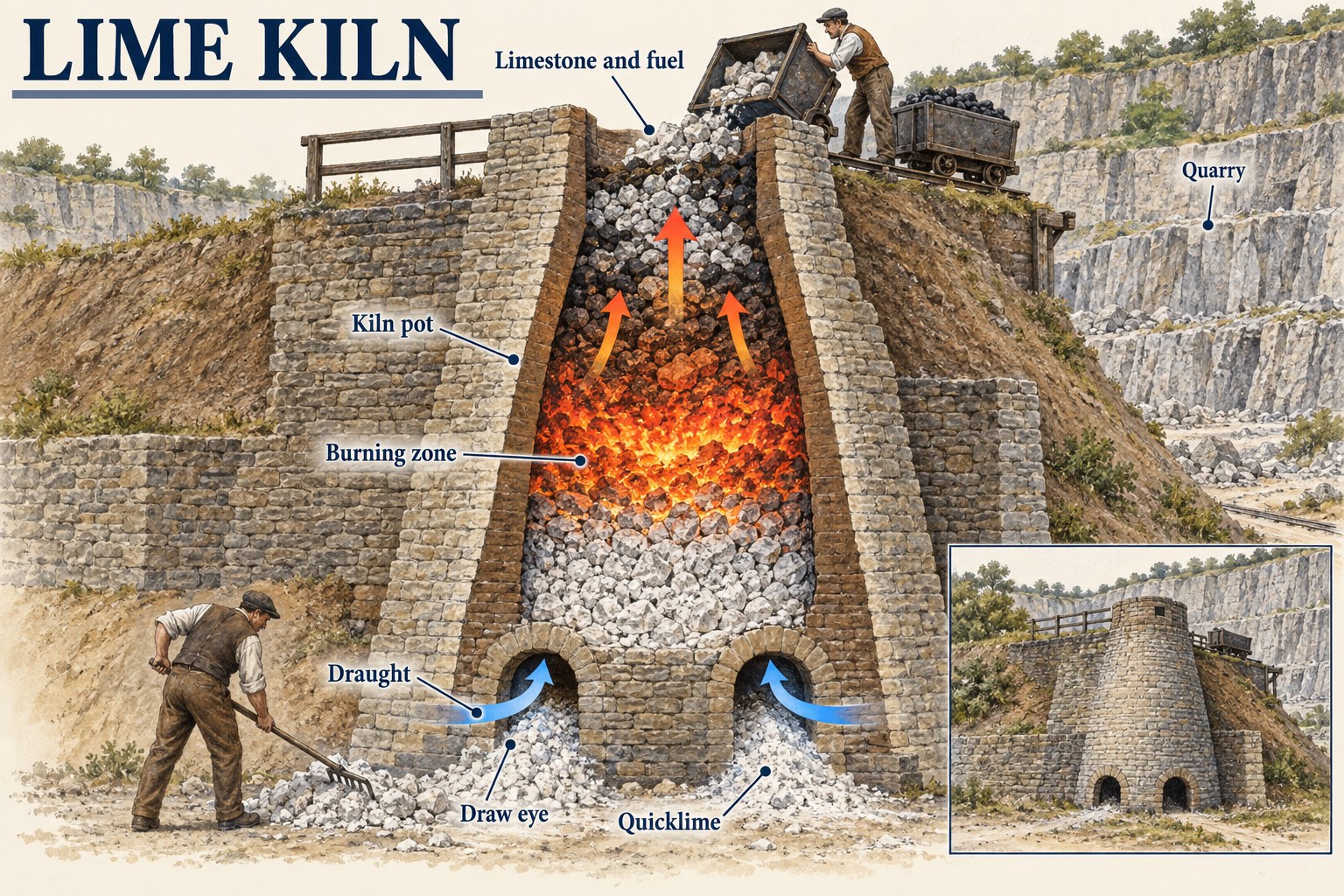
A kiln for burning limestone or chalk to quicklime. Heating the rock hard enough drives off its carbon dioxide and leaves calcium oxide — quicklime — which reacts violently with water to make slaked lime. Almost every limestone quarry of any size had kilns at its foot, because burnt lime is worth carrying and raw limestone largely is not.
Historical usage
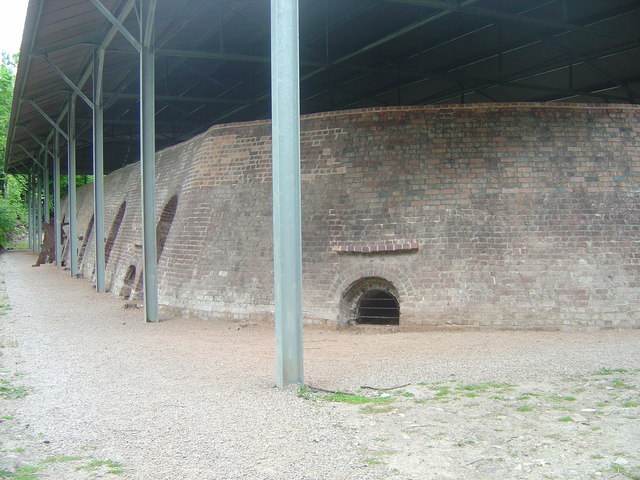
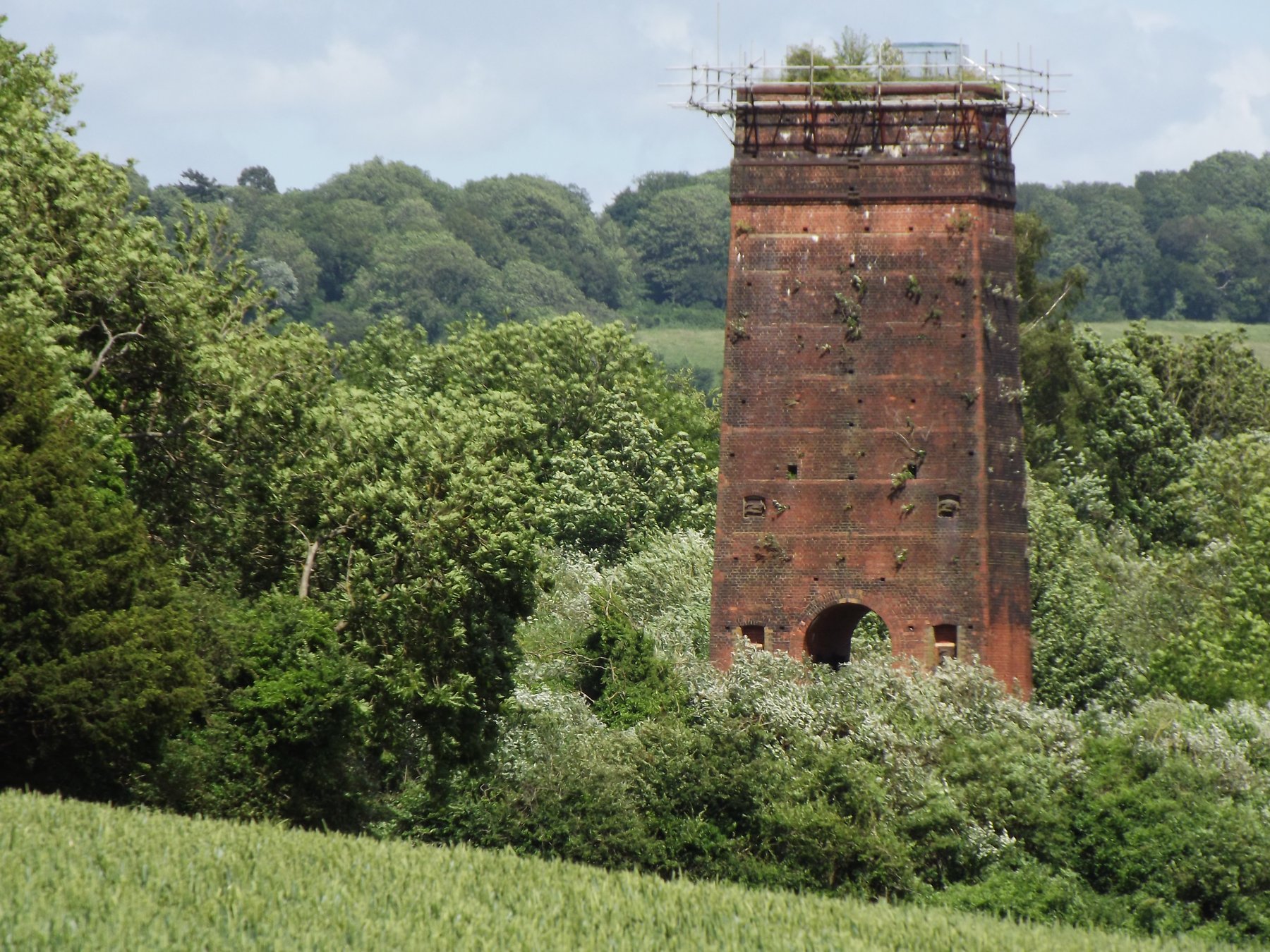
Lime burning appears to have arrived in Britain with the Romans; there is no evidence of kilns here before them, and Roman lime was used for mortar and as a soil dressing. From the medieval period lime was used as an agricultural fertiliser to sweeten acid land, and from the early nineteenth century across a wide range of industries — as a flux in blast furnaces, in gas and oil production, and in the chemical, pharmaceutical and food trades. The nineteenth century turned it into a large industry: in the Yorkshire Dales alone, four major works were operating in Ribblesdale by the 1870s and 1880s, feeding the growing towns of Lancashire and the West Riding. Llanymynech Hill sent enormous quantities of limestone to Staffordshire for iron smelting, and the works at its foot still has one of only three surviving Hoffmann kilns in the British Isles — the only one that kept its chimney.
How it worked
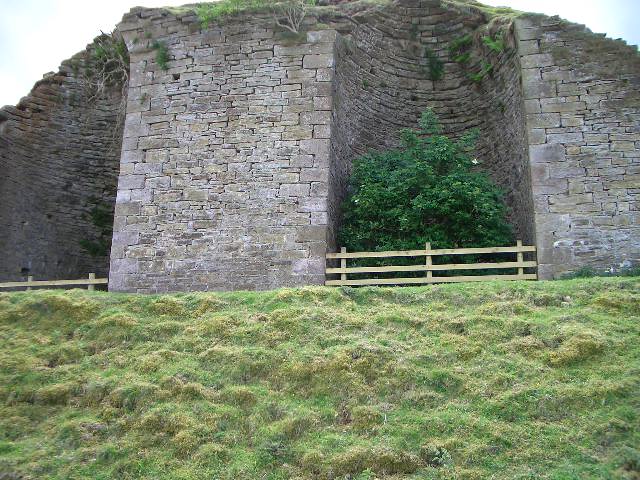
The simplest kilns were temporary clamps: alternating layers of stone and fuel built up and burnt through, then broken open. The standard permanent form is the draw kiln, a stone-built pot open at the top and tapering to draw holes or 'eyes' at the base, which both admit a controllable draught and give access to rake out the burnt lime. Stone and fuel are charged in at the top and burnt lime drawn from the bottom, so the kiln runs continuously. Later designs separated fuel from stone to keep the lime clean — Henry Robinson of Skipton patented three such draw kilns in the 1860s, firing through side fireboxes, and William Spencer's steel-clad vertical kilns of 1894 and 1900 proved among the most efficient ever built. The Hoffmann kiln, a continuous ring of chambers in which the fire is moved round from one to the next while others are being loaded, burnt, cooled and emptied, was the most successful design of the nineteenth century: very fuel-efficient and capable of exceptional quality. The first in the north of England was built at Meal Bank, Ingleton, in 1868.
Why it was used
Burning halves the weight and roughly doubles the value: quicklime could bear the cost of carriage to a market that raw stone could not. It also converts a rock into a chemical — mortar, agricultural lime, and blast-furnace flux all need burnt lime, not limestone.
Risks & limitations
Quicklime is dangerous stuff to make and handle. It burns skin, and slaking — the reaction with water — gives out enough heat to be violent, so damp quicklime in a confined space is a hazard in itself. Drawing a kiln means working at the base of a column of burning material, and kilns killed and injured men regularly through falls, burns and the carbon dioxide that pools in and around them. The industry itself proved vulnerable in the end to environmental controls, ageing plant, rising maintenance and lost markets, and most British lime works had closed by the early 1970s.
Regional variation
'Lime kiln', 'limekiln' and 'lime works' are used interchangeably; a small farm kiln burning for one estate is a 'field kiln' or 'selling kiln', as against the industrial banks of kilns at a quarry. In Scotland and northern England the ruined stone pot kiln built into a bank is the commonest survival, usually sited so that stone could be tipped in from above.
Related terminology
Calciner, Chalk, Charcoal Blast Furnace, Colliery Brickworks, Limestone, Magnesian Limestone, Quicklime, Waggonway
Mines associated with this term
5 examples chosen from 59 linked records — the term page is not an index.
- Charlestown Limeworks — Fife (well documented example)
Named in this record’s summary: “…Charles Bruce, 5th Earl of Elgin, from 1756 — the largest group of limekilns in Scotland, a range of fourteen in dressed stone, said to have…” - Harpur Hill Quarry — Derbyshire (well documented example)
Named 6 times in this record, first in the history: “…1835, first in larger shaft kilns and then in a multi-chambered Hoffmann kiln, under Buxton Lime Firms Ltd — which became Brunner Mond in 1918 and…” - Neston Colliery — Cheshire (well documented example)
Named in this record’s history: “…opened a colliery at Denhall, on the Dee Estuary, complete with limekilns and a quay built in 1791 to ship coal out to North Wales and…” - Purfleet Chalk Pits — Essex (well documented example)
Named in this record’s history: “…in 1669 Samuel Irons of Purfleet issued a trade token depicting a limekiln. The works expanded greatly in the eighteenth century. In 1738 the…” - Aberthaw Limestone Quarry — Vale of Glamorgan (well documented example)
Named 4 times in this record, first in the history: “…same limestone runs under the channel and comes up again there. A lime works and kilns were built beside Pleasant Harbour at East Aberthaw in…”
Sources
- (primary) Industrial Lime Burning — Out of Oblivion — Yorkshire Dales National Park Authority
- (primary) Pre-industrial Lime Kilns — Introductions to Heritage Assets — Historic England
Record created: 25 August 2026 · Last researched: 25 August 2026