 MineArchive
Rake
| Dialect | Derbyshire and the Pennines |
|---|---|
| Category | Mine Workings & Access |
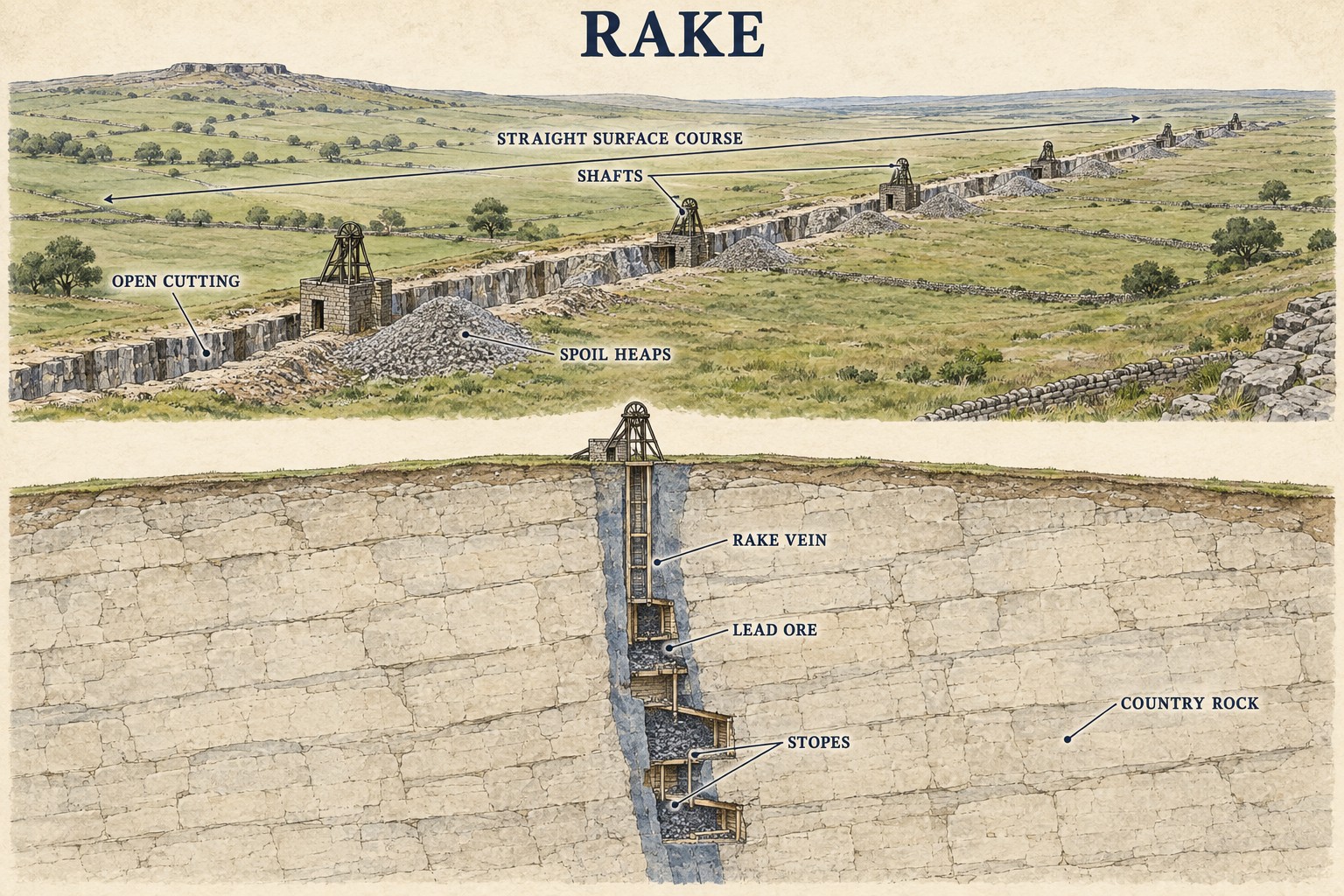
The main type of mineral vein in the Derbyshire Peak District — a near-vertical, straight-running fissure filled with ore, often traceable for miles across country.
Historical usage
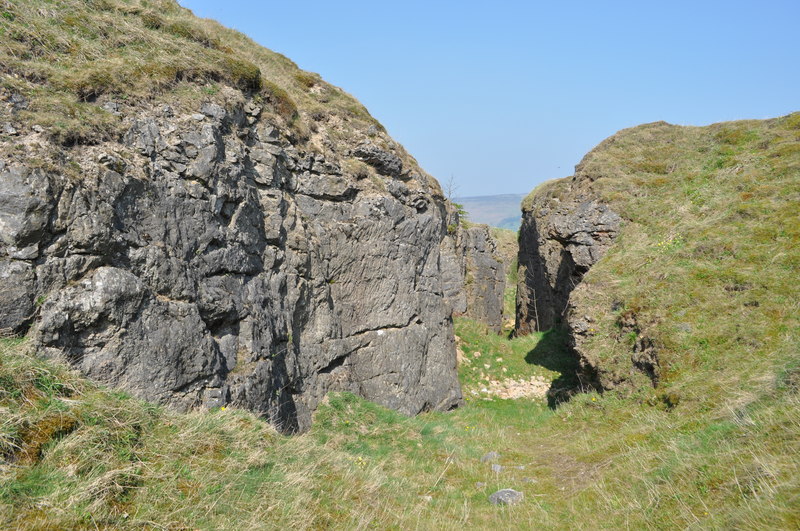
Rakes have been worked in the Peak District since at least Roman times, and most surviving rake workings date from the 16th-18th centuries, when they were mined as open trenches following the vein along the surface before going underground. Rake-vein mining is the characteristic early, technologically simple form of Derbyshire lead mining, and rakes remain the most common field monument left by that industry across the county.
How it worked
A rake was worked by following the vein's straight course, first as an open cutting where the vein reached the surface, then underground as the ore was chased downward — leaving the long, narrow, often deep trenches and gullies still visible across the Peak District landscape today.
Why it was used
Because a rake ran in a near-straight line and stood nearly vertical between two walls of rock, it could be followed with comparatively simple tools and little surveying skill, making it the most accessible and earliest-worked type of vein in the Derbyshire orefield.
Risks & limitations
A rake's straight course made it easy to trace but also easy to work out — once a rake's ore was exhausted along its length, there was often little left for a mine to fall back on, unlike a broader, less regular ore body.
Regional variation
Rakes are especially characteristic of Derbyshire, generally running east-west across most of the county but north-south in the Wirksworth area; the term and the vein type it describes are rarely used outside the Peak District orefield.
Related terminology
Mines associated with this term
5 examples chosen from 54 linked records — the term page is not an index.
- Glencraig Colliery — Fife (well documented example)
Named in this record’s history: “…a main haulage road, where a repairer named English was crushed by a rake of hutches when the haulage was started as he made for the pit…” - Grebe Swallet Mine — Somerset (well documented example)
Named twice in this record, first in the history: “…relics, extending underground towards the neighbouring Ubley's Rake to a depth of around 55 metres. The miners had worked systematically…” - Hurst Mines — North Yorkshire (well documented example)
Named twice in this record, first in the history: “…1679 the Duke leased part of Copperthwaite, Jingle Pot and Hind Rake to Humphrey Wharton and Philip Swale, with ore required to be sold…” - Watergrove Mine — Derbyshire (well documented example)
Named twice in this record, first in the summary: “…William Wyatt, who later built the ill-fated pumping engine at High Rake Mine.” - Auchinreoch Colliery — East Dunbartonshire (well documented example)
Named 4 times in this record, first in the history: “…Shaw, a brakesman of sixty-four, signalled in January 1913 for the rake to be run without the empty hutches attached, so that the full ones…”
Disasters associated with this term
Included only where MineArchive's own research gives a reasonable evidential basis, with the nature of the relationship stated — not every disaster where this term might plausibly apply.
- Glencraig Colliery Haulage Accident 1933 (contextual relationship)
Named twice in this record, first in the summary: “A Glencraig repairer named English was crushed to death by a rake of haulage hutches in 1933 while trying to escape unexpectedly…”
Sources
- (primary) Oxlow Rake lead mines, Peak Forest — Historic England
- (secondary) A Brief History of Derbyshire Lead Mining — Derbyshire Heritage
Record created: 22 August 2026 · Last researched: 22 August 2026