 MineArchive
Glencraig Colliery Haulage Accident 1933
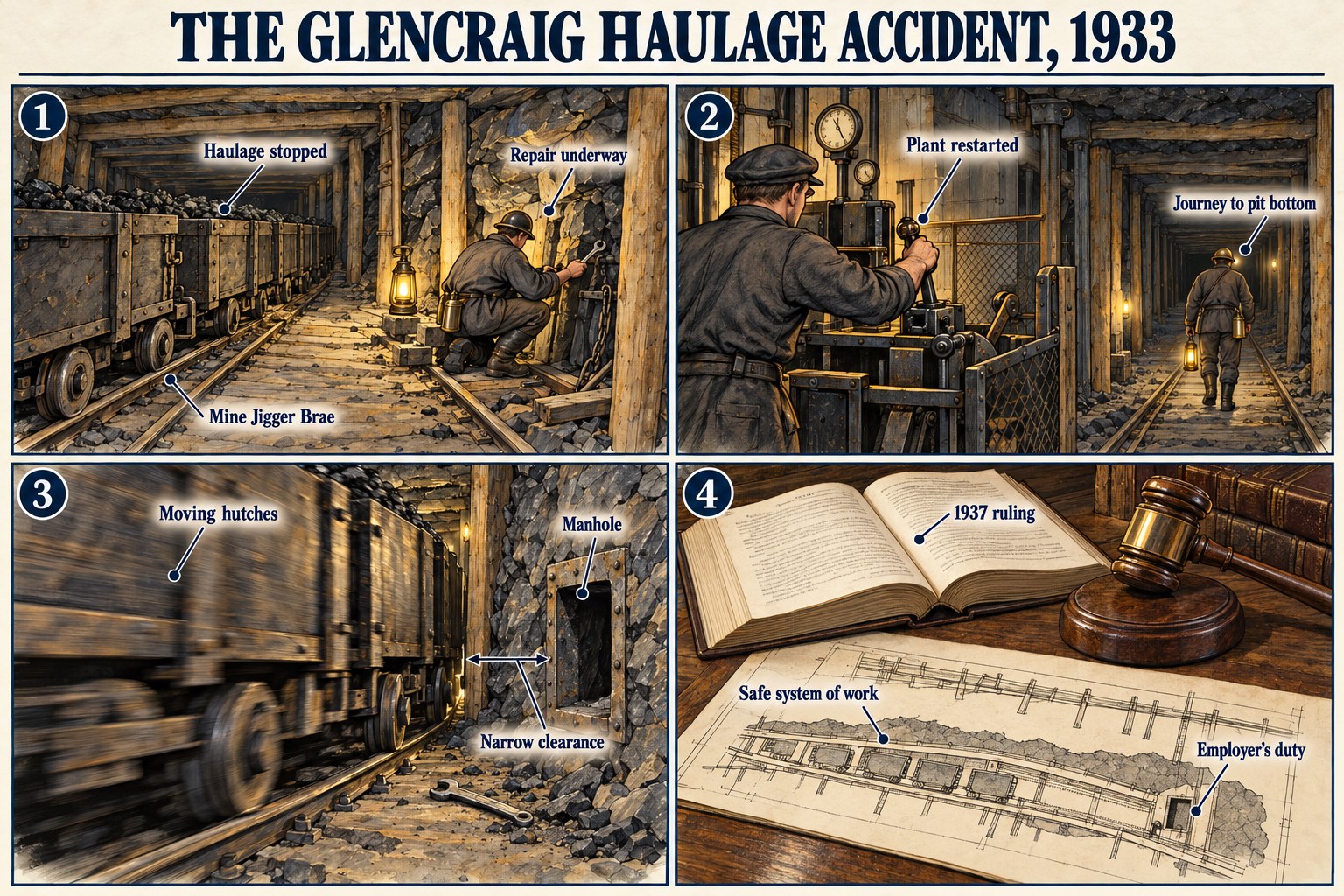
A Glencraig repairer named English was crushed to death by a rake of haulage hutches in 1933 while trying to escape unexpectedly restarted machinery — an accident whose 1937 House of Lords ruling, Wilsons & Clyde Coal Co Ltd v English, established the employer's non-delegable duty to provide a safe system of work, still a foundational principle of UK employers'-liability law.
| Date | 1933 |
|---|---|
| Mine | Glencraig Colliery |
| Region | Fife |
| Type | Haulage / Transport |
| Fatalities | 1 (Mr English, a repairer employed at Glencraig from 27 March 1933, died from his injuries.) |
| Context | During active mining |
Cause
English was repairing an airway off the Mine Jigger Brae, a main haulage road, when between 1:30 and 2pm the haulage plant was put in motion while he was making his way to the pit bottom. He tried to escape through a manhole but was caught by a rake of hutches and crushed between it and the side of the road.
What happened
The colliery company argued English had been contributorily negligent, saying he should either have warned the machinery operator or taken an alternative route. The case proceeded through the Court of Session before reaching the House of Lords, which ruled unanimously in favour of English's claim.
Legal & regulatory aftermath
The House of Lords held that an employer's duty to provide a safe system of work is non-delegable: even where responsibility for organising safe working is handed to a competent employee, the employer remains legally liable if that system turns out to be unsafe. Lord Thankerton stated that a workman who contracts to do work "is not to be held as having agreed to hold the master immune from the latter's liability for want of due care in the provision of a reasonably safe system of working". The ruling — reported as Wilsons & Clyde Coal Co Ltd v English [1937] UKHL 2, [1938] AC 57 — identified the duty as covering competent staff, adequate material, and a proper system of work with effective supervision, and remains a foundational citation in UK employers'-liability law.
Changes to practice & legislation
Established the employer's non-delegable duty of care as a distinct head of liability in UK employment law, separate from vicarious liability for the acts of other employees — still taught and cited today.
Related terminology
Mining terms this disaster is structurally linked to, with the nature of the relationship.
- Colliery (contextual relationship)
Named in this record’s narrative: “The colliery company argued English had been contributorily negligent, saying he…” - Haulage (contextual relationship)
Named 3 times in this record, first in the summary: “A Glencraig repairer named English was crushed to death by a rake of haulage hutches in 1933 while trying to escape unexpectedly restarted…” - Jigger (contextual relationship)
Named in this record’s cause: “English was repairing an airway off the Mine Jigger Brae, a main haulage road, when between 1:30 and 2pm the haulage…” - Rake (contextual relationship)
Named twice in this record, first in the summary: “A Glencraig repairer named English was crushed to death by a rake of haulage hutches in 1933 while trying to escape unexpectedly…” - Tub (contextual relationship)
Named twice in this record, first in the summary: “…repairer named English was crushed to death by a rake of haulage hutches in 1933 while trying to escape unexpectedly restarted machinery — an…”
Photographs & further reading
This page doesn't try to reproduce everything — these are the best original sources found for this disaster.
Summary of the House of Lords ruling arising from this accident.
View sourceSources
- (primary) Wilsons & Clyde Coal Co Ltd v English [1937] UKHL 2, [1938] AC 57 — House of Lords
- (secondary) Wilsons and Clyde Co v English — case summary — LawTeacher.net
Record created: 29 August 2026 · Last researched: 29 August 2026