 MineArchive
Colliery
| Also known as | Coal Mine (The plainer modern usage, and the standard term outside Britain), Coal Pit (Older form, common in early records and place-names), Glofa (Welsh) |
|---|---|
| Category | Structures & Machinery |
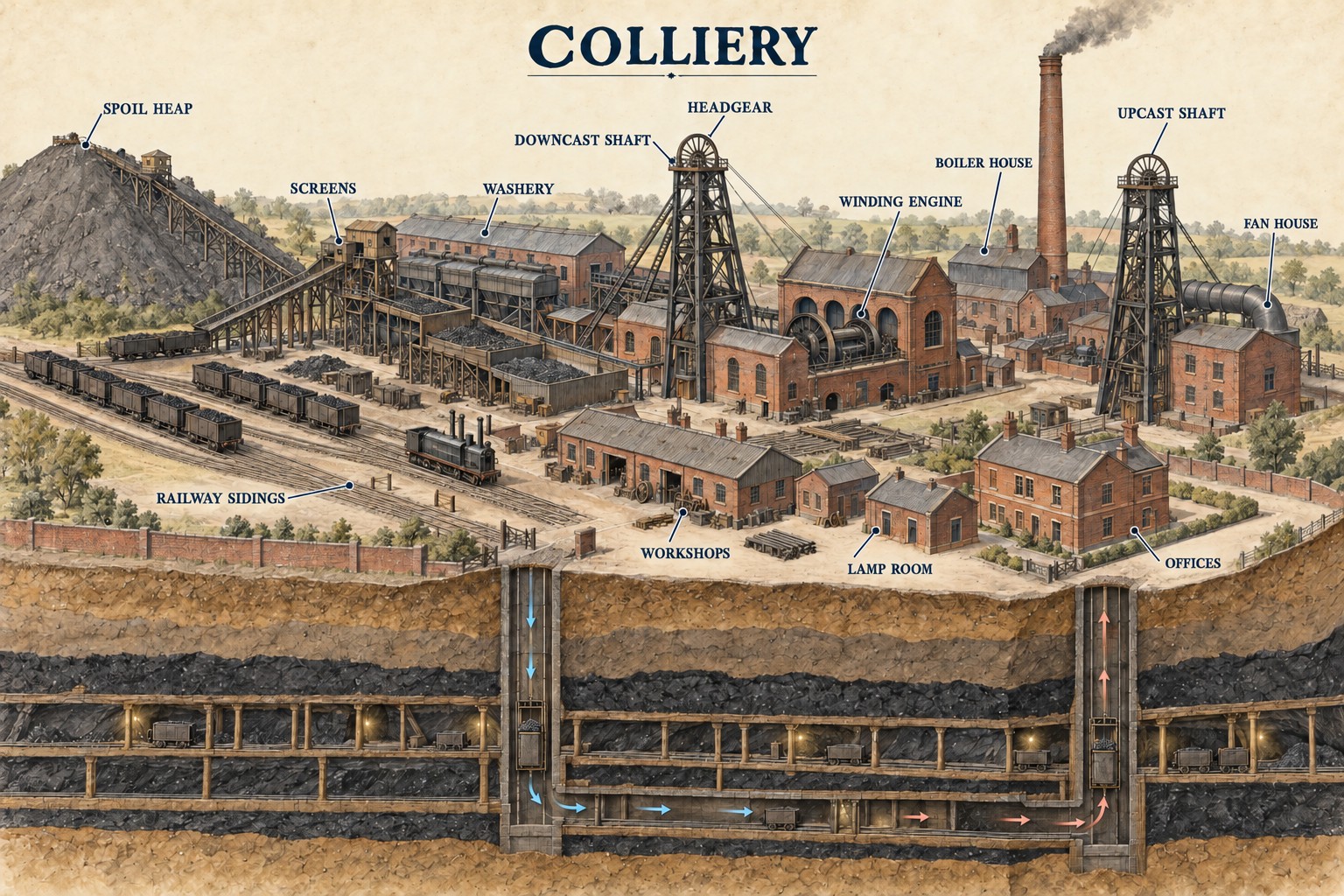
A coal mine considered as a whole working establishment: the shaft or shafts and the underground workings they serve, together with the surface plant that makes the coal saleable — winding engines, screens, washery, workshops, offices and sidings. The distinction from 'coal mine' is real if slight: a coal mine is the excavation, a colliery is the entire concern standing over it. It is the word the official record almost always uses, which is why so many British pits are catalogued as a colliery rather than a mine.
Historical usage
The word is first recorded in the 1630s, formed from 'collier' with the suffix -y, on the same pattern as bakery or brewery — a place where a trade is carried on. 'Collier' is much older and did not originally mean a coal miner at all: it appears in the late 14th century for a charcoal maker and seller, took on the sense of a digger in a coal mine only in the 1590s, and by the 1620s also meant a coasting vessel carrying coal. The man was named first, the ship second and the place last. 'Colliery' then became the settled term of art in statute, inspectors' reports and abandonment plans, and stayed that way through nationalisation — the National Coal Board took over some 1,647 mines in 1947 — until deep mining ended at Kellingley in December 2015.
How it worked
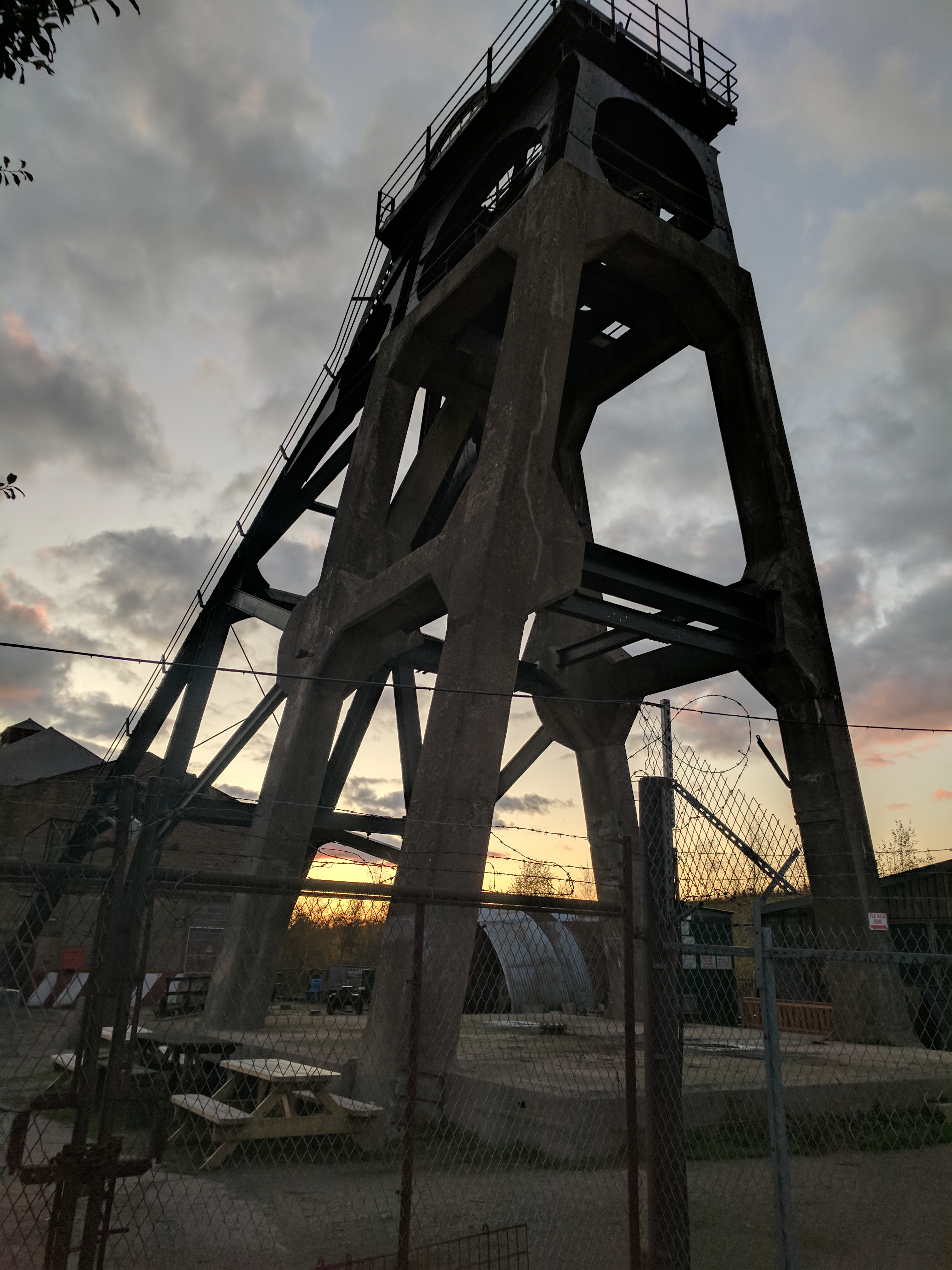
A developed colliery was an integrated surface system, not just a hole. Ventilation set its basic shape: one shaft was the downcast, drawing fresh air in, another the upcast, from which a fan house drew the foul air out. Headgear stood over each shaft, with a winding engine house alongside, and a boiler house and chimney to raise steam for both. Coal came up in tubs or skips to the screens, where it was sized and graded, then often to a washery, and out by railway sidings; waste went to the spoil heap. Round these stood the lamp room, workshops, offices, a magazine, and — after the Mining Industry Act 1926 funded them widely — pithead baths. Clock Face in Lancashire is a fair example of the developed type: No. 2 downcast, No. 3 upcast with the fans, No. 1 for pumping, and a 1939 baths building holding showers, lamp room, rescue station, first-aid room, canteen and cycle shed for 1,600 men and 40 pit-brow women, reached by a steel walkway bridge from the screens.
Why it was used
The layout was not a matter of taste. After the Hartley disaster of 1862, when 204 men and boys died behind a single blocked shaft, the law required every colliery to have at least two independent ways out, which fixed the two-shaft arrangement and with it the downcast/upcast ventilation circuit. Concentrating the winding, screening, washing and workshops on one site was then simple economics: coal is bulky and low-value, so every extra handling and every mile of haulage eats the margin.
Risks & limitations
As a label it is looser than it looks. 'Colliery' can mean one shaft, a group of shafts sunk decades apart and worked as one concern, or a company's whole holding under a single name — so a closure date attached to a colliery may refer to the last shaft, the last coal drawn, or the winding-up of the business, and the three can be years apart. Pits were also renamed and renumbered freely, often after the owner or the village, and neighbouring collieries frequently shared a name with a number after it.
Regional variation
'Colliery' is the formal and official word everywhere in Britain, but rarely the spoken one. In the North East, Yorkshire, the Midlands and the Scottish coalfields the everyday word is 'pit', which carries the whole vocabulary of pit village, pit head, pit brow and going down the pit. In Wales the Welsh word is 'glofa'. 'Coal mine' is the plainer modern usage and the standard term outside Britain.
Related terminology
Mines associated with this term
5 examples chosen from 660 linked records — the term page is not an index.
- Bickershaw Colliery — Greater Manchester (well documented example)
Named 8 times in this record, first in the history: “Turner and Ackers sank Bickershaw's first shaft around 1830; the colliery was substantially redeveloped from 1872 with new No.1 and No.2…” - Califat Coal Mine — Leicestershire (well documented example)
Named 3 times in this record, first in the summary: “Califat was one of three collieries sunk in the Leicestershire coalfield by the Coleorton Colliery…” - Chisnall Hall Colliery — Lancashire (well documented example)
Named 8 times in this record, first in the summary: “The largest colliery on the Lancashire coalfield north of Wigan, on Coppull Moor, worked…” - Cortonwood Colliery — South Yorkshire (well documented example)
Named 3 times in this record, first in the summary: “A South Yorkshire colliery of no unusual size or fame until March 1984, when the National Coal…” - Creswell Colliery — Derbyshire (well documented example)
Named 5 times in this record, first in the history: “…when 3,001 tons were raised to the surface in a single day. The colliery worked the Top Hard, Waterloo and High Hazel seams. It passed to the…”
Disasters associated with this term
5 examples chosen from 751 linked records, most direct relationship first.
- Aberaman Colliery explosion, 1855 (contextual relationship)
Named 3 times in this record, first in the summary: “…firedamp fired by naked lights in the pillar workings of Aberaman Colliery, Aberdare, killed five men and boys, one of them a sixteen-year-old…” - Aberaman Colliery explosion, 1858 (contextual relationship)
Named twice in this record, first in the summary: “An explosion of gas at Aberaman Colliery on 20 March 1858 fatally injured two colliers, who died two days…” - Aberaman Colliery fall of coal, 1862 (contextual relationship)
Named twice in this record, first in the summary: “…of coal killed two colliers holing in the Nine Feet seam at Aberaman Colliery on 21 June 1862.” - Aberaman Colliery roof fall, 1894 (contextual relationship)
Named twice in this record, first in the summary: “On the night shift of 14 November 1894 a shot fired at Aberaman Colliery brought down a fall that buried three men; two were dead when they…” - Aberaman Colliery roof fall, 1908 (contextual relationship)
Named twice in this record, first in the summary: “Three men died after a fall of roof at Powell Duffryn's Aberaman Colliery on 3 May 1908 while they were pulling down a low bridge of ground on…”
Sources
- (secondary) Clock Face Colliery, Part 2 — Sutton Beauty & Heritage
- (secondary) Collier (etymology) — Online Etymology Dictionary
- (secondary) Colliery (etymology) — Online Etymology Dictionary
Record created: 26 August 2026 · Last researched: 26 August 2026