 MineArchive
Bad Air
| Also known as | Choke damp (North East England), Foul air |
|---|---|
| Category | Ventilation & Mine Gases |
The general, everyday term British miners used for any unbreathable underground atmosphere — oxygen-deficient, suffocating air, as opposed to the explosive firedamp — used across metal and coal mining alike, long before, and alongside, the more specific 'damp' terminology coal miners developed.
Historical usage
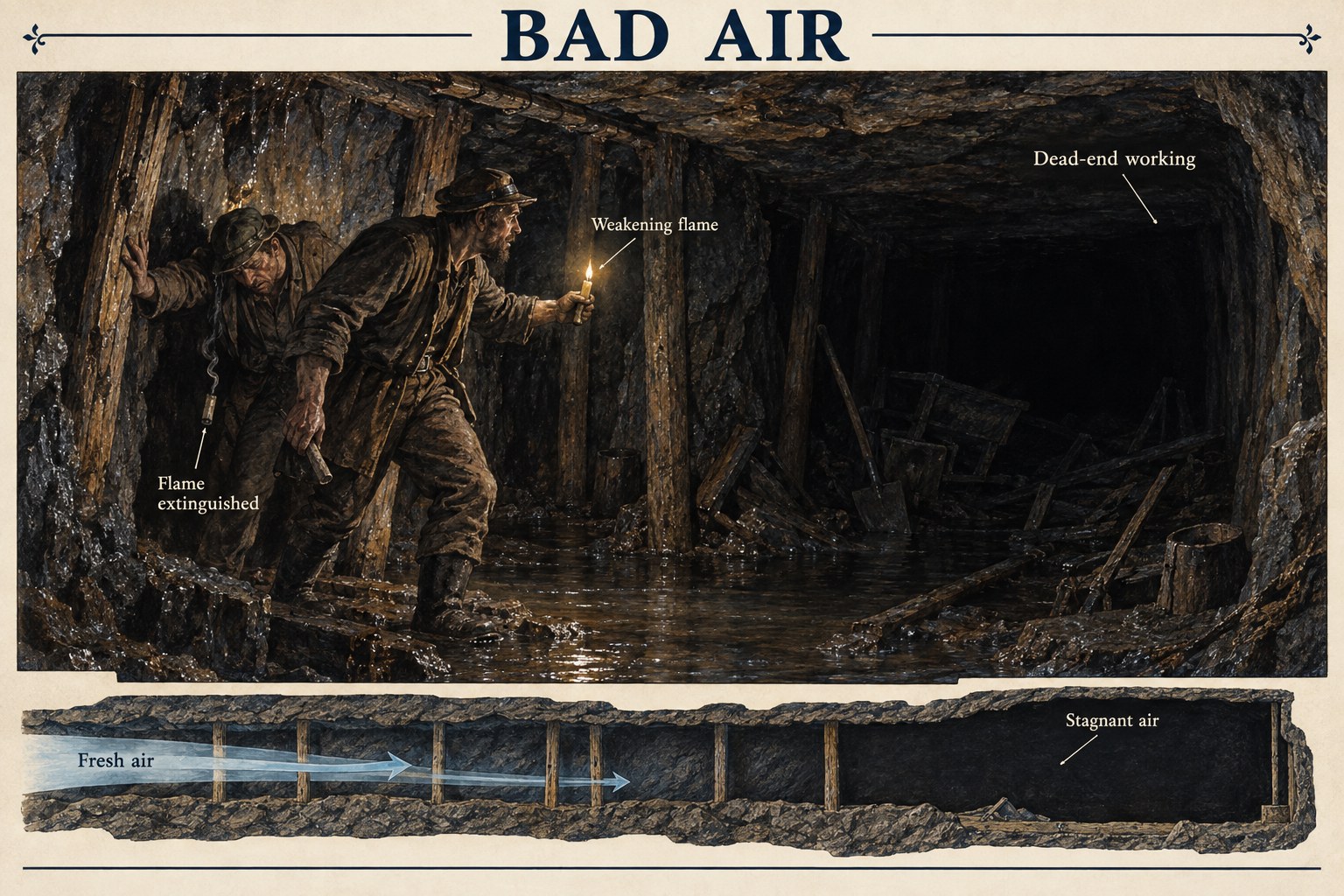
'Bad air' (also called stythe in parts of North East England) is an older, more general term than blackdamp or chokedamp, used wherever miners worked — not just in coal — to describe air too depleted of oxygen to breathe safely. It built up naturally in old, poorly ventilated workings, dead-end drives and disused shafts, where decomposition and the miners' own candles or lamps steadily consumed what oxygen was present with nothing to replace it.
How it worked
Because bad air is invisible, odourless and gives no warning to the body until a miner is already dangerously short of oxygen, its presence had to be judged indirectly. The standard test for centuries was a simple candle or lamp flame: as oxygen levels fell, a flame burned lower and more feebly before finally going out altogether, well before the air became lethal to a person — giving a working, if crude, early warning system long before any instrument existed to measure gas levels directly.
Why it was used
Recognising bad air as a distinct hazard from firedamp mattered because the two called for opposite responses: firedamp demanded avoiding any flame or spark, while bad air was best detected using one. Any mine without active ventilation — natural airflow through connected shafts and adits, later assisted by underground furnaces and, eventually, powered fans — was at constant risk of it, making ventilation one of the oldest and most basic mine safety disciplines, predating any of the named toxic gases by centuries.
Risks & limitations
The candle test was useless against firedamp, which it could ignite outright, so miners had to judge from context — a stale, dead-end working was tested for bad air with a flame; a gassy coal seam was approached instead with a safety lamp built to contain any flame entirely.
Related terminology
Mines associated with this term
5 examples chosen from 10 linked records — the term page is not an index.
- Brownrigg Colliery — Northumberland (well documented example)
Named twice in this record, first in the history: “…a sinker, William Elliott, aged 21, was killed by stythe (foul air) while sinking the pit on 13 August 1869, and a hewer, Robert Young,…” - Cwmbran Colliery — Torfaen (well documented example)
Named in this record’s history: “…the Mine Slope in 1854; ventilation was by a mechanical fan drawing foul air out through the entrance, with fresh air coming down an airshaft…” - Danebower Colliery — Cheshire (well documented example)
Named in this record’s workings: “…up the hillside to a chimney: a fire lit at the flue's foot drew the foul air out of the workings. The chimney is square, tapering slightly, 8 m…” - Elemore Colliery — County Durham (well documented example)
Named in this record’s history: “…evidence to say what caused the ignition. Three more men died from foul air in December 1895. With the Main Coal exhausted and the Hutton nearly…” - Oakley Colliery — Fife (well documented example)
The explosion of 21 January 1856 in a Forth Iron Works pit here was reported as an explosion of foul air, and killed four men.
Disasters associated with this term
5 examples chosen from 29 linked records, most direct relationship first.
- Greenside Mine gas exposure, 1960 (direct cause)
The men died of bad air accumulated in old, unventilated abandoned stopes. - Heaton Main Colliery inrush, 1815 (hazard involved)
The trapped men died of foul air. - Hurlet Colliery explosion, 1805 (hazard involved)
A rescuer was suffocated by foul air. - Magpie Mine suffocation of three Maypitt miners (hazard involved)
The three men died from suffocation in an atmosphere made irrespirable by deliberately lit smoke, the same underlying hazard as bad air more generally. - Burdon Main Colliery explosion, 1835 (contextual relationship)
Named in this record’s aftermath: “…found, without retiring, that the deceased died by an explosion of foul air and its afterdamp, caused by the opening of a trap door, whether…”
Sources
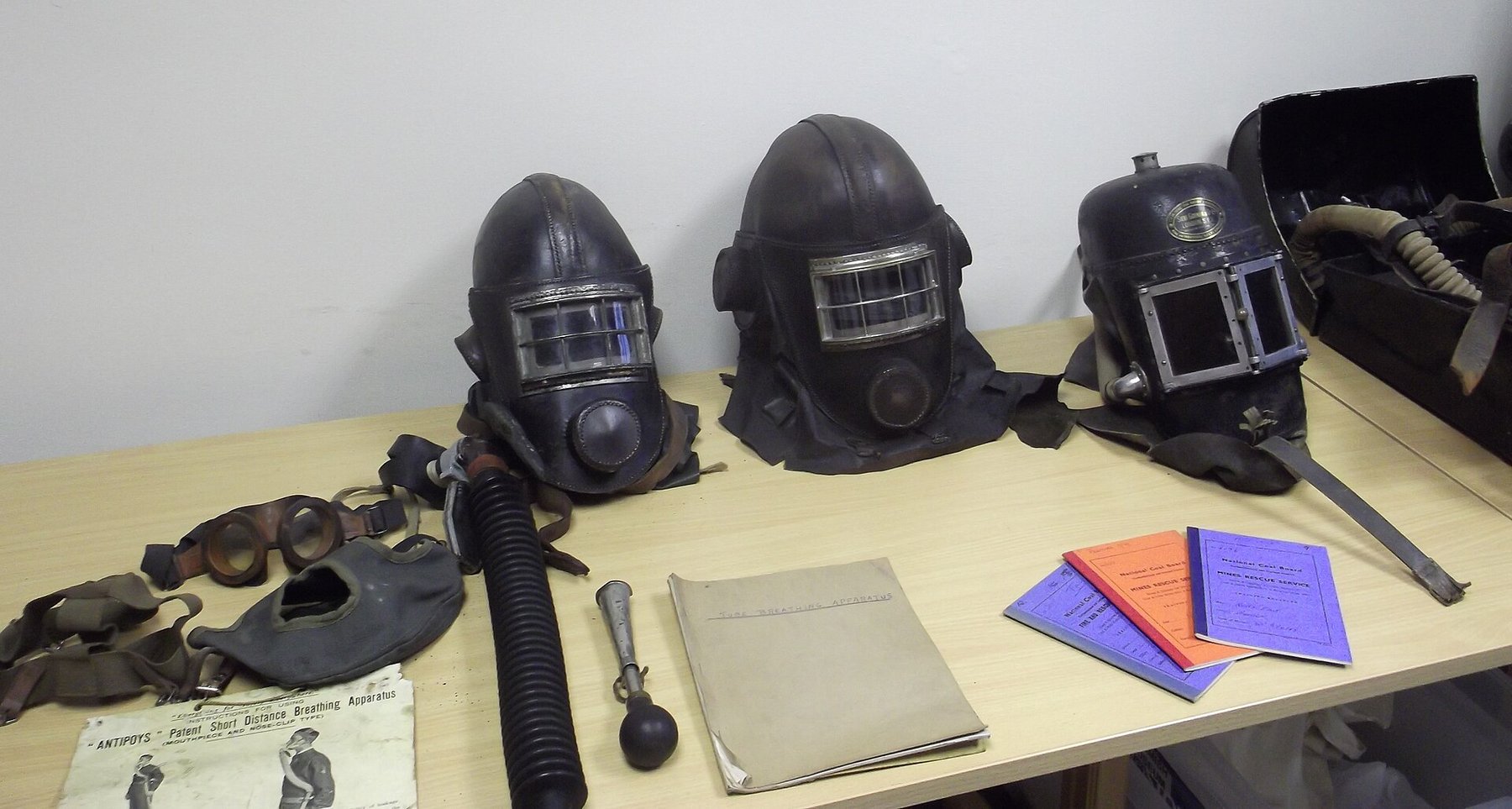
- (observational) Vintage rescue breathing apparatus, Houghton-le-Spring Mines Rescue Station centenary — Wikimedia Commons
- (primary) P11-18 — Mine Safety and Health Administration (MSHA)
- (secondary) Blackdamp — Wikipedia
- (secondary) Mine Tales: From candles to canaries, ventilation is a vexing challenge — Arizona Daily Star

Record created: 20 August 2026 · Last researched: 9 September 2026