 MineArchive
Magpie Mine suffocation of three Maypitt miners, 1833
Three miners from the neighbouring Maypitt mine suffocated after Magpie miners lit fires underground to smoke them out during a dispute over a shared lead vein — the origin of the mine's 'Widow's Curse' story.
| Date | 1833 |
|---|---|
| Mines involved | Maypit Mine, Magpie Mine |
| Region | Derbyshire |
| Primary type | Gas / Asphyxiation |
| Associated types | Fire |
| Fatalities | 3 |
| Context | During active mining |
Location
Plotted at Magpie Mine. Recorded location. The large pin is the mine; the small round markers are the nearest mines on record. Click one for its page. View on full map
Cause
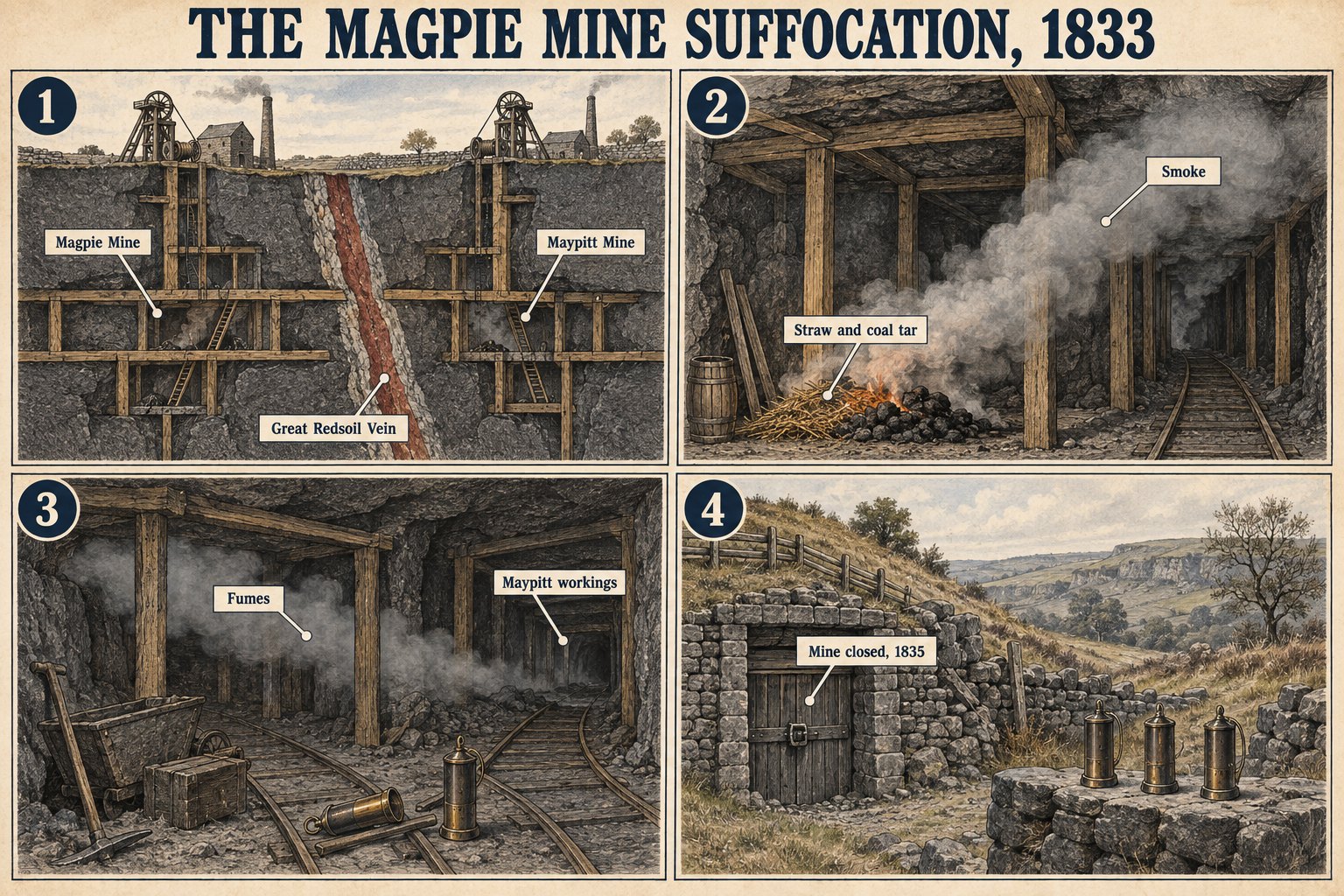
Magpie and the neighbouring Maypitt mine were both working the Great Redsoil vein, and miners from each side had taken to lighting fires underground to smoke the other side out of disputed workings. By then the quarrel had been running for years, underground and in the courts. It began in 1824 as a dispute over ownership, when Magpie miners broke through into Maypit's workings in a vein both sides claimed; in 1829 the Magpie men proved the vein was theirs. It turned violent when they broke into Great Red Soil, a vein freed long before and also worked by the Maypit men.
What happened
In 1833, during a long-running dispute between Magpie Mine and the adjoining Maypitt mine over rights to the Great Redsoil vein, Magpie miners lit fires of burning straw and coal tar underground to smoke their rivals out. Three Maypitt miners, working the Great Red Soil, were suffocated by the fumes, and others were injured. Twenty-four Magpie miners were later tried for murder. Several were freed straight away, and in the end all were acquitted, since it proved impossible to establish which of them was responsible for lighting the fire, and Maypitt's own men had also taken provocative action during the dispute. Local tradition holds that the dead men's widows cursed the mine; the affair is said to have ruined it, and it closed for a period in 1835.
Investigation & inquiry
Twenty-four Magpie miners stood trial for murder. All were acquitted, the court finding it impossible to establish individual responsibility for lighting the fire, or that those charged had intended to kill rather than merely to drive their rivals off. One account has the accused held for a year in prison before a long trial at Derby Assizes, at which five were acquitted of murder on conflicting evidence and for lack of intent.
What's uncertain
Points where sources disagree or the record could not be settled; both accounts are kept. All open questions in the archive.
- After a year in prison and a lengthy trial at Derby Assizes, five Magpie miners were acquitted of murder on conflicting evidence and lack of intent. (disputed) 4
Recorded claims
Individual factual claims, each attached to the source(s) that support it below. Where sources disagree, both are kept.
- Three miners from the Maypitt mine suffocated after Magpie miners lit fires underground during the dispute over the Great Redsoil vein. 1,2
- Twenty-four Magpie miners were tried for murder and all were acquitted, as it could not be established which of them was responsible. 1,2
- The dispute between Magpie and Maypitt over the Great Redsoil vein ran for years, both underground and in the courts. 1
- Several of the 24 accused were freed immediately before all were eventually acquitted. 1
- Magpie Mine closed in 1835, the disputes having ruined it. 1,2
- The dispute with Maypit began over ownership in 1824; in 1829 the Magpie miners proved they owned the vein in question. 3
- The dispute turned violent when Magpie miners broke into the Great Red Soil vein, and ended with three Great Red Soil miners dead and others injured. 3
- After a year in prison and a lengthy trial at Derby Assizes, five Magpie miners were acquitted of murder on conflicting evidence and lack of intent. (disputed) 4
- A slump in trade, the cost of the legal disputes and flooding closed Magpie Mine in 1835. 3
Related terminology
Mining terms this disaster is structurally linked to, with the nature of the relationship.
- Afterdamp (direct cause)
Fires deliberately lit underground during a dispute over the Great Redsoil vein produced toxic smoke that suffocated three miners from the neighbouring Maypitt mine — the same post-fire gas hazard afterdamp describes, from an arson fire rather than an explosion. - Bad Air (hazard involved)
The three men died from suffocation in an atmosphere made irrespirable by deliberately lit smoke, the same underlying hazard as bad air more generally. - Barmote Court (contextual relationship)
The fatal 1833 dispute arose from unresolved rival claims to the Great Redsoil vein — the class of dispute barmote courts were set up to adjudicate. - Meer (contributing factor)
The underlying dispute between Magpie and Maypitt was over meer boundaries on the shared Great Redsoil vein. - Vein (contextual relationship)
The whole quarrel was over a vein: Magpie and Maypitt were working the same lead vein, and the fires lit to drive the other side off it suffocated three men.
Sources
- (secondary) Magpie Mine History — Peak District Mines Historical Society
- (secondary) Magpie Mine — Wikipedia
- (primary) Magpie, Dirty Red Soil, Maypit, Horsesteps and Great Red Soil lead mines and a limekiln (List Entry 1019490) — Historic England
- (secondary) Magpie Mine (Biggin Hall) — Biggin Hall
- (primary) Magpie Mine plans (BGS catalogue) — British Geological Survey
Record created: 20 August 2026 · Last researched: 20 November 2026