 MineArchive
Meer
| Dialect | Derbyshire |
|---|---|
| Category | Law & Custom |
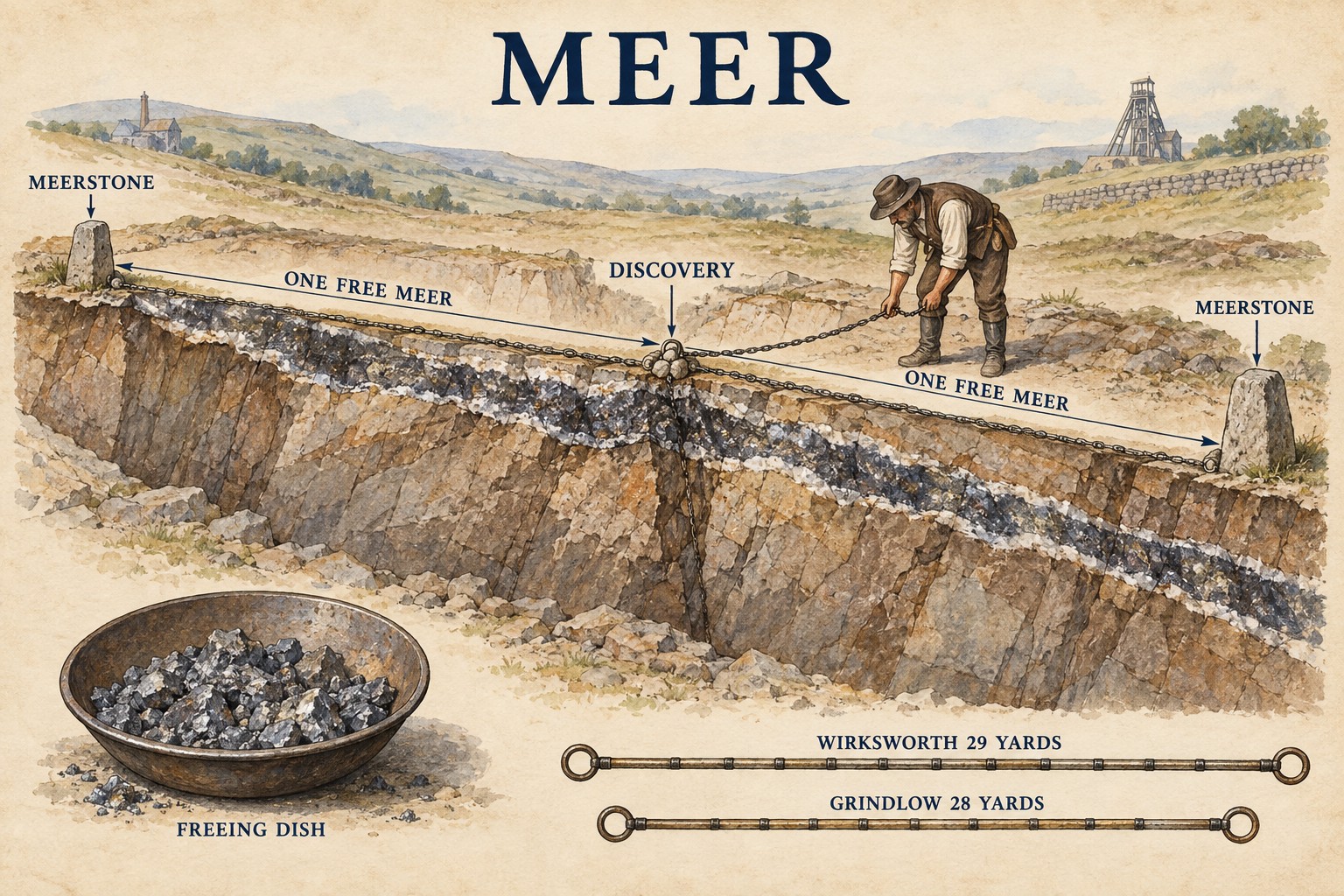
A fixed unit of length along a lead vein — typically 29 yards in Derbyshire's Wirksworth liberty, though the exact length varied by district — granted to a miner under Barmote law as their measured claim to work a newly discovered vein.
Historical usage
Under the barmote system that governed lead mining across Derbyshire's 'King's Field' from at least the 13th century, a miner who found a new vein of lead could claim it by paying the Barmaster a 'freeing dish' of ore, traditionally around 65 pounds in weight; on registration, the Barmaster measured out and granted the finder two free meers of ground along the vein, one on each side of the discovery point, with further meers available to other miners further along the same vein on payment of the standard due. Meer lengths were fixed by ancient custom rather than a single national standard, and varied between Derbyshire's different mining liberties — 29 yards at Wirksworth, 28 yards in the Liberty of Grindlow among them — a legacy of the barmote courts' long independent local jurisdiction.
How it worked
Once a discovery was registered and freed, a miner's meers were marked out along the vein's length using boundary stones known as meerstones, planted at the ends of each claimed length; a miner who failed to work their meer within the time allowed under barmote custom risked having it reallocated to someone who would.
Why it was used
The meer gave Derbyshire's lead miners a standardised, legally defensible unit of claim, preventing the same vein being worked simultaneously and in conflict by rival parties, and giving the Barmaster's court a straightforward basis for settling disputes over exactly whose ground was whose.
Risks & limitations
Because a meer measured length along a vein rather than area, its real value depended entirely on how rich that particular stretch of vein turned out to be — a claim could be worthless if the ore pinched out just past the discovery point, or extraordinarily valuable if it didn't.
Regional variation
A specifically Derbyshire institution, tied to the Peak District's barmote courts; Cornwall and Devon's stannary law used the broadly comparable, but differently structured, sett instead.
Related terminology
Mines associated with this term
Included only where MineArchive's own research gives a reasonable evidential basis — not every mine where this might plausibly apply.
- Frankland Fold Mine — North Yorkshire (well documented example)
Named in this record’s history: “…Grassington High and Low Moors that was worked, under a customary 'meers' system granting miners units of ground in exchange for a fifth…” - Grassington Moor Mines — North Yorkshire (well documented example)
Named in this record’s history: “…and 18th-century miners worked shallow shafts under the historic 'meer' system, allotting each miner a 30-yard block of vein with a buffer…” - Slitherstone and Linacre Lead Mines — Derbyshire (well documented example)
Named twice in this record, first in the history: “…founder -- the point where the vein was first discovered -- and four meers west and one meer east of Birch Hall mine at Two Rakes Head.…” - True Blue Mine — Derbyshire (well documented example)
Named twice in this record, first in the history: “…its walled enclosure survive a good gin circle and a washing meer, along with the collapsed remains of small drystone coes -- a pair…” - Magpie Mine — Derbyshire (historical documentary reference)
Magpie's fatal 1833 dispute with the neighbouring Maypitt mine, over a shared lead vein, was exactly the kind of meer-boundary conflict barmote law existed to settle.
Disasters associated with this term
Included only where MineArchive's own research gives a reasonable evidential basis, with the nature of the relationship stated — not every disaster where this term might plausibly apply.
- Magpie Mine suffocation of three Maypitt miners (contributing factor)
The underlying dispute between Magpie and Maypitt was over meer boundaries on the shared Great Redsoil vein.
Sources
- (primary) Barmote Courts — Duchy of Lancaster
- (primary) Derbyshire Mining Customs and Mineral Courts Act 1852 — legislation.gov.uk
- (secondary) Barmote court — Wikipedia
Record created: 22 August 2026 · Last researched: 22 August 2026