 MineArchive
Barmaster
| Dialect | Derbyshire |
|---|---|
| Category | Law & Custom |
The officer appointed to administer a Derbyshire lead-mining 'liberty', regulating claims and running the local Barmote Court alongside a steward and a jury of miners.
Historical usage
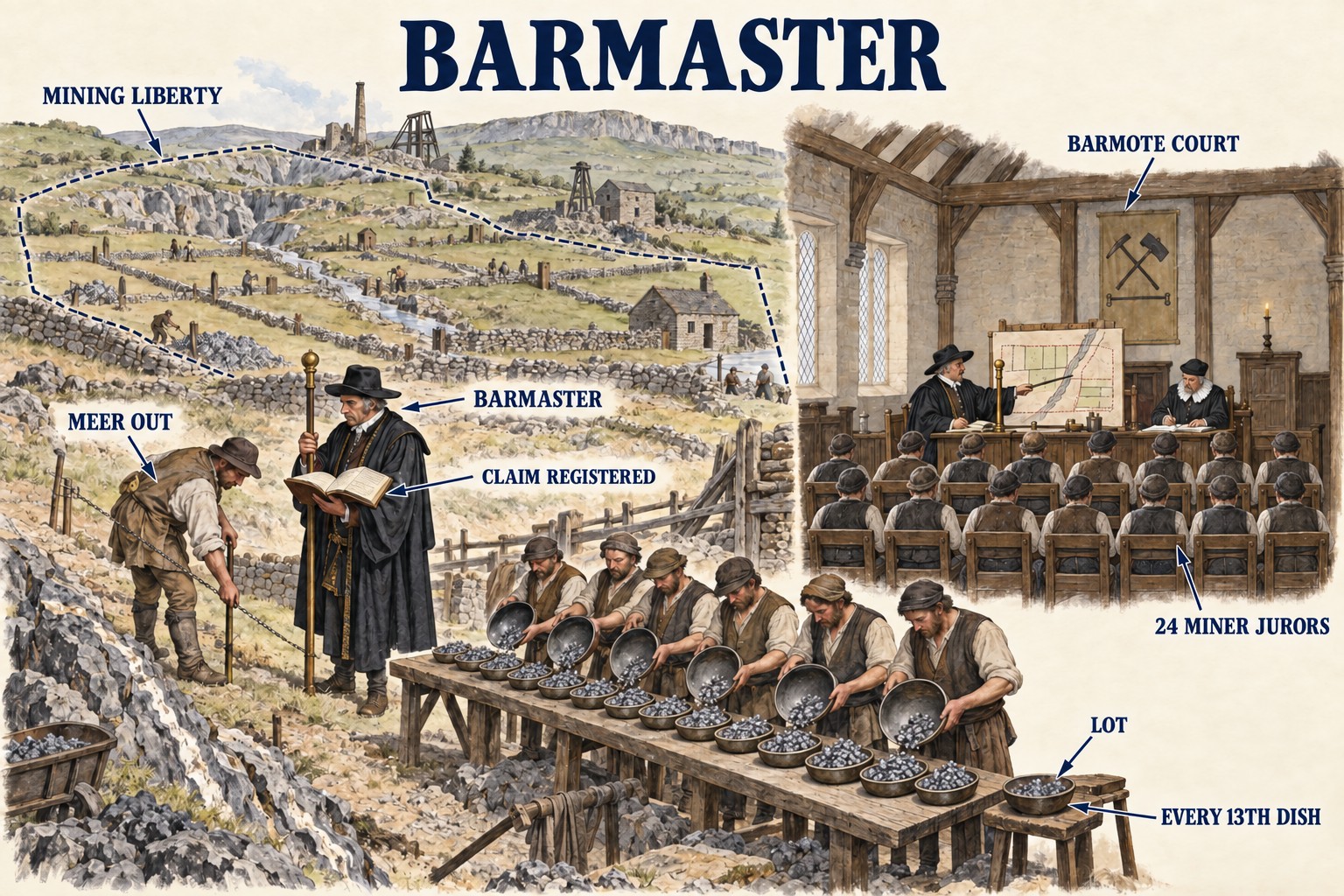
The High Peak and Low Peak lead orefields were divided into liberties, each with its own barmaster appointed to oversee mining within it -- a system already established by the time the Barmote Courts themselves were formally set up in 1288. A chief barmaster, overseeing the whole mining area, was a wealthy and influential figure in his own right. The office survives today in much reduced, largely ceremonial form: the Chancellor of the Duchy of Lancaster still appoints a barmaster and a steward for the courts that continue to meet, jointly, once a year at Wirksworth.
How it worked
The barmaster registered new claims (a miner had first to 'meer out' his ground under the barmaster's supervision), collected the traditional royalty of every thirteenth dish of ore raised (called 'lot'), and enforced the decisions of the Barmote Court, whose twenty-four jurors -- themselves working miners -- settled disputes over boundaries, ownership and mining customs under his and the steward's direction.
Why it was used
A specialist local official who understood mining custom, rather than the ordinary courts, was needed to register claims fairly, collect the customary royalty, and settle the boundary and ownership disputes that a jurisdiction made up of thousands of small, adjoining workings inevitably produced.
Related terminology
Mines associated with this term
5 examples chosen from 6 linked records — the term page is not an index.
- Snake Mine — Derbyshire (well documented example)
Named in this record’s history: “…of Mines reports and the account books of Samuel Sheldon, Deputy Barmaster for Middleton-by-Wirksworth, begin in 1876 and show a mine already…” - Dirtlow Rake Mine — Derbyshire (well documented example)
The mine's history is documented in an almost continuous record thanks to the surviving Castleton Barmaster Books. - Placket Mine — Derbyshire (well documented example)
Named in this record’s history: “…ground roughly below the churchyard: when a jury appointed by the Barmaster came to inspect the Orchard workings they found them locked against…” - Slack, Mount Pleasant and Barmasters Grove Lead Mines — Derbyshire (well documented example)
Named 5 times in this record, first in the history: “…area of mining containing Nether Slack, Upper Slack, Scorah Slack, Barmasters Grove and Mount Pleasant lies just north of the Great Bonsall Fault,…” - Twentylands Mine — Derbyshire (well documented example)
Named in this record’s history: “…Twentylands and Captains mines are not recorded in the Wirksworth Barmaster's book as it stood in March 1698, but documentary evidence shows…”
Sources
- (secondary) Barmote court — Wikipedia
- (secondary) Derbyshire's Barmote Court – The oldest court in England — Buxton Museum and Art Gallery
Record created: 31 August 2026 · Last researched: 31 August 2026