 MineArchive
Lead
| Category | Commodities |
|---|---|
| Commodity page | Lead → |
A soft, dense, low-melting metal (Pb), Britain's most widely worked historic metal ore, smelted from galena and used for roofing, pipework, shot and paint.
Historical usage
Lead was one of the first metals systematically worked across Roman Britain: within decades of the conquest, lead output from Britain — chiefly the Mendips, Derbyshire, Shropshire and Flintshire — is thought to have overtaken that of Spain's Rio Tinto, then the Empire's largest producer, and lead pigs (ingots) stamped with imperial names have been found across these districts. For at least two thousand years afterwards, from the Roman period until the late 19th century, lead was worked almost continuously somewhere in Britain, reaching its own industrial peak in the 18th and 19th centuries, when Britain became the world's leading lead producer.
How it worked
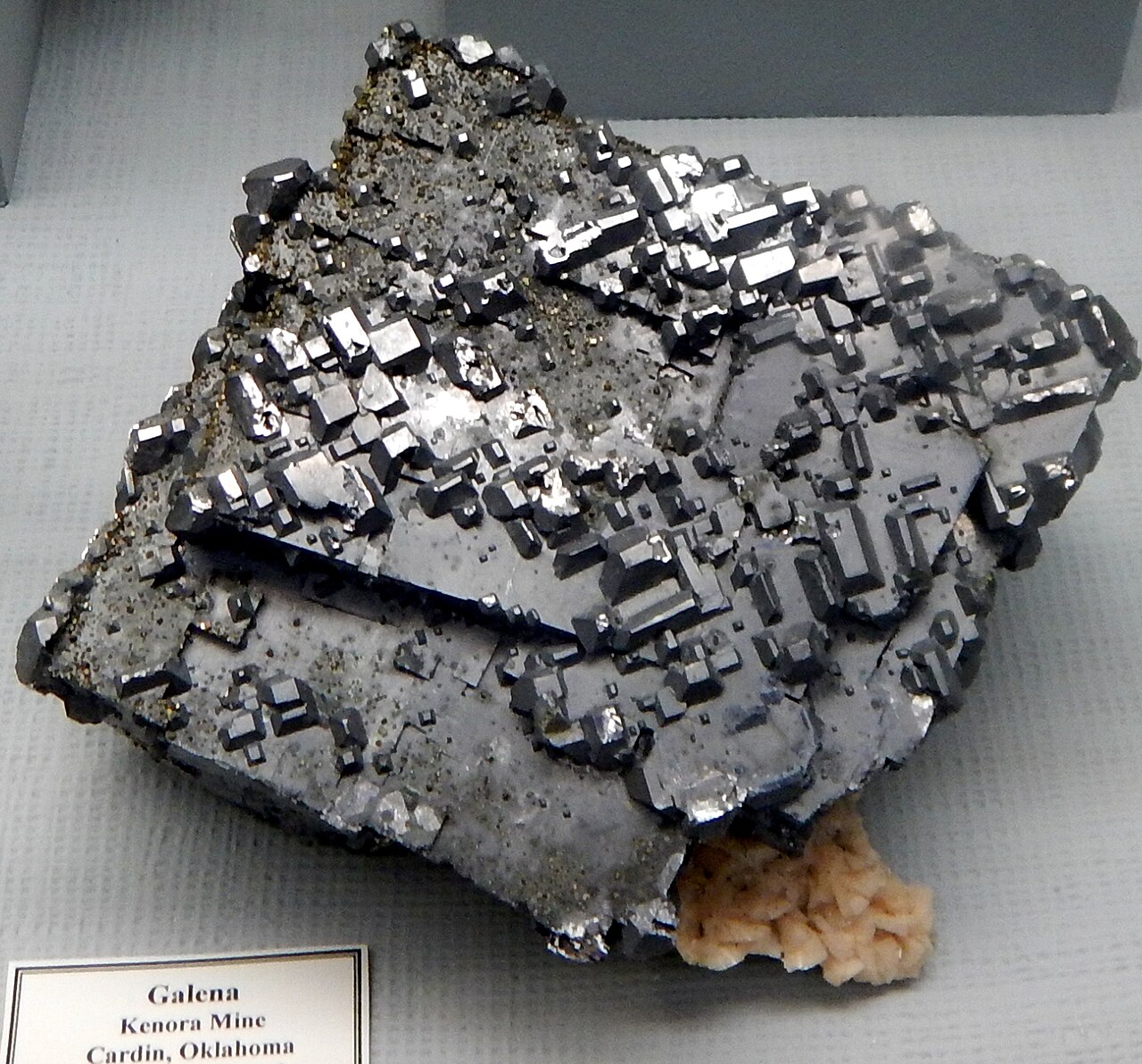
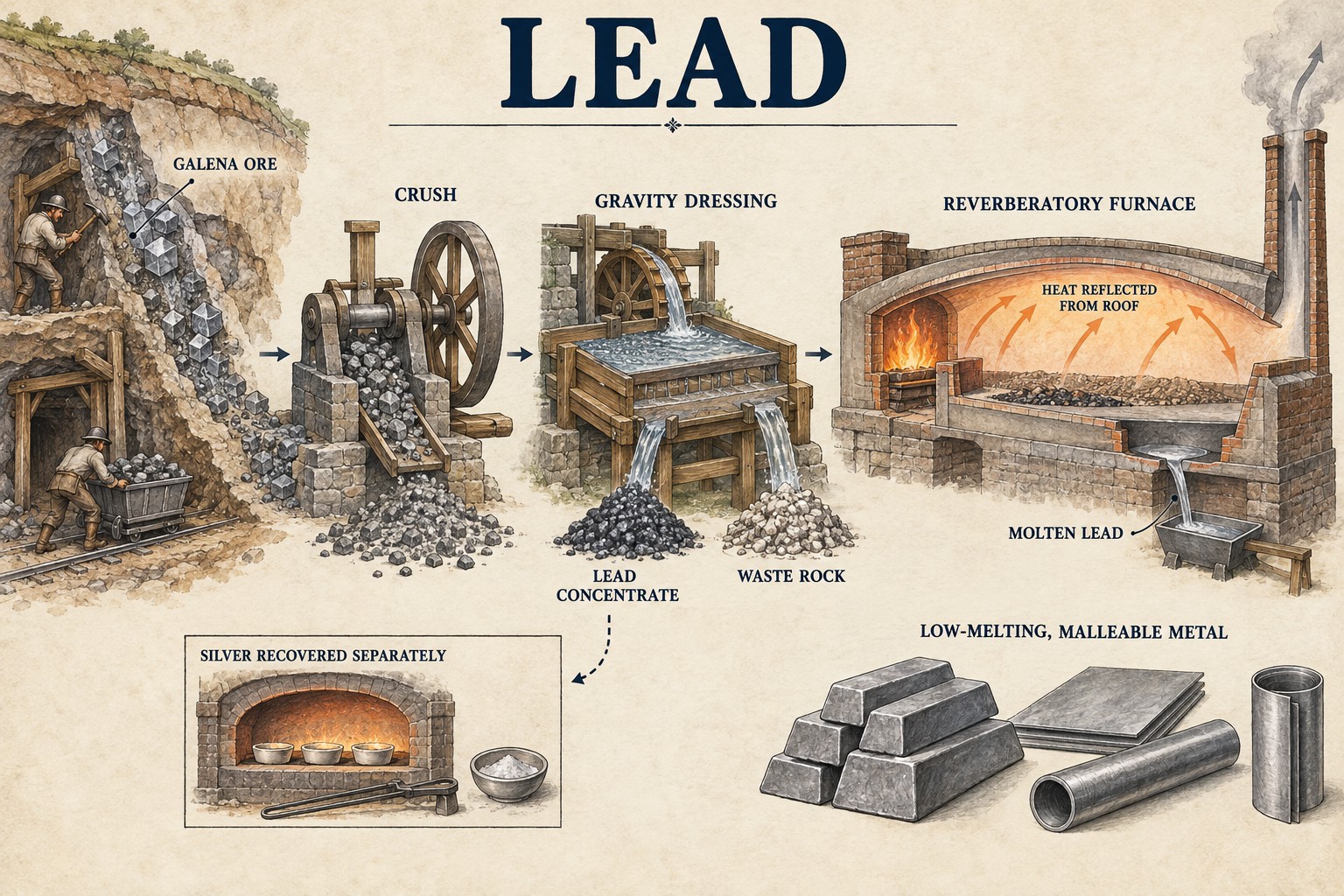
Lead ore (galena) was dressed by crushing and gravity separation — buddling and jigging — to concentrate the heavy ore from lighter waste rock, then smelted in a cupola or reverberatory furnace to yield metallic lead; silver, where present in the ore, was recovered separately from the smelted lead by cupellation.
Why it was used
Lead's low melting point, malleability and resistance to corrosion made it uniquely easy to work into sheet, pipe and shot, while its density gave it obvious advantages for ammunition and, later, for weighting and shielding.
Value over time
Britain dominated world lead production through the 18th and 19th centuries, but that dominance collapsed within a few decades from the 1870s-80s onward as cheaper imported lead — from Spain, Australia and North America — undercut the increasingly marginal British orefields; a collapse in the international lead market in 1880 forced the closure of many North Pennine mines outright, and by the turn of the 20th century British lead mines simply could not compete on price, with the last working mine in Swaledale closing in 1912. Displaced miners emigrated in large numbers to keep mining lead abroad, in Spain and in Pittsburgh in the United States. Today lead trades at around $2,000 a tonne on the London Metal Exchange, but modern demand — some 80% of it for lead-acid batteries — is met mostly (around 60%) by recycling rather than fresh mining, a fundamentally different market from the one that built Britain's historic lead orefields.
Hazards & challenges
Lead is a cumulative poison, and lead miners and — especially — smelter workers suffered chronic lead poisoning (plumbism) throughout the industry's history, long before its cause was properly understood: colic, anaemia, wristdrop (paralysis of the hand), gout, and in severe cases encephalopathy, madness and death. Smelting was consistently the more dangerous stage than mining the ore itself, and even routine maintenance carried real risk — workers who cleared the smelting flues at Nenthead and Eggleston in Teesdale reported severe colicky pains from the concentrated lead fume they were exposed to. In Derbyshire, the effects were common enough to leave a lasting name: 'belland' referred both to lead-poisoned livestock grazing near dressing floors and to the low stone walls built specifically to keep animals off contaminated ground.
Risks & limitations
Lead ore bodies, once stripped of their richest, most accessible ground, become progressively more expensive to work — deeper, lower-grade, or requiring ever more elaborate drainage (soughs, adits, pumping engines) — which is exactly what made British lead so vulnerable once cheap, easily worked foreign ore reached the market.
Regional variation
Lead is, by a wide margin, the most common commodity on this site, worked at dozens of mines across the Pennines (Weardale, Swaledale, Alston Moor), the Peak District, Wales (Cardiganshire, Flintshire, Gwynedd), the Mendips, the Lake District and Scotland (Leadhills-Wanlockhead, Strontian) — each district developing its own vocabulary for shared techniques, notably sough (Derbyshire) versus adit (Cornwall/Devon) for the same gravity-drainage principle. The vocabulary of lead mining is as regional as the orefields themselves, and this site carries the local words on their own pages: the Derbyshire meer and the barmote courts that measured and allotted it, the Cornish and Devon adventurer and cost book, the Pennine sough driven to drain a field rather than a mine. A lead miner moving between orefields would have found the ore familiar and almost nothing else.
Related terminology
Antimony, Flats, Galena, Pipe Vein, Show Cave, Smelt Mill Flue
Mines associated with this term
5 examples chosen from 188 linked records — the term page is not an index.
- Bere Alston Silver-Lead Mines — Devon (well documented example)
Named in this record’s geology: “Silver-bearing lead of the Tamar valley; the veins worked are not named on the record.” - Caplecleugh Mine — Cumbria (well documented example)
Named 4 times in this record, first in the summary: “A lead and, later, zinc mine in the Nenthead field on Alston Moor, opened…” - Combe Martin Silver Mines — Devon (well documented example)
Silver-bearing lead worked from the reign of Edward I to the late 19th century, at times profitable enough to help fund England's wars with France. - Faggergill Mine — North Yorkshire (well documented example)
Named 5 times in this record, first in the summary: “One of Arkengarthdale's principal lead mines, worked in some form since at least the 16th century and…” - Fee Donald Mine — Highland (well documented example)
Named 5 times in this record, first in the summary: “One of five historic lead mines in the Strontian district of Ardnamurchan, opened in 1727 and…”
See every mine that worked lead →
Disasters associated with this term
5 examples chosen from 6 linked records, most direct relationship first.
- Bryngwiog Lead Mine Inundation, 1862 (contextual relationship)
Named twice in this record, first in the summary: “…22 February 1862, water from old workings broke into the Bryngwiog lead mine on Halkyn Mountain in Flintshire and sixteen men were drowned.…” - Bryngwiog Mine inrush, 1862 (contextual relationship)
Bryngwiog was being developed for lead on Halkyn Mountain when it broke through — one of the worst disasters in that district's lead-mining history. - Coldberry Mine roof fall, 1870 (contextual relationship)
Named in this record’s summary: “…two young labourers were crushed by a fall of roof at Coldberry, a lead mine in Teesdale.” - Coldberry Mine waste heap collapse, 1896 (contextual relationship)
Named 3 times in this record, first in the summary: “…February 1896 two young ore dressers were smothered at the Coldberry lead washing, in Teesdale, when a heap collapsed on them.” - Mawstone Mine Disaster (contextual relationship)
Named in this record’s aftermath: “…though it was worked in fits and starts until the 1950s before lead mining across the district became uneconomical.”
Sources
- (primary) History of lead mining — British Geological Survey (Foundations of the Mendips)
- (secondary) A History of Lead Mining in the Pennines — dokumen.pub
- (secondary) Derbyshire lead mining history — Wikipedia
- (secondary) History of lead mining in Derbyshire — Wikipedia
- (secondary) History of lead poisoning in the world — Dr Herbert L. Needleman
- (secondary) Lead Mining Heritage in the Peak District: A Guide — Lithosphere Expeditions
- (secondary) Lead Production in the 18th and 19th Centuries — MyLearning (Yorkshire Dales)
- (secondary) Occupational Exposure to Heavy Metals Poisoning: Scottish Lead Mining — Social History of Medicine (Oxford Academic)
Record created: 20 August 2026 · Last researched: 11 September 2026