 MineArchive
Antimony
| Category | Commodities |
|---|---|
| Commodity page | Antimony → |
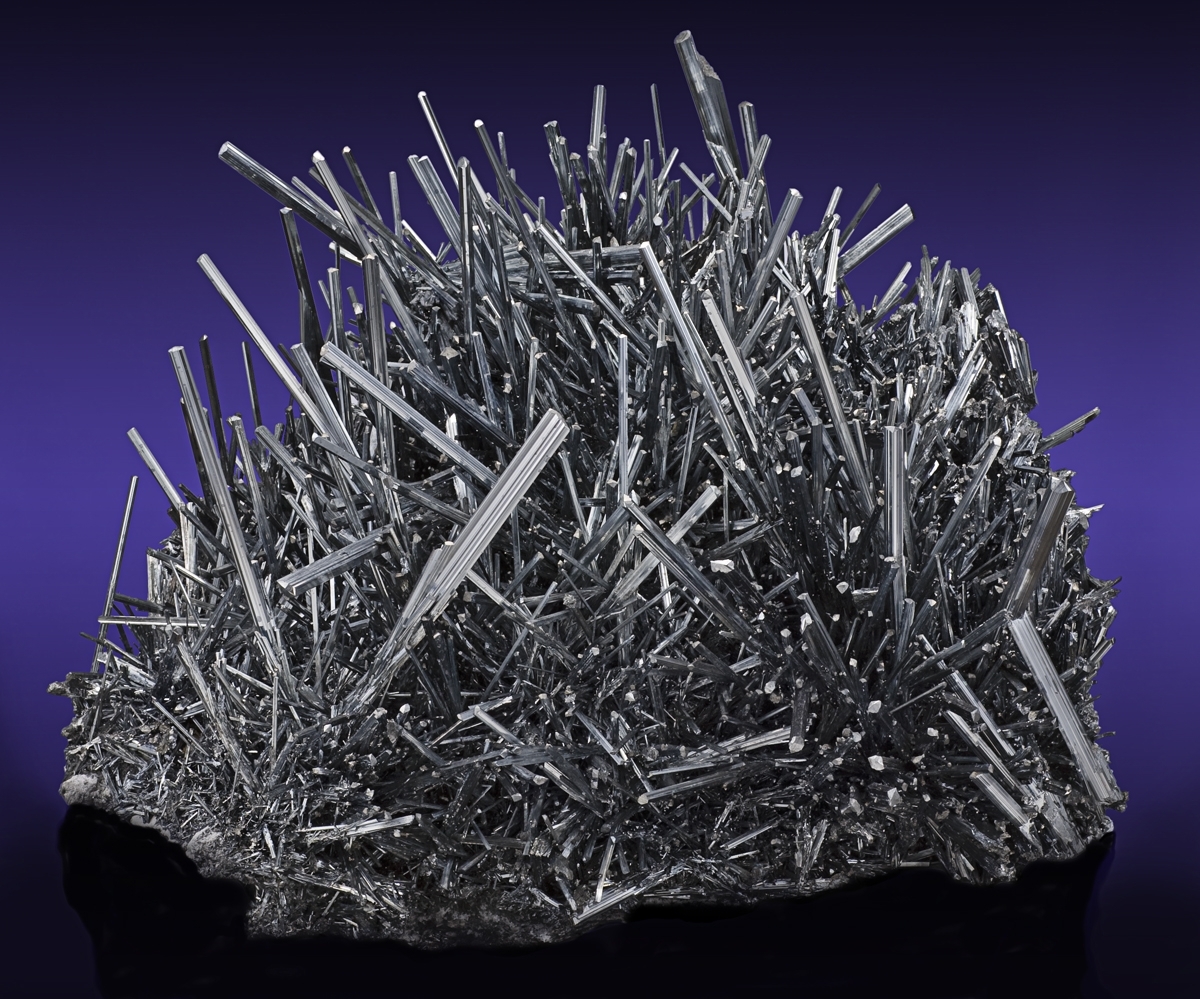
A brittle, silvery-white semi-metal mined chiefly as the sulphide ore stibnite, historically alloyed with lead and tin to make hard, durable metal, and today used mostly as a flame retardant — a mineral known and worked in Britain only on a small, short-lived scale, at Glendinning in Dumfries and Galloway.
Historical usage
Antimony compounds have been known and used since antiquity — a roughly 5,000-year-old antimony vase survives in the Louvre — but Britain's own antimony mining history is brief and narrow. The Louisa Mine at Glendinning, opened in 1793, was Britain's first and probably largest antimony mine, yet it was worked for barely five years before closing, and its two later reopenings, in the 1890s and around 1920, were smaller still. Britain's antimony needs were met overwhelmingly by imports throughout the metal's industrial history, from 19th-century alloying and pigment uses through to the flame-retardant chemistry that dominates demand today.
How it worked
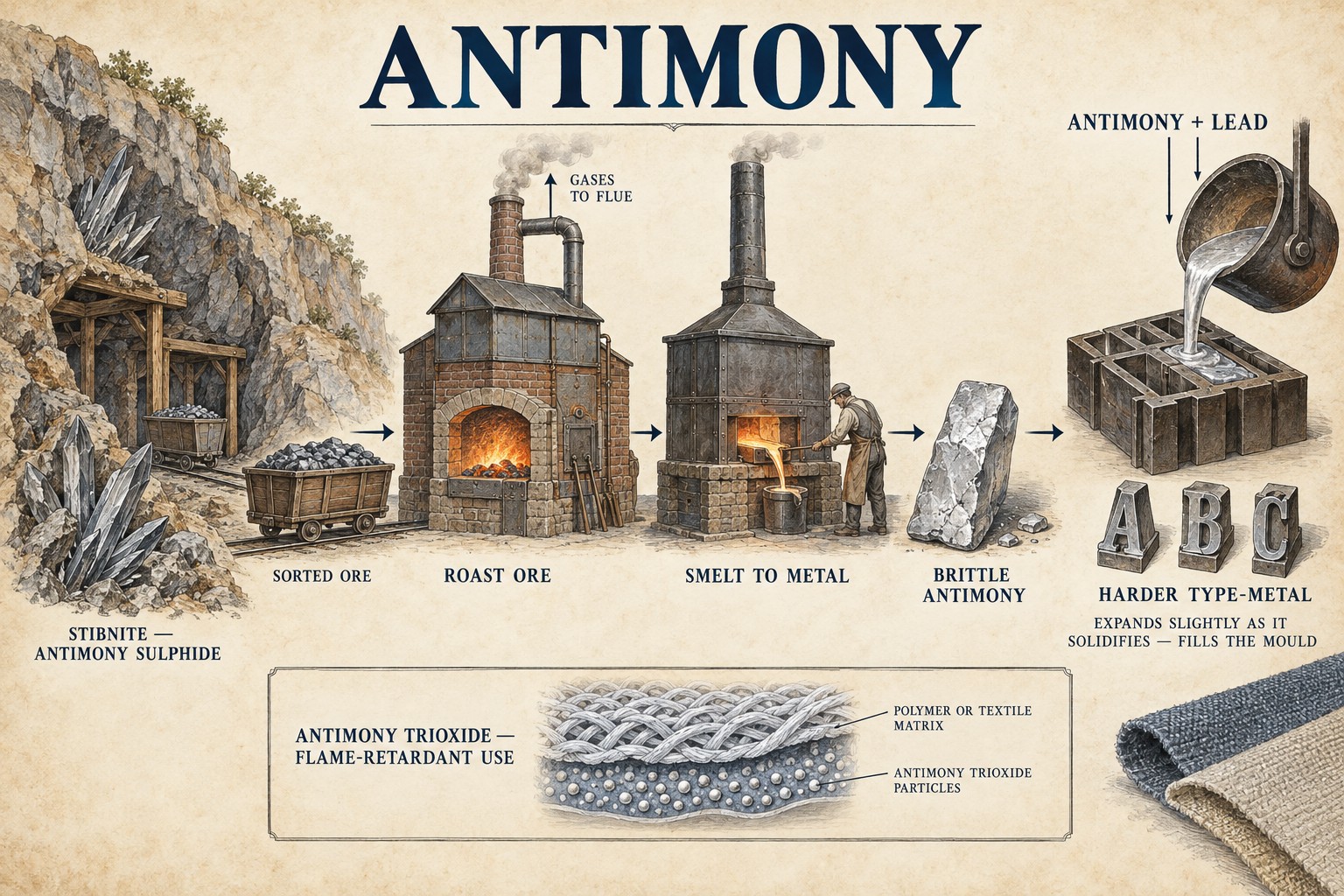
Antimony was mined as the ore stibnite (antimony sulphide) from mineral veins, then roasted and smelted to release the metal, historically close to the mine itself — at Glendinning, ore was smelted right next to the mining village of Jamestown rather than shipped out unprocessed. The metal's most valuable industrial property is that, unlike most metals, it expands slightly on solidifying, letting antimony alloys take a very sharp, complete impression of a mould — exactly the quality that made it indispensable in metal type casting.
Why it was used
Alloyed with lead, antimony makes a much harder, more durable metal than lead alone — the basis of printers' type-metal, used for centuries to cast the individual letters of hand-set printing, and of 'British metal', a lead-free pewter alloyed with tin instead. Antimony trioxide is also an effective flame retardant, and today accounts for the largest single share of world antimony consumption, blended into plastics, textiles and electronics casings. Other applications have included ammunition (Major-General Henry Shrapnel's 1784 shrapnel shell design used an antimony-hardened lead alloy for its shot) and, more recently, lead-acid batteries and semiconductors.
Value over time
For most of its industrial history antimony was a steady, unglamorous input to type-metal, pewter and, from the mid-20th century onward, flame-retardant chemistry — commodities whose demand grew with printing and consumer manufacturing but never generated dramatic price swings. That changed sharply in the 2020s: China, which dominates world antimony mining and refining, imposed export controls in late 2024 explicitly citing the metal's strategic and military value, and prices that had sat around $1,400 a tonne before the controls rose to roughly $38,000 by September 2024 and over $60,000 within about a year — a shift from an obscure industrial input to a metal now formally classed as critical by the EU, US and China alike.
Hazards & challenges
Antimony is toxic to humans in even modest exposure, and long-term exposure to antimony compounds has been linked to lung cancer and other serious respiratory harm — a hazard shared by both the miners handling stibnite ore and the smelter workers roasting it, since roasting sulphide ore drives off toxic fumes. Antimony ore bodies frequently carry arsenic alongside the antimony itself, compounding the hazard rather than adding a separate, unrelated one. The contamination also long outlasts the mining: soil at Glendinning still shows measurably elevated antimony, arsenic and lead more than a century after the mine closed, from ore processed and smelted right at the site.
Risks & limitations
Britain was never a serious antimony producer: Glendinning's total output across all three of its working periods came to only around 200 tonnes of ore, a trivial figure next to the country's industrial demand, so domestic mining was always a marginal sideline rather than a real substitute for imports. That import dependence has become a live strategic concern in the 21st century: production is now heavily concentrated in China, which introduced export controls on antimony in 2024-25 citing the metal's military applications, and world prices responded by rising roughly fivefold within about a year.
Regional variation
Glendinning is essentially Britain's only antimony mine of any real note — a single, short-lived Scottish deposit rather than part of any wider British antimony-mining district, which is what makes it worth recording in some detail even though its total output was small; nowhere else in Britain hosted a comparable stibnite deposit worth mining.
Related terminology
Mines associated with this term
Included only where MineArchive's own research gives a reasonable evidential basis — not every mine where this might plausibly apply.
- Glendinning (Louisa) Mine — Dumfries and Galloway (well documented example)
Britain's first and largest antimony mine, worked as stibnite ore in three short periods between 1793 and 1922.
See every mine that worked antimony →
Sources
- (primary) Mineral Commodity Profiles: Antimony — USGS
- (secondary) A brief primer on the history of antimony — North of 60 Mining News
- (secondary) Critical minerals (Part 10): Antimony - a metal with a long memory — Deposits Magazine
- (secondary) Mobility of antimony, arsenic and lead at a former antimony mine, Glendinning, Scotland — Science of the Total Environment
Record created: 21 August 2026 · Last researched: 22 August 2026