 MineArchive
Tin
| Category | Commodities |
|---|---|
| Commodity page | Tin → |
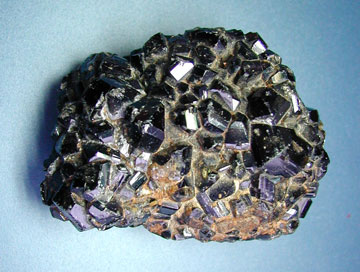
A pale, corrosion-resistant metal (Sn) smelted from cassiterite ore, worked in Britain for over 4,000 years — the metal that gave Cornwall its name in trade with the ancient Mediterranean and underpinned Britain's Bronze Age economy.
Historical usage
Cornish tin streaming for cassiterite began in the Bronze Age, and by Roman times Cornwall's tin was traded as far as the Mediterranean. Deep lode mining developed from the 16th century onward, and by the mid-19th century Cornwall had around 2,000 tin mines and produced roughly half the world's tin — around 10,000 tons a year — even as its copper industry collapsed. Competition from cheaper Malayan and Bolivian tin drove a long decline; a brief 20th-century revival around Geevor and South Crofty ended when South Crofty, Europe's last working tin mine, closed in 1998 after the 1985 world tin price crash made it unviable.
How it worked
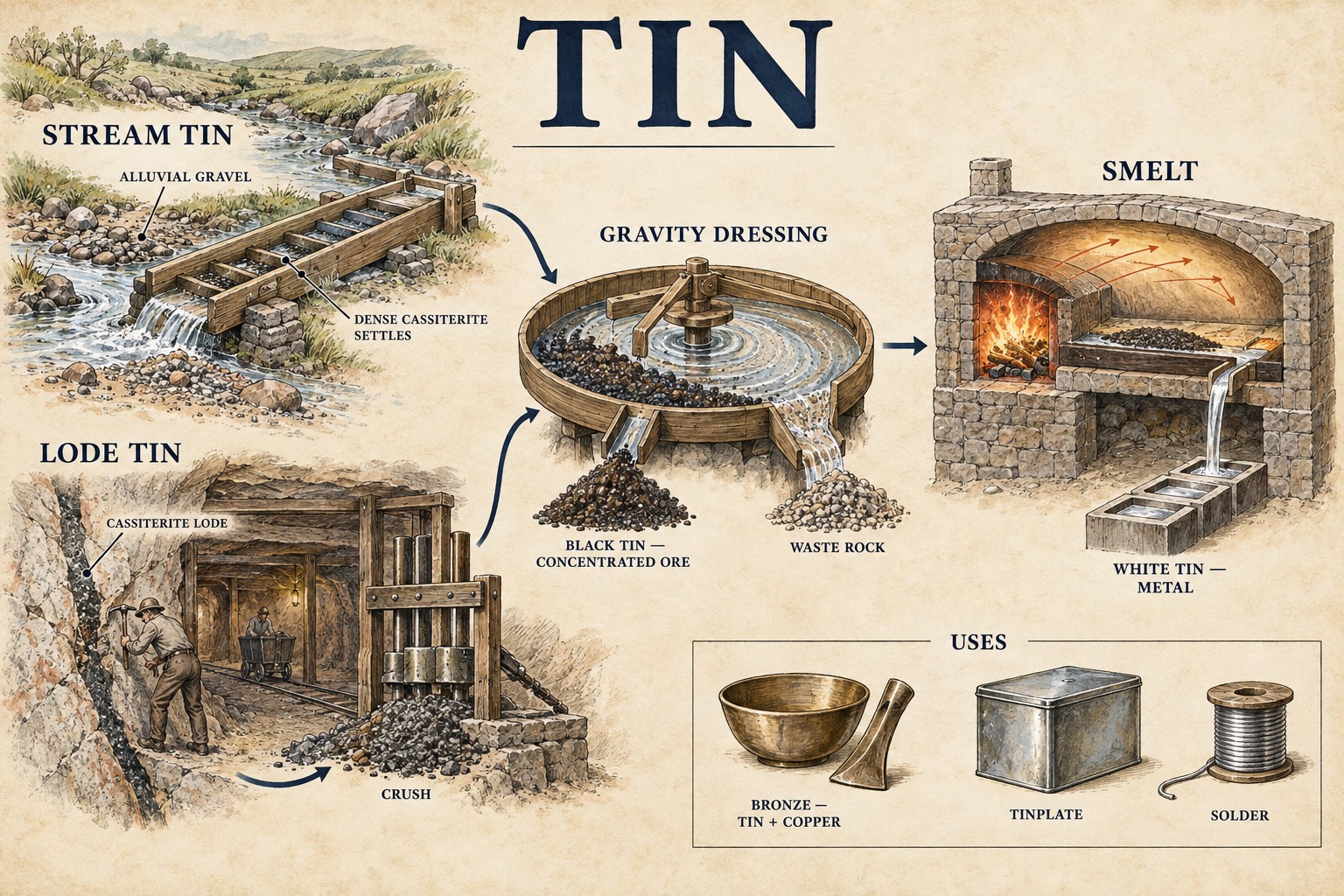
Tin occurred both as alluvial "stream tin" washed into river gravels, recovered by streaming and panning, and as lode tin (cassiterite) in hard-rock veins, reached by deep shaft mining. Crushed ore ("black tin") was concentrated by gravity — buddling, vanning, jigging — to separate dense cassiterite from waste rock, then smelted in a reverberatory furnace to yield metallic "white tin."
Why it was used
Tin's low melting point, resistance to corrosion, and — critically, alloyed with copper — its ability to produce bronze, far harder and more useful than either metal alone, made it one of the most sought-after metals of the ancient and medieval world. Later, tinplating for food cans and use in solder and pewter kept demand high into the industrial era.
Value over time
Tin's price was effectively managed for most of the 20th century by the International Tin Council, a cartel of producer and consumer nations that bought stock to maintain a floor price. That system collapsed on 24 October 1985, when the Council ran out of money to defend the price after accumulating a 62,000-tonne stockpile and debts of up to $950 million; the market price halved almost overnight, and the London Metal Exchange suspended tin trading for months. The crash removed any remaining economic case for Cornwall's high-cost deep mines, and South Crofty closed in 1998.
Hazards & challenges
Cornish tin lodes frequently run alongside arsenopyrite, so tin miners and processors faced arsenic exposure on top of the industry-wide risk of silicosis from crystalline silica dust in granite and quartz workings; a documented rise in fatal lung disease among young Cornish miners in the late 19th and early 20th centuries was linked directly to this dust exposure, compounded by tuberculosis.
Risks & limitations
Cornwall's tin lodes run deep and narrow, making extraction increasingly expensive as workings went deeper and had to be pumped continuously against flooding; by the 20th century, Cornish tin could not compete on cost with the much larger, shallower and cheaper deposits of Malaya, Bolivia and Nigeria.
Regional variation
Overwhelmingly a Cornwall-and-west-Devon story in Britain — the "Tin Coast" around St Just, and Camborne-Redruth — though small-scale streaming also occurred historically on Dartmoor's fringes.
Related terminology
Black Tin and White Tin, Bronze Age, Tungsten
Mines associated with this term
5 examples chosen from 90 linked records — the term page is not an index.
- Geevor Tin Mine — Cornwall (well documented example)
Named 6 times in this record, first in the summary: “…was one of Cornwall's largest and longest-lived 20th-century tin mines, closing in 1990 after nearly 80 years as Geevor Tin Mines…” - Levant Mine — Cornwall (well documented example)
Named 10 times in this record, first in the summary: “Levant, on Cornwall's Tin Coast, worked tin and copper lodes running out under the sea for…” - Brimpts Tin Mine — Devon (well documented example)
Named twice in this record, first in the summary: “A Dartmoor tin sett on the southern slopes of Laughter Tor, west of Dartmeet,…” - Devon United Mine — Devon (well documented example)
Named 4 times in this record, first in the summary: “…South Devon United — worked from about 1820 for copper and later for tin and arsenic. Almost nothing is left above ground, but the dumps of…” - Wheal Hermon — Cornwall (well documented example)
Named twice in this record, first in the summary: “Reputed to be the oldest tin mine in Cornwall marked on a map -- Hatfield's 1560 survey of the St…”
See every mine that worked tin →
Disasters associated with this term
Included only where MineArchive's own research gives a reasonable evidential basis, with the nature of the relationship stated — not every disaster where this term might plausibly apply.
- Dolcoath Mine stope collapse (contextual relationship)
The 1893 collapse occurred after Dolcoath's shift from copper to tin working.
Sources
- (primary) Tin mining and silicosis in Cornwall — PubMed
- (secondary) Economic History: The International Tin Cartel — International Tin Association
- (secondary) South Crofty — Wikipedia
- (secondary) The story of Cornish tin mining — British Heritage
Record created: 22 August 2026 · Last researched: 22 August 2026