 MineArchive
Geevor Tin Mine
| Location | Between Pendeen and Trewellard, Cornwall — 50.1525, -5.6758 (exact) |
|---|---|
| Commodities | Tin, Copper |
| Type | Metal |
| Worked | 1911–1990 |
| Maximum depth | 480 m (1,575 ft) at Victory Shaft, 1975; a sub-incline reached about 650 m below surface |
| Operators | West Australian Gold Field Company (1904–1911), Geevor Tin Mines Ltd (1911–1990) |
Overview
Geevor, on the coast between Pendeen and Trewellard, was one of Cornwall's largest and longest-lived 20th-century tin mines, closing in 1990 after nearly 80 years as Geevor Tin Mines Ltd. It is now the largest preserved mine site in Britain, run as a museum within the Cornwall and West Devon Mining Landscape World Heritage Site.
History
Workings on the site have much older origins, with tin and copper extraction recorded from the late 18th century under the name Wheal an Giver (Cornish for ‘mine of the goats’); it later operated as East Levant Mine until 1840 and as North Levant from 1851 to 1891. After the Second Boer War, returning St Just miners established Levant North, known as Wheal Geevor, in 1901. The West Australian Gold Field Company acquired the mine in 1904, and the operation was reorganised as Geevor Tin Mines Ltd in 1911. The Wethered Shaft was begun in 1909, and the Victory Shaft was sunk around 1919 to mark the end of the First World War, though work there was discontinued in 1944. Over nearly 80 years of operation, Geevor's workings extended to more than 85 miles of tunnels, yielding around 50,000 tons of black tin and generating over £7 million in profit; daily pumping exceeded a million gallons of water, roughly a quarter of it seawater. During the 1960s, underground development broke into a seabed void connecting toward the neighbouring Levant mine's flooded workings, which had closed in 1930, and the breach had to be sealed before work could continue. Employment peaked at around 270 in the 1960s, falling to about 120 by 1988. The mine finally closed in 1990, not because its tin was exhausted but because it was no longer economically recoverable following the 1985 collapse of the International Tin Council and the resulting fall in tin prices; pumps were switched off in May 1991.
Geology
Tin-bearing lodes at Geevor lie within Carboniferous biotite granite intruded into Devonian killas (metamorphosed sedimentary and volcanic rock). Cassiterite, forming roughly 1% of vein material, occurs in northwest–southeast trending veins alongside quartz, tourmaline, metal sulphides and fluorite.
Geological setting: Hydrothermal Deposits (well documented example), Veins and Lodes (well documented example)
Workings
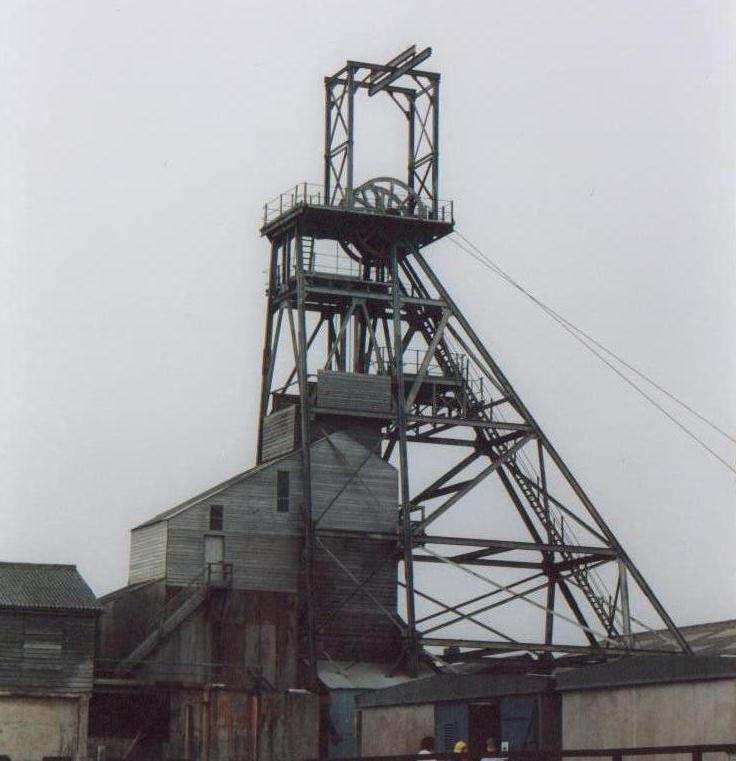
Principal shafts were the Wethered Shaft, begun 1909, and the Victory Shaft, sunk from 1919 about 500 m away and named for the end of the First World War. Victory Shaft carried men and materials in a nine-man cage and raised ore in two-tonne skips; it took a wooden headgear in 1919, a steam winder in 1923, and in 1954 the galvanised steel headgear that still stands, erected over the old timber frame with a new electric winder. The shaft reached its full depth of 480 m in 1975, and from that year an inclined sub-shaft was driven from near its bottom to reach Levant's workings under the Atlantic, taking the mine to about 650 m below surface with ore returned to Victory Shaft by conveyor. Underground tours today access the 18th-century Wheal Mexico workings, among the oldest parts of the site.
Closure
Geevor closed in 1990 not for want of tin but because the tin left could no longer be won at a profit, after the October 1985 collapse of the International Tin Council took the price down with it. The mine went into care and maintenance, and the pumps were switched off in May 1991, allowing the workings to flood.
What remains
Since closure, the 67-acre site has been preserved as Cornwall's largest mine museum, including the Hard Rock Museum, mill, compressor hall, mess/'dry', and locker rooms, run since 2001 by the charity Pendeen Community Heritage. A £3.8 million improvement programme was funded through the Heritage Lottery Fund, Objective One and local councils. The site was inscribed as part of the Cornwall and West Devon Mining Landscape UNESCO World Heritage Site in 2006, and is a European Route of Industrial Heritage Anchor Point. The Victory Shaft headgear, weathered by decades of coastal exposure, was refurbished between February and October 2022 — encapsulated for blasting and recoating, with corroded steel and rotten timber replaced and a new landing support frame fitted.
The headframe, mill, compressor hall and other surface buildings survive largely intact as part of the museum, alongside underground access to the historic Wheal Mexico workings.
Related mines
- Levant Mine — Geevor's 1960s underground development broke into Levant's own flooded workings, which had to be sealed before work could continue.
- Pendeen Consols — Pendeen Consols was absorbed into the Geevor sett, and its surviving mine plan came to the BGS from Pendeen Community Heritage at Geevor Tin Mine.
- Wheal Edward — Geevor Tin Mines later owned Wheal Edward and explored its cliff and undersea sections.
Nearby mines
- Higher Levant Mine — 0.4 miles (0.7 km) SW
- Levant Mine — 0.4 miles (0.7 km) W
- Parkenoweth Mine — 0.5 miles (0.8 km) E
- East Boscaswell Mine — 0.8 miles (1.3 km) NE
- Wheal Cock — 0.8 miles (1.3 km) SW
Straight-line distance, within 9 miles (15 km). Show on the map.
Disasters & major incidents
-
Levant Mine man-engine disaster
20 October 1919 · Winding / Shaft Accident · 31 fatalities
During a shift change at Levant Mine, a link between the man-engine's reciprocating rod and its surface beam broke, collapsing the engine down the shaft while 130-150 miners were using it.
What's uncertain
Points where sources disagree or the record could not be settled; both accounts are kept. All open questions in the archive.
- A 2024 report on the preserved site describes lockers in the mine's ‘dry’ (changing room) still marked with the mine's closure date, some still holding personal items and work clothing. (uncertain) 2
Recorded claims
Individual factual claims, each attached to the source(s) that support it below. Where sources disagree, both are kept.
- Geevor's underground workings connect toward the flooded former Levant mine, closed since 1930; during the 1960s a breach into a seabed void had to be sealed before work could extend in that direction. 1
- Over its operating life, Geevor produced around 50,000 tons of black tin from more than 85 miles of tunnels, generating over £7 million in profit. 1
- Geevor's 1990 closure followed the 1985 collapse of the International Tin Council; the mine was not exhausted of tin ore but ceased to be economically recoverable, with pumps switched off in May 1991. 1
- A 2024 report on the preserved site describes lockers in the mine's ‘dry’ (changing room) still marked with the mine's closure date, some still holding personal items and work clothing. (uncertain) 2
- Victory Shaft reached its full depth of 480 m (1,575 ft) in 1975; an inclined sub-shaft driven from near its bottom to reach the Levant workings took the mine to about 650 m below surface. 3
- The present galvanised steel headgear was erected over the original timber frame in 1954, together with a new electric winder, the shaft having been sunk with a wooden headgear in 1919 and given a steam winder in 1923. 3
- The Victory Shaft headgear was refurbished between February and October 2022 — encapsulation, blasting and recoating, steel and timber repair, and a new GRP landing support frame. 4
- BGS holds scanned Geevor plans including level plans for No 3, No 14 and No 15 levels and a plan of the exploration of the undersea sections of West Wheal Owles and Wheal Edward. 5
Photographs & further reading
One of several scanned Geevor level plans in the BGS catalogue.
View sourceThe museum's own account of the shaft, its headgear and the sub-incline driven to the Levant workings.
View sourceA report on the preserved site covering the headframe, the miners' locker room and shower block, and the ore-processing plant.
View sourceSources
- (secondary) Geevor Tin Mine — Wikipedia
- (observational) Geevor Tin Mine, Cornwall - August 2024 — 28DaysLater
- (primary) Victory Shaft — Geevor Tin Mine Museum
- (secondary) Geevor Tin Mine, Cornwall — Victory Shaft headgear refurbishment — Taziker
- (primary) BGS mine plans catalogue: Geevor Mine No 15 Level (record 24123) — British Geological Survey
Record created: 19 August 2026 · Last researched: 25 August 2026