 MineArchive
Care and Maintenance
| Also known as | C&M (industry abbreviation), On care and maintenance (usual form in company statements) |
|---|---|
| Category | Later Uses & Research |
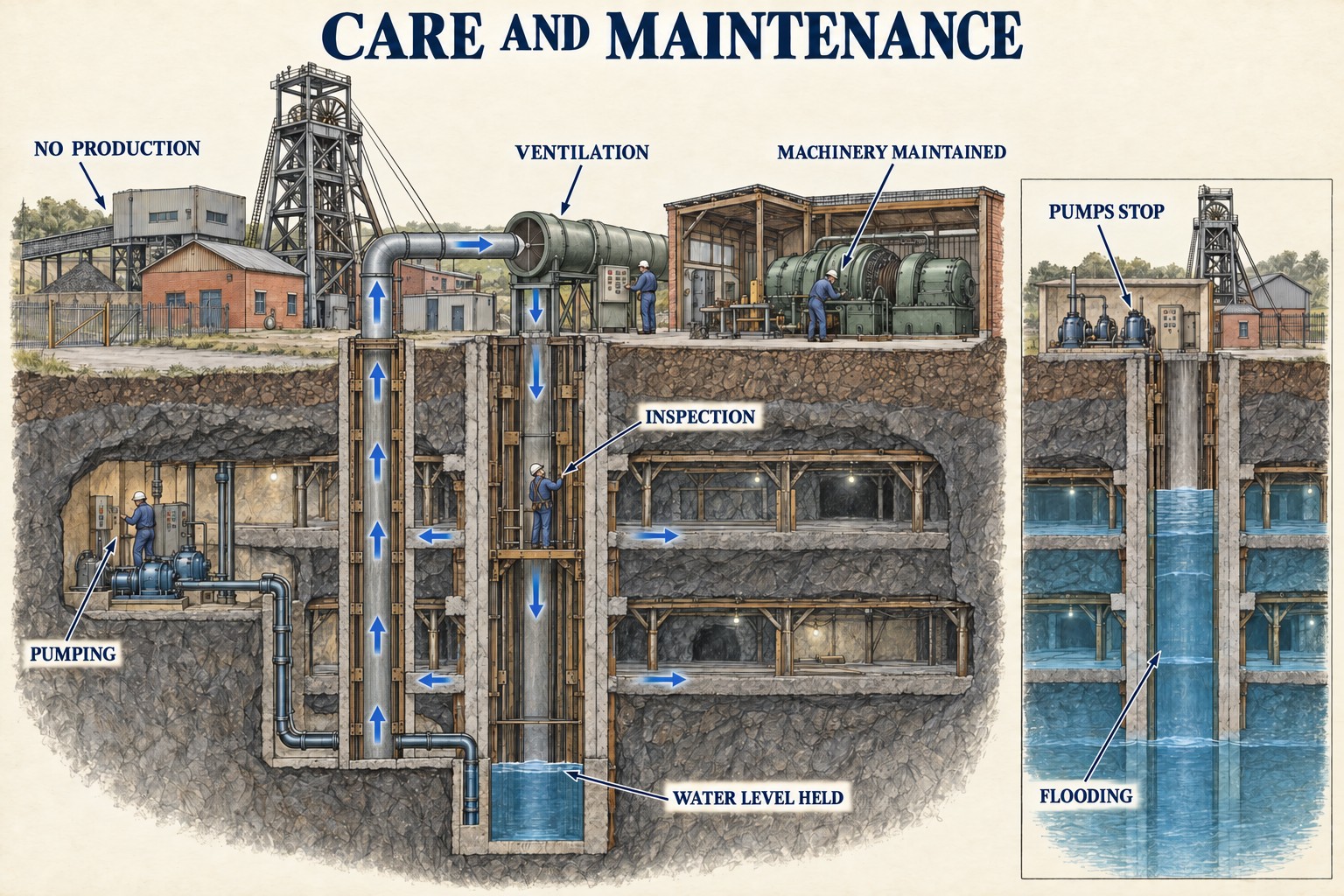
The state a mine enters when production stops but abandonment has not been accepted: the workings are kept pumped, ventilated and safe, and the shafts kept open, against the possibility of restarting. It is a holding position, and an expensive one.
Historical usage
The phrase belongs to 20th-century and modern mining rather than to the Victorian vocabulary, and in Britain it is bound up with the long decline of metal mining and coal. Its meaning is clearest in the mines that did not get it: Geevor stopped producing in 1990 and went to care and maintenance, but the pumps were switched off in May 1991 and the workings flooded; South Crofty closed in 1998 and flooded too, and reversing that has since required a water treatment plant, active dewatering from 2023 and the pumping and treating of some eight million cubic metres of water, with production not expected before the late 2020s.
How it worked
A mine on care and maintenance keeps a skeleton crew doing the work that stops the mine destroying itself: pumping to hold the water level, ventilating so the workings remain enterable, inspecting shafts, headgear and ground support, and maintaining idle machinery, tailings dams and water treatment. Nothing is produced. The cost is carried in the expectation that the metal price, or the owner's finances, will change.
Why it was used
Because reopening a maintained mine is a different proposition from reopening a flooded one. Water is the decisive factor: once pumping stops, the workings fill, timber and steel corrode, and the cost of getting back in rises by orders of magnitude — which is why care and maintenance is the difference between a pause and, in practice, an ending.
Risks & limitations
It only works while someone pays for it, and the companies that put mines on care and maintenance are often the ones least able to keep doing so. The pumps going off is rarely a neutral event either: at Wheal Jane the pumps were stopped after closure in 1991 and the following year an adit near the surface gave way, discharging tens of millions of litres of acidic mine water into the Carnon River and the Fal estuary.
Regional variation
A universal industry status rather than a regional practice, but in a British context it is most associated with Cornwall's last tin mines and with late 20th-century collieries, where 'on care and maintenance' was frequently the formula used publicly for a closure that everyone involved expected to be permanent.
Related terminology
Inrush, National Coal Board, Shaft, Shaft Capping, Subsidence
Mines associated with this term
5 examples chosen from 14 linked records — the term page is not an index.
- Geevor Tin Mine — Cornwall (well documented example)
Geevor went to care and maintenance on closing in 1990; the pumps were switched off in May 1991 and the workings flooded. - Hickleton Main Colliery — South Yorkshire (well documented example)
Named in this record’s closure notes: “…Mine Research Society's account has the pit merged with Highgate on care and maintenance in January 1986 and closed in 1988, its shafts filled and the site…” - Thorne Colliery — South Yorkshire (well documented example)
Named in this record’s summary: “…shaft was finished; and water closed the pit in 1956. It stayed on care and maintenance for another half-century while three separate attempts to reopen it…” - Cononish Mine — Stirling (well documented example)
Named twice in this record, first in the current condition: “…into administration on 24 November 2023, and the site was placed on care and maintenance with a core team retained for environmental monitoring. The…” - Hem Heath Colliery — Staffordshire (well documented example)
Named in this record’s closure notes: “…produced in October 1992 and closed formally in October 1993 on a care-and-maintenance basis. Coal Investments then took it over and shut the Florence…”
Disasters associated with this term
Included only where MineArchive's own research gives a reasonable evidential basis, with the nature of the relationship stated — not every disaster where this term might plausibly apply.
- Wheal Jane acid mine water discharge, 1992 (direct cause)
The discharge followed the cessation of pumping after closure — the failure mode care and maintenance exists to prevent.
Sources
- (primary) Victory Shaft — Geevor Tin Mine Museum
- (secondary) Care and maintenance — Wikipedia
- (secondary) Cornish Metals starts dewatering UK tin mine — Mining.com
Record created: 25 August 2026 · Last researched: 25 August 2026