 MineArchive
Thorne Colliery
| Also known as | Moorends Colliery |
|---|---|
| Location | Moorends, near Thorne, on Thorne Moors north-east of Doncaster, South Yorkshire — 53.6355, -0.9350 (exact) |
| Commodity | Coal |
| Type | Coal |
| Worked | January 1925–1956 |
| Maximum depth | 964 yards (about 881 m) at No. 2 shaft; coal was reached at 921½ yards (842.6 m). |
| Operators | Pease & Partners Ltd. (1909–1947), National Coal Board (1947–1956) |
Overview
A colliery on Thorne Moors north-east of Doncaster whose sinking took seventeen years — one of the longest and most difficult in British mining — against water that never stopped coming. Coal was reached in 1924 at 921 yards; six sinkers died in a shaft accident in 1926 weeks before the second shaft was finished; and water closed the pit in 1956. It stayed on care and maintenance for another half-century while three separate attempts to reopen it came to nothing.
History
Experimental borings began in 1902 and continued to 1908; a borehole put down in 1904 by the Thorne Borehole Syndicate, a group of local businessmen, proved the Barnsley Bed in 1908 at 916 yards and roughly nine feet thick. Pease & Partners of Darlington took on the sinking, forecasting 6,000 tons a day at a cost of £500,000 over ten years.
Work began around 1909 and the trouble started almost at once. After June 1910 the workings were inundated and sinking was suspended while electric pumps were installed. Difficulties were reported to the company's 1911 annual meeting; work stopped again in 1912 and would only resume if the royalty owners took less. Ground freezing was used in 1913 under German supervision, with eighteen months' more work expected. Then the war: the German workers running the freezing plant were arrested and taken to York Castle, released the next day, registered and allowed back, then re-arrested a week later, though four were still at the mine in November. Sinking was suspended in June 1915.
Work restarted in 1919, this time using the cementation process rather than freezing, and within six months the water ingress had practically stopped. Coal was finally reached in August 1924 at 921½ yards and worked from January 1925. The second shaft was completed in 1926 and claimed as the deepest in South Yorkshire — but on 15 March that year, weeks before it was finished, six sinkers fell to their deaths when the capstan engine holding their scaffold failed (see Disasters, below).
Production then ran well through the 1930s and 1940s, with shaft water a constant nuisance and labour relations strained; by 1943 pumping capacity had been raised to 900 gallons a minute. The colliery was nationalised on 1 January 1947 and worked another nine years. In 1956 it was 'temporarily' closed by flooding and faults; in August 1958 the No. 2 shaft lining failed. A 1966 paper of the Mining Engineers, opening with the judgement that Thorne 'was probably the most courageous coal mining enterprise undertaken in the early years of the twentieth century', identified the fundamental problem as unconformable strata driving excessive water flow, and proposed composite steel-and-concrete shaft linings.
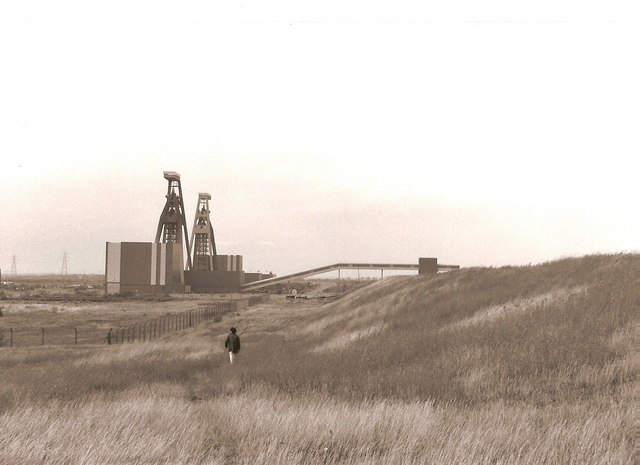
Reopening was attempted twice more. The NCB planned a £180 million restart in the 1980s and erected new headgear and winding gear, but the collapse in coal prices ended it; RJB Mining proposed a restart in the 1990s, and in 2002 the pit was judged uneconomic. In 2004 the pumps were turned off and on 18 August the headgear was demolished, watched by many in the community.
Geology
The colliery was sunk on Thorne Moors to the Barnsley Bed, proved by borehole in 1908 at 916 yards and about nine feet thick — deep coal on the concealed eastern edge of the South Yorkshire coalfield. The overlying sequence was the problem: the Mining Engineers' 1966 paper identified unconformable strata, geologically out of sequence, as the fundamental cause of the excessive water flow that dogged the pit from first sinking to final abandonment. The No. 2 shaft reached 964 yards, with an inset at 863 yards at the Kent's Thick or High Hazel seam where it connected to No. 1.
Geological setting: Concealed Coalfields (well documented example), Sedimentary Beds and Seams (well documented example)
Workings
Two shafts, sunk with extraordinary difficulty over seventeen years — ground freezing under German supervision from 1913, then the cementation process from 1919. No. 2 was 21 ft finished diameter and 964 yards deep, with an inset at the High Hazel seam at 863 yards connecting to No. 1. Pumping was permanent and heavy: 900 gallons a minute by 1943. Shaft linings were the recurring weak point, No. 2's failing in August 1958, and composite steel-bonded-to-concrete linings were proposed in 1966 to withstand the hydrostatic pressure.
Closure
'Temporarily' closed in 1956 by flooding and faults, with a few voluntary redundancies and the rest of the workforce redeployed; production never resumed. The No. 2 shaft lining failed in August 1958 and the site stayed on maintenance for decades. Wikipedia dates the end of production to 1958. Restart plans by the NCB in the 1980s and RJB Mining in the 1990s both failed, and in 2002 the pit was judged uneconomic. The pumps were switched off in 2004 and the headgear demolished on 18 August that year.
What remains
Nothing of the colliery stands. The headgear — erected for the 1980s restart that never happened — was demolished on 18 August 2004, watched by many local people, and the pumps were turned off the same year. Thorne Colliery F.C. is among the few remaining reminders of the pit, and part of the site has since been developed as a solar farm.
None. The headgear came down in 2004 and the site has been cleared.
Redevelopment
Part of the former colliery site has been developed as a solar farm.
Nearby mines
- Hatfield Main Colliery — 3.8 miles (6.1 km) SW
- Askern Main Colliery — 8.8 miles (14.2 km) W
- Markham Main Colliery — 8.8 miles (14.2 km) SW
Straight-line distance, within 9 miles (15 km). Show on the map.
Disasters & major incidents
-
Thorne Colliery Shaft Accident, 1926
15 March 1926 · Winding / Shaft Accident · 6 fatalities
Six sinkers were killed at Thorne Colliery on 15 March 1926 when the capstan engine holding their six-ton sinking scaffold failed and dropped it, with its ropes, to the bottom of the No. 2 shaft. It was the largest loss of life in a British mine that year, and it came three weeks after sinking proper had been completed.
Recorded claims
Individual factual claims, each attached to the source(s) that support it below. Where sources disagree, both are kept.
- A borehole sunk in 1904 by the Thorne Borehole Syndicate proved the Barnsley Bed in 1908 at a depth of 916 yards and roughly nine feet thick. 1
- Ground freezing was used from 1913 under German supervision; the German workers were arrested at the outbreak of war and taken to York Castle, released and re-registered, then re-arrested a week later, and sinking was suspended in June 1915. 1
- When work restarted in 1919 Pease & Partners used the cementation process instead of freezing, and within six months the water ingress had practically stopped. 1
- Coal was reached in August 1924 at a depth of 921½ yards and worked from January 1925; the second shaft was completed the following year and claimed as the deepest in South Yorkshire. 1
- The No. 2 shaft was 21 ft finished diameter and sunk to 964 yards at the Barnsley seam, with an inset at 863 yards at the Kent's Thick or High Hazel seam connecting to No. 1. 2
- Water remained a permanent problem: by 1943 pumping capacity had been increased to 900 gallons per minute. 1
- The pit was 'temporarily' closed in 1956 by flooding and faults and never resumed production; the No. 2 shaft lining failed in August 1958. 1
- A 1966 paper of the Mining Engineers called Thorne 'probably the most courageous coal mining enterprise undertaken in the early years of the twentieth century' and identified its fundamental problem as unconformable strata causing excessive water flow, proposing composite steel-and-concrete shaft linings. 1
- In 2004 the pumps were turned off and on 18 August the headgear, erected for a restart that never happened, was demolished. 1
Photographs & further reading
The colliery record with its list of named deaths, including the six sinkers lost in 1926.
View sourceThe Divisional Inspector's own report on the accident that killed six sinkers, with the dimensions of the shaft, the scaffold and its ropes, the narrative of the fall and the recovery, and the recommendation that followed from it.
View sourceSources
- (secondary) Thorne Colliery — Wikipedia
- (primary) Major H. M. Hudspeth, Report on the Shaft Accident at No. 2 Shaft, Thorne Colliery, 15th March 1926 (H.M. Divisional Inspector of Mines) — Durham Mining Museum
- (primary) Thorne Colliery — Durham Mining Museum
Record created: 3 September 2026 · Last researched: 3 September 2026