 MineArchive
Markham Main Colliery
| Location | Armthorpe, near Doncaster, South Yorkshire — 53.5374, -1.0729 (exact) |
|---|---|
| Commodity | Coal |
| Type | Coal |
| Worked | 1916 (sinking)–1996 |
| Maximum depth | Two shafts, each 17 feet in diameter: No. 1 to 2,838 feet (865m), No. 2 to 2,241 feet (683m). |
| Operators | Markham Main Colliery Ltd (1916–1937), Doncaster Amalgamated Collieries Ltd (1937–1947), National Coal Board (1947–1994), Coal Investments (1994–1996) |
Overview
Markham Main Colliery was a Doncaster-area coal mine at Armthorpe, sunk from 1916 and named for its founder Sir Arthur Markham, who died before it produced its first coal. It closed in 1996 with an estimated fifty years of reserves still in the ground.
History
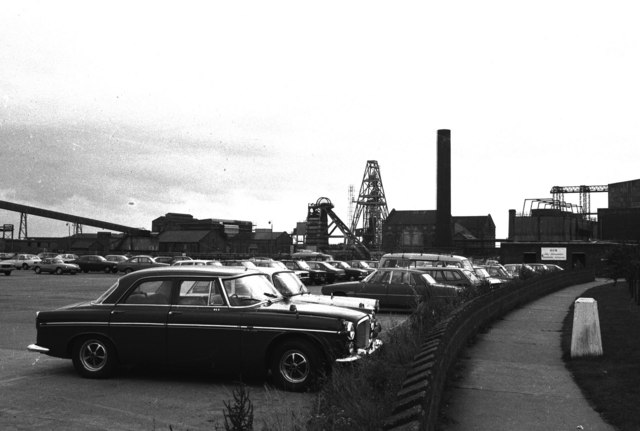
Plans for a new colliery at Armthorpe began in June 1913, when Earl Fitzwilliam leased the minerals beneath his estate there to the industrialist Sir Arthur Markham. The pit was sunk from 6 May 1916, but Markham died on 5 August that year, and the colliery was named Markham Main in his honour. Work stopped shortly afterwards, on 24 August 1916, because of wartime restrictions on capital and shortages of labour and materials, and did not resume until 21 May 1922; the first coal was raised on 5 May 1924. Two shafts were sunk, each 17 feet in diameter -- No. 1 to 2,838 feet and No. 2 to 2,241 feet. Ownership passed from Markham Main Colliery Ltd to the Doncaster Amalgamated Collieries Ltd in 1937, and to the National Coal Board at nationalisation in 1946. The workforce peaked at around 2,700 in the 1950s, producing some 14,000 tonnes of coal a week; by the mid-1980s, with around 1,500 employees, weekly output had risen to 18,000 tonnes. During the 1984-85 miners' strike, Markham Main was the last Yorkshire pit to return to work, doing so three days after the strike's national end -- a defiance that gave rise to the 'Battle of Markham Main', a notable confrontation between striking miners and police. Michael Heseltine announced the colliery's closure in October 1992 as part of a wider round of pit closures, despite an estimated 50 million tonnes of coal reserves still remaining -- enough, it was said, for another fifty years of working. Local women set up a protest camp at the site against the closure, reportedly the first of its kind. The colliery closed for good in 1996, by then run by Coal Investments under Malcolm Edwards before passing to the Coal Authority. Between 1920 and 1996, 87 miners died at the pit.
Geology
Coal of the South Yorkshire field; the seams worked are not recorded.
Workings
Worked via two shafts sunk from 1916, each 17 feet in diameter, reaching 2,838 feet and 2,241 feet respectively.
Closure
Closure was announced in October 1992 despite an estimated 50 million tonnes of remaining reserves -- enough, it was said, for a further fifty years of working -- and the colliery finally closed in 1996.
What remains
The site is now a housing estate adjacent to Sandall Beat Wood.
No colliery-era structures are known to survive on the redeveloped site; a memorial garden commemorates the pit nearby.
Redevelopment
The site was redeveloped as a housing estate after closure.
Nearby mines
- Bentley Colliery — 3.4 miles (5.4 km) NW
- Rossington Colliery — 4.7 miles (7.5 km) S
- Bullcroft Colliery — 5.6 miles (9.0 km) NW
- Hatfield Main Colliery — 5.6 miles (9.0 km) NE
- Yorkshire Main Colliery — 5.7 miles (9.2 km) SW
Straight-line distance, within 9 miles (15 km). Show on the map.
Recorded claims
Individual factual claims, each attached to the source(s) that support it below. Where sources disagree, both are kept.
- 87 miners died at Markham Main Colliery between 1920 and 1996. 1
- During the 1984-85 miners' strike, Markham Main was the last Yorkshire pit to return to work, doing so three days after the strike's national end, in a confrontation remembered as the 'Battle of Markham Main'. 1
- The Coal Authority's mine plans catalogue holds well over a hundred records for Markham Main, including surface plans, seam plans for the Meltonfield seam, and spoil heap plans. 2
Photographs & further reading
The NMRS's own record for the colliery, part of its wider South Yorkshire coalfield coverage.
View sourceSources
- (secondary) Markham Main Colliery — Wikipedia
- (primary) BGS/Mining Remediation Authority mine plans catalogue: Markham Main — The Coal Authority
Record created: 2 September 2026 · Last researched: 2 September 2026