 MineArchive
Rossington Colliery
| Location | Rossington, near Doncaster, South Yorkshire — 53.4700, -1.0640 (approximate) |
|---|---|
| Commodity | Coal |
| Type | Coal |
| Worked | From 10 July 1912 (sinking)–31 March 2006 |
| Maximum depth | Swallow Wood Seam, 848.5 m (following 1963-65 deepening) |
| Operators | Rossington Main Colliery Co. Ltd (1912–1927), Amalgamated Denaby Collieries Ltd (1936–1947) |
Overview
A Doncaster-area pit whose sinking was nearly defeated by water within its first fortnight, and which went on to work for over ninety years — including a brief closure and private reopening in the 1990s before finally shutting for good in 2006.
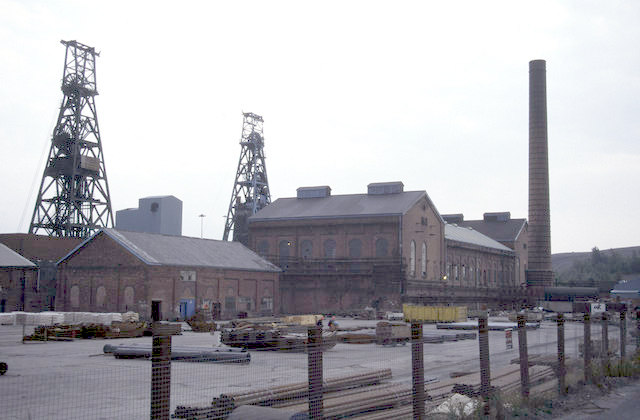
History
Rossington Main Colliery Co. Ltd, a joint subsidiary of the Sheepbridge Coal & Iron Company and John Brown & Co., began sinking No. 1 Shaft on 10 July 1912. Sinking nearly failed within two weeks, when the flow of water into the shaft became too great to continue; work resumed in February 1913, and No. 1 Shaft finally reached the Barnsley Seam, at 798 metres, on 3 May 1915, with the parallel No. 2 Shaft reaching the same seam that November. Coal-getting from the Barnsley Seam began in July 1916, and the Dunsil Seam was also worked in several later periods (1917-22, 1925-27, 1955-58 and 1983-91). A 1963-65 modernisation programme deepened both shafts further, to the Swallow Wood Seam at 848.5 metres.
Ownership passed to Yorkshire Amalgamated Collieries Ltd in 1927, and to Amalgamated Denaby Collieries Ltd in 1936 — the same company that, by the 1930s, also controlled Maltby Colliery. Rossington passed to the National Coal Board at nationalisation in 1947. Once part of Yorkshire Amalgamated's group, the colliery went on to produce over a million tons of coal a year at its peak. Closure came in April 1993, but rather than being abandoned outright the pit was put on care and maintenance while a buyer was sought; RJB Mining (UK) Ltd reopened it as a private mine in July 1994. Production finally ended on 31 March 2006, after losses and geological faulting had cut output; the site was demolished the following year, and the former colliery tip was later reworked and landscaped for housing development.
Geology
Coal of the South Yorkshire field: the Barnsley Seam, reached at 798 metres in May 1915.
Workings
Worked from twin shafts, No. 1 and No. 2, sunk 1912-15 to the Barnsley Seam at 798 metres, deepened in 1963-65 to reach the Swallow Wood Seam at 848.5 metres; the Dunsil Seam was also worked intermittently across several distinct periods between 1917 and 1991.
Closure
Closed April 1993, put on care and maintenance, then reopened privately by RJB Mining in July 1994; production finally ended 31 March 2006 after losses and faulting cut output, and the site was demolished in 2007.
What remains
The former colliery tip was reworked and landscaped, and the site designated for housing development.
No specific surviving colliery structures are recorded; the site was demolished in 2007.
Related mines
- Maltby Colliery — Both were controlled by the same company, Amalgamated Denaby Collieries Ltd, by the 1930s.
Nearby mines
- Harworth Colliery — 3.8 miles (6.1 km) S, Nottinghamshire
- Markham Main Colliery — 4.7 miles (7.5 km) N
- Yorkshire Main Colliery — 5.0 miles (8.0 km) W
- Maltby Colliery — 6.0 miles (9.7 km) SW
- Cadeby Main Colliery — 6.9 miles (11.1 km) W
Straight-line distance, within 9 miles (15 km). Show on the map.
Recorded claims
Individual factual claims, each attached to the source(s) that support it below. Where sources disagree, both are kept.
- Sinking of No. 1 Shaft began 10 July 1912 but stopped within two weeks when the flow of water became too great; work resumed in February 1913 and the shaft reached the Barnsley Seam at 798 metres on 3 May 1915. 1
- Coal-getting from the Barnsley Seam began in July 1916; the Dunsil Seam was also worked in several later periods (1917-22, 1925-27, 1955-58 and 1983-91). 1
- A 1963-65 modernisation programme deepened both shafts to reach the Swallow Wood Seam at 848.5 metres. 1
- Ownership passed to Yorkshire Amalgamated Collieries Ltd in 1927 and to Amalgamated Denaby Collieries Ltd in 1936. 1
- The colliery closed in April 1993 and was put on care and maintenance before RJB Mining (UK) Ltd reopened it as a private mine in July 1994; production finally ended on 31 March 2006 after losses and geological faulting cut output, and the site was demolished in 2007. 1,2
Sources
- (secondary) Rossington Main Colliery — Northern Mine Research Society
- (secondary) A Doncaster historian has released a new book based on the history of the Rossington Colliery — Doncaster Free Press
Record created: 27 August 2026 · Last researched: 27 August 2026