 MineArchive
Harworth Colliery
| Location | Harworth, Bassetlaw, Nottinghamshire — 53.4150, -1.0610 (exact) |
|---|---|
| Commodity | Coal |
| Type | Coal |
| Worked | 1913 (sinking)–2006 |
| Maximum depth | The Barnsley seam was reached at 848 metres (2,782 feet) on 29 October 1923; the Parkgate seam was also worked. |
| Operators | Northern Union Mining Company (1913–1917), Barber, Walker and Company (1917–1947), National Coal Board (1947–1994), UK Coal (1994–2006) |
Overview
Harworth Colliery was a Bassetlaw coal mine sunk from 1913, whose Barnsley-seam coal fuelled the LNER's Flying Scotsman on its record-breaking 1932 run. It closed in 2006 after 86 years of production and was demolished a decade later for housing.
History
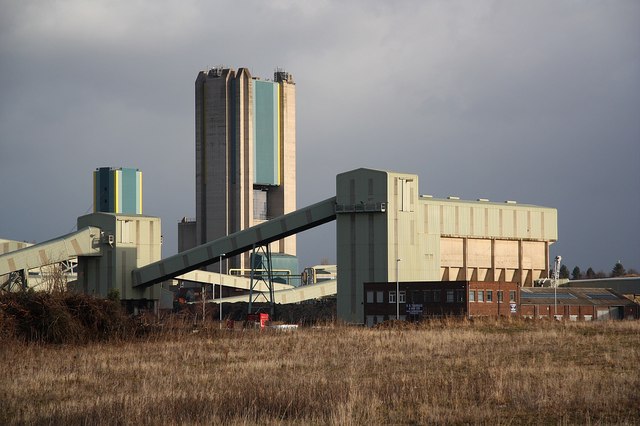
Work began sinking Harworth Colliery's shaft in 1913, when the Northern Union Mining Company was set up with German investment; the First World War halted construction, and in 1917 the pit was bought by Barber, Walker & Co. for £80,100. Sinking resumed in 1921, and both shafts reached the Barnsley seam, at 848 metres, on 29 October 1923, after underground faults had complicated the work. A 4.2 km railway connection to the East Coast Main Line, including a 256-foot viaduct over the River Ryton, was completed in 1924, and a further connection to the South Yorkshire Joint Railway followed in 1928 to handle a forecast 5,000 tons of coal a day. Harworth's coal was graded by depth, the upper layers suited to steaming and the lower to house and coking use, and the colliery's output supplied railway companies including the LNER -- its coal was used by the Flying Scotsman on its celebrated record-breaking run in 1932. Concrete headgears, built in the late 1950s, were themselves replaced by new headgears in 1989 (No. 1 Shaft) and 1994 (No. 2 Shaft), and the colliery reached a production capacity of one million tonnes a year by 1993, with later output supplying the Drax and Cottam power stations via the South Yorkshire Joint Railway. UK Coal warned the pit's roughly 400 workers in 2002 that it faced closure amid annual losses of £8 million, and by 2005-06, with around 450 employees, a further £50 million investment would have been needed to access a new seam offering perhaps 25 more years of reserves; the colliery closed instead. A 2008 proposal to reopen Harworth, backed by restoration work on underground roadways, ultimately came to nothing, and the colliery was demolished in April 2016 to make way for housing.
Geology
Coal of the Nottinghamshire field: the Barnsley seam, reached at 848 metres on 29 October 1923 after underground faults complicated the sinking.
Workings
Worked the Barnsley and Parkgate seams via two shafts, connected by rail to both the East Coast Main Line (1924) and the South Yorkshire Joint Railway (1928).
Closure
UK Coal warned the workforce of closure in 2002 amid annual losses of £8 million, and the colliery closed rather than continue.
What remains
The colliery was demolished in April 2016; the site has been redeveloped for retail, industrial and residential use, including the 'Simpson Park' housing development named for the cyclist Tom Simpson.
None of the colliery's surface buildings survive: the site was cleared in April 2016 and has been built over.
Redevelopment
Redeveloped by the Harworth Group (successor to UK Coal) as 'Simpson Park', comprising around 1,200-1,300 homes and a primary school, named after the cyclist Tom Simpson.
Related mines
- Firbeck Colliery — Linked by the South Yorkshire Joint Railway connection of 1928, which served both pits.
- Kellingley Colliery — Both were UK Coal deep mines after privatisation in 1994.
Nearby mines
- Rossington Colliery — 3.8 miles (6.1 km) N, South Yorkshire
- Firbeck Colliery — 4.1 miles (6.6 km) SW
- Maltby Colliery — 5.5 miles (8.9 km) W, South Yorkshire
- Dinnington Colliery — 6.8 miles (11.0 km) SW, South Yorkshire
- Yorkshire Main Colliery — 7.0 miles (11.2 km) NW, South Yorkshire
Straight-line distance, within 9 miles (15 km). Show on the map.
Culture
- Harworth Colliery F.C. (Sports)
Formed in 1931 as Harworth Colliery Athletic and long named Harworth Colliery Institute after the pit and its institute; it plays on as Harworth Colliery (Wikipedia; Football Club History Database).
Recorded claims
Individual factual claims, each attached to the source(s) that support it below. Where sources disagree, both are kept.
- Coal from Harworth Colliery was used by the LNER's Flying Scotsman locomotive during its celebrated record-breaking run in 1932. 1
- The Coal Authority's mine plans catalogue holds 174 records for Harworth, covering the Surface, Blyth and Haigh Moor seams, with abandonment dates ranging from 1961 to 1988. 2
- Both shafts reached the Barnsley seam at 848 metres in the autumn of 1923, the first on 29 October and the second on 15 November; a 4.2-kilometre railway to the East Coast Main Line followed in 1924 and a link to the South Yorkshire Joint Railway, shared with Firbeck Colliery, in 1928. 1
- About 400 men were employed when closure was first mooted in November 2002 and around 450 in 2005; the pit was mothballed in 2006, ending 86 years of mining in Bassetlaw, and demolished in April 2016 for housing. 1
Photographs & further reading
The football club founded by and named for the colliery's workers -- a possible future Culture connection, not yet researched as one.
View sourceSources
- (secondary) Harworth Colliery — Wikipedia
- (primary) BGS/Mining Remediation Authority mine plans catalogue: Harworth — The Coal Authority
Record created: 2 September 2026 · Last researched: 24 September 2026