 MineArchive
Shaft Sinking
| Also known as | Sinker (The man who does the work), Sinking (The work itself), Tubbing (The cast iron watertight lining used in wet sinking), Kind-Chaudron process (The system of boring a shaft under water) |
|---|---|
| Category | Mine Workings & Access |
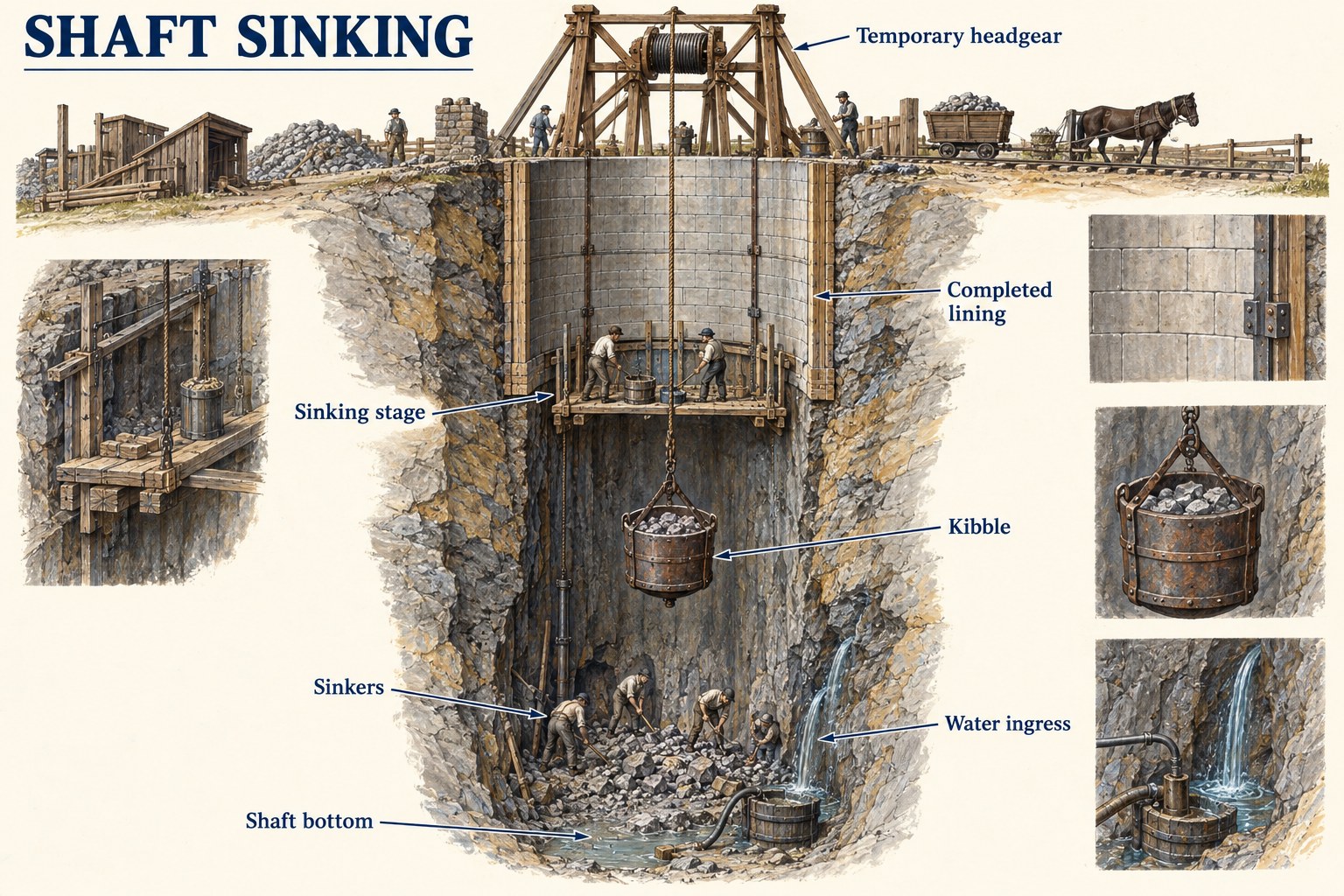
The work of driving a shaft downward from the surface to reach the mineral — a distinct trade with its own men, the sinkers, and its own problems, chief among them water. Sinking a shaft was the largest single act of capital and risk in opening a mine, and it happened before a ton of anything had been raised.
Historical usage
Sinkers were a specialist and itinerant body of men who moved from job to job as new pits were opened, and the sinking of a deep shaft could take years. The nineteenth century's deep collieries and the twentieth century's replacements for them all began this way; several British mining disasters happened during sinking rather than during working, which is why the trade appears in the accident record in its own right.
How it worked
In rock, sinking proceeded by rounds: a set of holes drilled in the shaft bottom, fired, and the broken rock hoisted out in a kibble or skip, three or four feet at a time by hand drilling and five to nine by machine. Speed depended less on the drilling than on getting the rock away, and generally fell off as the shaft got deeper. The sides were then lined — timber sets in rectangular shafts, masonry or cast iron rings in circular ones. Where water was the problem, the answer was cast iron tubbing: flanged rings built up as a watertight lining, the joints packed with lead or pine rather than bolted, seated on a wedging-crib driven into solid ground at the bottom to seal the column off. Two further methods dealt with water too heavy to pump. The Kind-Chaudron system, introduced in 1852, bored the whole shaft under water with a massive trepan weighing between twelve and thirty tons and then lowered a lined casing down through it — boring on an enormous scale, workable only in firm rock. From 1883 the freezing process circulated refrigerated calcium chloride brine through a ring of pipes to freeze the ground solid before excavating it; the shafts of Dawdon Colliery in County Durham were sunk through water-bearing Permian strata this way between 1904 and 1906.
Why it was used
A shaft is what makes a deep mine possible: it carries men, coal, materials, ventilation and pumping, and until one is down and lined nothing else in the mine can begin. Adits and drifts are cheaper wherever the ground allows them, but they only reach what lies above the level of the valley floor.
Risks & limitations
Sinking is dangerous work done in a confined space with everything — water, rock, tools — capable of falling onto the men at the bottom. Water was the commercial risk as much as the physical one: a shaft that met more water than expected could swallow the capital raised for the whole venture, and this is why so many nineteenth-century sinkings were abandoned part-way. Depth compounds it: the rate of sinking falls as the shaft deepens, so the last hundred feet always cost far more than the first.
Regional variation
'Sinker' is used throughout the British coalfields for the men and 'sinking' for the work; a shaft still being sunk is 'in sinking'. In Cornwall shafts were more often sunk on the underlie, following the dip of the lode rather than going down vertically, which changes the whole character of the job.
Related terminology
Adit, Capstan, Ground Freezing, Inrush, Kibble, Shaft, Stoneman, Sump, Winding Engine
Mines associated with this term
5 examples chosen from 301 linked records — the term page is not an index.
- Ladysmith Pit — Cumbria (notable incident)
The 1901 inquest describes the sinking in detail: brick walling built up in lengths from curb rings, the open ground between held by iron rings and deals. - Abercynon Colliery — Rhondda Cynon Taf (well documented example)
Named 4 times in this record, first in the summary: “…at Cardiff, and known at first as the Dowlais Cardiff Colliery. The sinking took nearly seven years and killed eighteen men. It worked for…” - Bullcroft Colliery — South Yorkshire (well documented example)
Named 7 times in this record, first in the summary: “A Doncaster-coalfield colliery at Carcroft whose sinking ran into what the accounts call a subterranean river — a flow that…” - Califat Coal Mine — Leicestershire (well documented example)
Named in this record’s workings: “…coalfield in the 1850s. Miners' cottages stood on the site from the sinking in 1854.” - Cardowan Colliery — North Lanarkshire (well documented example)
Named in this record’s history: “Sinking of Cardowan's No.1 and No.2 shafts began in 1924, reaching the…”
Disasters associated with this term
5 examples chosen from 82 linked records, most direct relationship first.
- Abercarn Colliery shaft explosion, 1876 (contextual relationship)
Named 4 times in this record, first in the summary: “…shaft being sunk at Cwmcarn for the Abercarn colliery killed three sinkers on 24 July 1876, two years before the Prince of Wales disaster.” - Abercynon Colliery Shaft Accident, 1895 (contextual relationship)
Named in this record’s narrative: “The shafts had been sinking since December 1889 and were within a year of reaching coal. On 9…” - Abercynon Colliery Sinking Accident, 1893 (contextual relationship)
Named in this record’s cause: “A fall in the shaft during sinking operations.” - Agecroft Colliery shot accident, 1899 (contextual relationship)
Named 4 times in this record, first in the summary: “A shot went off while it was being charged in the No. 4 pit sinking at Agecroft on 1 February 1899, killing a chargeman and two sinkers.” - Albion Colliery shaft accident, March 1886 (contextual relationship)
Named twice in this record, first in the summary: “Two sinkers were killed by falling fireclay while working in the side of the…”
Sources
- (primary) Shaft-sinking — 1911 Encyclopaedia Britannica — Encyclopaedia Britannica (11th edition), via Wikisource
- (secondary) The evolution of shaft sinking, 1800-1900 — CIM Magazine, Canadian Institute of Mining
Record created: 25 August 2026 · Last researched: 25 August 2026